Preparing for AFCAT 2027 requires more than just understanding the syllabus. Candidates must also develop the ability to answer questions quickly and accurately within the given time. Many aspirants know the concepts but struggle to complete the examination because of poor time management, lengthy calculations, or unnecessary guesswork.
Improving speed and accuracy is essential for achieving a good score in the AFCAT online examination. With regular practice, mock tests, and the right preparation strategy, candidates can improve their performance and approach the exam with confidence.
This article explains practical tips to improve speed and accuracy in AFCAT 2027.
1. Understand the AFCAT 2027 Exam Pattern
Before developing an exam strategy, candidates should understand the examination structure.
Particulars | Details |
|---|---|
Examination mode | Online |
Total questions | 100 |
Total marks | 300 |
Duration | 2 hours |
Correct answer | +3 marks |
Incorrect answer | -1 mark |
Unattempted question | 0 marks |
The examination covers four major areas:
General Awareness
Verbal Ability in English
Numerical Ability
Reasoning and Military Aptitude Test
Understanding the pattern helps candidates plan how much time to spend on each section.
2. Strengthen Your Basic Concepts
Speed comes naturally when you understand the concepts clearly. Trying to solve questions quickly without understanding the fundamentals can lead to mistakes.
Focus on:
English: Grammar rules, vocabulary, comprehension, synonyms, and antonyms.
General Awareness: Current affairs, history, geography, science, defence awareness, and important events.
Numerical Ability: Percentages, ratios, averages, profit and loss, time and work, and speed and distance.
Reasoning: Analogy, coding-decoding, series, classification, spatial ability, and figure-based questions.
First develop accuracy while solving questions without time pressure. Gradually introduce time limits.
3. Practise Time Management
Time management is one of the most important skills for AFCAT 2027.
Candidates should avoid spending too much time on a single difficult question. If a question requires lengthy calculations or seems confusing, move to the next one and return to it later if time permits.
Useful strategies include:
Divide your available time among the four sections.
Start with questions you can solve confidently.
Avoid spending excessive time on difficult questions.
Keep some time for reviewing marked questions.
Practise completing full-length tests within two hours.
The goal is not simply to attempt all questions but to maximise the number of correct answers.
4. Improve Speed in Numerical Ability
Numerical Ability can consume considerable time if calculations are slow.
To improve calculation speed:
Memorise multiplication tables, squares, and cubes.
Learn percentage-to-fraction conversions.
Practise mental calculations daily.
Understand shortcuts for common arithmetic problems.
Avoid unnecessary steps in calculations.
Solve timed practice questions regularly.
Important topics to practise include percentages, averages, ratio and proportion, profit and loss, simple and compound interest, time and work, and speed, time and distance.
Tip: Practise 15–20 numerical questions daily with a fixed time limit.
5. Improve Accuracy in English and Reasoning
English and Reasoning can become scoring areas with consistent practice.
For English:
Read English newspapers or articles regularly.
Learn a few new vocabulary words every day.
Revise grammar rules.
Practise comprehension passages.
Read questions carefully before selecting an answer.
For Reasoning:
Identify patterns instead of guessing.
Practise different question types regularly.
Use diagrams for direction and blood relation problems.
Improve visual observation through figure-based questions.
Review incorrect answers to understand your mistakes.
Avoid rushing through questions. A few extra seconds spent understanding a question can prevent negative marking.
6. Practise Mock Tests Regularly
Mock tests are essential for improving both speed and accuracy. They help candidates understand their strengths, weaknesses, and time management skills.
After every mock test, analyse:
How many questions were answered correctly?
How many answers were incorrect?
Which questions consumed the most time?
Which topics need more practice?
Did you leave easy questions unanswered?
Maintain a record of your mock test scores and try to improve gradually.
Do not take mock tests only to check your marks. Use them to identify and correct mistakes.
7. Avoid Negative Marking Through Smart Attempting
AFCAT follows a negative marking system. Therefore, random guessing can reduce your overall score.
Follow these tips:
Attempt questions you understand confidently.
Eliminate clearly incorrect options where possible.
Avoid spending too much time on uncertain questions.
Check calculations before submitting an answer.
Do not select an answer simply because you want to increase your attempt count.
Accuracy is more valuable than unnecessary attempts.
8. Develop an Effective Daily Practice Routine
A consistent routine can help candidates improve their performance.
Activity | Daily Time |
|---|---|
English practice | 20 minutes |
Numerical Ability | 25 minutes |
Reasoning | 20 minutes |
General Awareness | 20 minutes |
Timed MCQ practice | 15 minutes |
Mistake analysis and revision | 10 minutes |
Total | 1 hour 50 minutes |
In addition, attempt full-length mock tests regularly and gradually increase their frequency as the examination approaches.
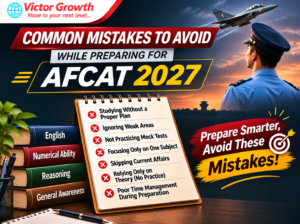
9. Common Mistakes to Avoid in AFCAT 2027
Avoid these mistakes during preparation and the actual examination:
Spending too much time on one question.
Ignoring weak subjects.
Attempting questions without understanding them.
Practising only untimed questions.
Memorising shortcuts without understanding concepts.
Taking mock tests without analysing mistakes.
Ignoring revision.
Panicking when difficult questions appear.
Staying calm and following a planned strategy can make a significant difference.
10. Choosing the Right Coaching for Defence Exam Preparation
Proper guidance can help candidates follow a structured preparation plan, practise important topics, and improve their examination techniques.
Students searching for the best NDA coaching in Kerala should compare institutes based on faculty experience, syllabus coverage, study materials, mock test facilities, and individual academic support.
Victor Growth Coaching Centre in Kochi offers guidance for defence examination aspirants. Students preparing for AFCAT should select a programme that specifically covers the AFCAT syllabus, online examination pattern, and selection process. NDA and AFCAT are different examinations, so candidates should choose coaching according to their individual goals.
Frequently Asked Questions (FAQs)
1. How can I improve my speed in AFCAT 2027?
Practise timed MCQs daily, learn calculation shortcuts, revise important concepts, and attempt regular mock tests.
2. How can I improve accuracy in AFCAT?
Understand the concepts, read questions carefully, avoid random guessing, and analyse incorrect answers after every practice test.
3. Are mock tests important for AFCAT preparation?
Yes. Mock tests help improve time management, identify weak areas, and develop confidence in the online examination format.
4. How much time should I spend on each AFCAT question?
The average available time is approximately 1.2 minutes per question. However, the actual time should vary depending on the difficulty and type of question.
5. Is it better to attempt all 100 questions in AFCAT?
Not necessarily. Candidates should focus on maximising correct answers rather than attempting every question through guesswork because incorrect answers carry negative marks.
6. How many mock tests should I practise before AFCAT 2027?
There is no fixed number. Focus on regular full-length tests, proper analysis, and correcting mistakes rather than simply increasing the number of tests.
7. Can beginners improve their speed and accuracy for AFCAT?
Yes. Beginners can improve through strong fundamentals, daily timed practice, regular revision, and gradual exposure to full-length mock tests.
Conclusion
Improving speed and accuracy is essential for performing well in AFCAT 2027. Candidates should focus on strengthening basic concepts, practising timed questions, managing examination time effectively, and avoiding unnecessary negative marking.
Remember, speed improves through practice, while accuracy develops through understanding and careful analysis. Follow a consistent preparation routine and use mock tests effectively to approach the AFCAT online examination with confidence.