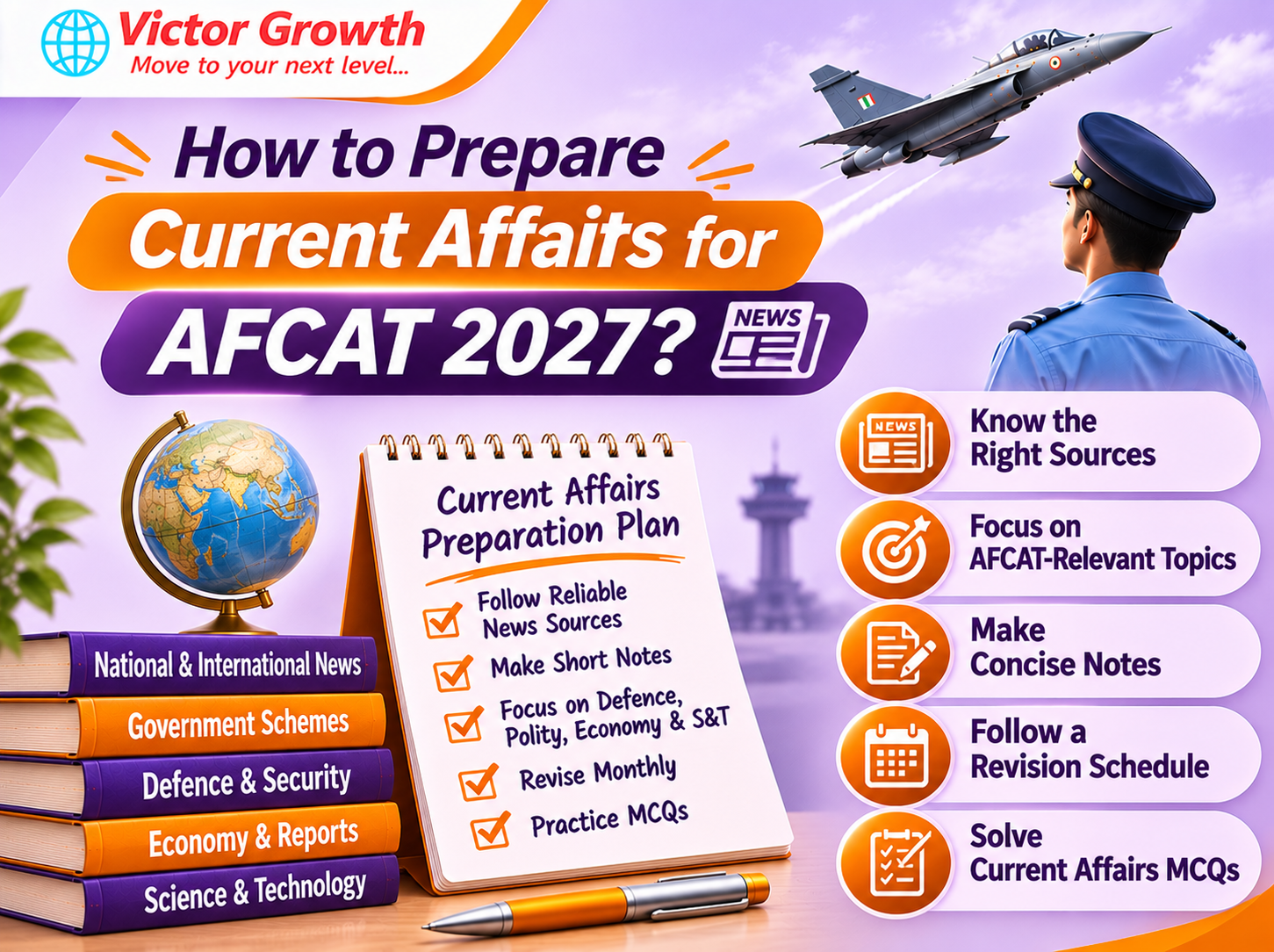
Current Affairs is an important part of the General Awareness section of the Air Force Common Admission Test (AFCAT). Candidates are expected to have knowledge of important national and international developments, defence news, government policies, sports, awards, science and technology.
For aspirants preparing for AFCAT 2027, current affairs preparation should be a daily habit. However, reading every news article is not necessary. The key is to identify relevant information, prepare short notes and revise important events regularly.
This guide explains how beginners can prepare current affairs effectively for AFCAT 2027.
1. Understand the Current Affairs Topics for AFCAT 2027
Before starting preparation, understand the important areas from which current affairs questions may be asked.
Topic | Important Areas to Cover |
|---|---|
National Affairs | Important government decisions, policies and national events |
International Affairs | International relations, agreements and global developments |
Defence Current Affairs | Military exercises, defence deals, missiles and aircraft |
Science and Technology | Space missions, inventions and technological developments |
Sports | Tournaments, winners, records and important personalities |
Awards and Honours | National and international awards |
Important Appointments | Heads of organisations and important government appointments |
Government Schemes | Major Central Government schemes and initiatives |
Summits and Conferences | Important international meetings and agreements |
Important Days | National and international observances |
Give special attention to defence-related developments because AFCAT is an examination for entry into the Indian Air Force.
2. Give Special Attention to Defence Current Affairs
Defence awareness is particularly relevant for AFCAT aspirants. Candidates should regularly follow developments related to the Indian Armed Forces.
Important areas include:
Indian Army, Indian Navy and Indian Air Force.
Important military exercises conducted by India.
Indian defence missiles and aircraft.
Indigenous defence equipment.
Important defence operations.
Defence agreements with other countries.
DRDO developments.
Indian Air Force commands and major aircraft.
Important appointments in the defence sector.
New developments in military technology.
Preparation tip: Maintain a separate notebook for defence current affairs. Record important exercises, participating countries, locations and the purpose of each exercise.
3. Read Newspapers Daily
Newspaper reading is one of the most effective ways to improve current affairs knowledge.
Recommended newspapers include:
The Hindu
The Indian Express
You do not need to read every page. Focus on important national news, international relations, defence, science and technology, government policies and sports.
How to read newspapers effectively:
Spend around 20–30 minutes reading important news.
Identify news relevant to competitive examinations.
Note important names, places and events.
Avoid spending too much time on political opinions and entertainment news.
Revise your notes at the end of the week.
4. Follow Reliable Current Affairs Sources
Apart from newspapers, use reliable sources to prepare for AFCAT.
Some useful resources include:
Press Information Bureau (PIB): Government announcements, policies and important initiatives.
Ministry of Defence: Defence-related developments and military exercises.
Indian Air Force updates: Important developments related to the Air Force.
ISRO: Space missions and scientific achievements.
Monthly Current Affairs Magazines: Useful for consolidating important events.
Manorama Yearbook: Helpful for general awareness and important developments.
Avoid depending on too many sources. Select a few reliable resources and revise them regularly.
5. Prepare Monthly Current Affairs Notes
Preparing short notes makes revision easier, especially closer to the examination.
Divide your notes into categories:
National Affairs
International Affairs
Defence
Science and Technology
Sports
Awards and Honours
Important Appointments
Government Schemes
Summits and Conferences
For each important event, record:
What happened?
When did it happen?
Where did it happen?
Which organisations or countries were involved?
Why is it important?
This method helps you remember facts more effectively.
6. Follow a Daily Current Affairs Study Plan
Consistency is more important than studying for long hours occasionally.
Here is a simple daily timetable:
Activity | Time |
|---|---|
Newspaper reading | 20 minutes |
National and International Affairs | 15 minutes |
Defence Current Affairs | 15 minutes |
Science and Technology | 10 minutes |
Current Affairs MCQs | 20 minutes |
Revision | 10 minutes |
You can adjust the schedule according to your daily routine.
7. Practise Previous Year Questions and Mock Tests
Reading current affairs alone is not enough. Regular practice helps you understand how questions are framed in AFCAT.
Follow these steps:
Solve previous year AFCAT General Awareness questions.
Practise current affairs MCQs regularly.
Attempt topic-wise quizzes.
Take full-length mock tests.
Analyse incorrect answers.
Revise important facts from your notes.
Focus on understanding the background of important events rather than memorising isolated facts.
8. Common Mistakes to Avoid in Current Affairs Preparation
Many aspirants waste valuable preparation time by following an unstructured approach.
Avoid these mistakes:
Reading multiple newspapers every day.
Collecting too many current affairs magazines.
Ignoring defence-related developments.
Memorising news without understanding its importance.
Not revising monthly notes.
Spending too much time on irrelevant news.
Avoiding practice questions.
A limited number of reliable sources, combined with regular revision, is more effective than collecting excessive information.
9. Choose the Right Defence Coaching in Kerala
Proper academic guidance can help aspirants understand important current affairs, connect national developments with static General Awareness and practise examination-oriented questions.
When searching for the best NDA coaching in Kerala, remember that NDA and AFCAT are different examinations with separate eligibility criteria and preparation strategies. NDA is an entry route after Class 12, whereas AFCAT is designed for eligible graduates and other candidates meeting the prescribed qualifications.
Victor Growth Coaching Centre in Kochi provides coaching support for defence examination aspirants. Before selecting a programme, evaluate faculty experience, current affairs coverage, study materials, mock tests and academic support.
Frequently Asked Questions (FAQs)
1. Is current affairs important for AFCAT 2027?
Yes. Current affairs form an important part of the General Awareness section. Candidates should follow national, international and defence-related developments.
2. How many months of current affairs should I prepare for AFCAT?
Focus on the months leading up to the examination and revise important developments from the preceding months as well. Do not ignore major events from earlier periods that remain relevant.
3. Which newspaper is best for AFCAT current affairs?
The Hindu and The Indian Express are useful options. Choose one newspaper and read it consistently.
4. Is defence current affairs important for AFCAT?
Yes. Pay special attention to military exercises, defence agreements, missiles, aircraft, DRDO developments and Indian Air Force updates.
5. How much time should I spend on current affairs daily?
Around 45 minutes to one hour is a useful starting point. Include reading, note-making, MCQ practice and revision.
6. Is Manorama Yearbook useful for AFCAT preparation?
Yes. It can help with general awareness, important events, awards, sports and other factual information. Supplement it with updated current affairs.
7. Can I prepare AFCAT current affairs without coaching?
Yes. Candidates can prepare independently using newspapers, reliable government updates, monthly compilations, short notes and regular mock tests.
Conclusion
Preparing current affairs for AFCAT 2027 requires regular reading, focused note-making and systematic revision. Give importance to national and international developments, defence news, science and technology, sports and government policies.
Avoid unnecessary information and concentrate on examination-relevant topics. Follow a daily routine, practise MCQs and revise your notes every week.
With consistent preparation and the right study strategy, you can strengthen your General Awareness and improve your overall AFCAT 2027 performance.