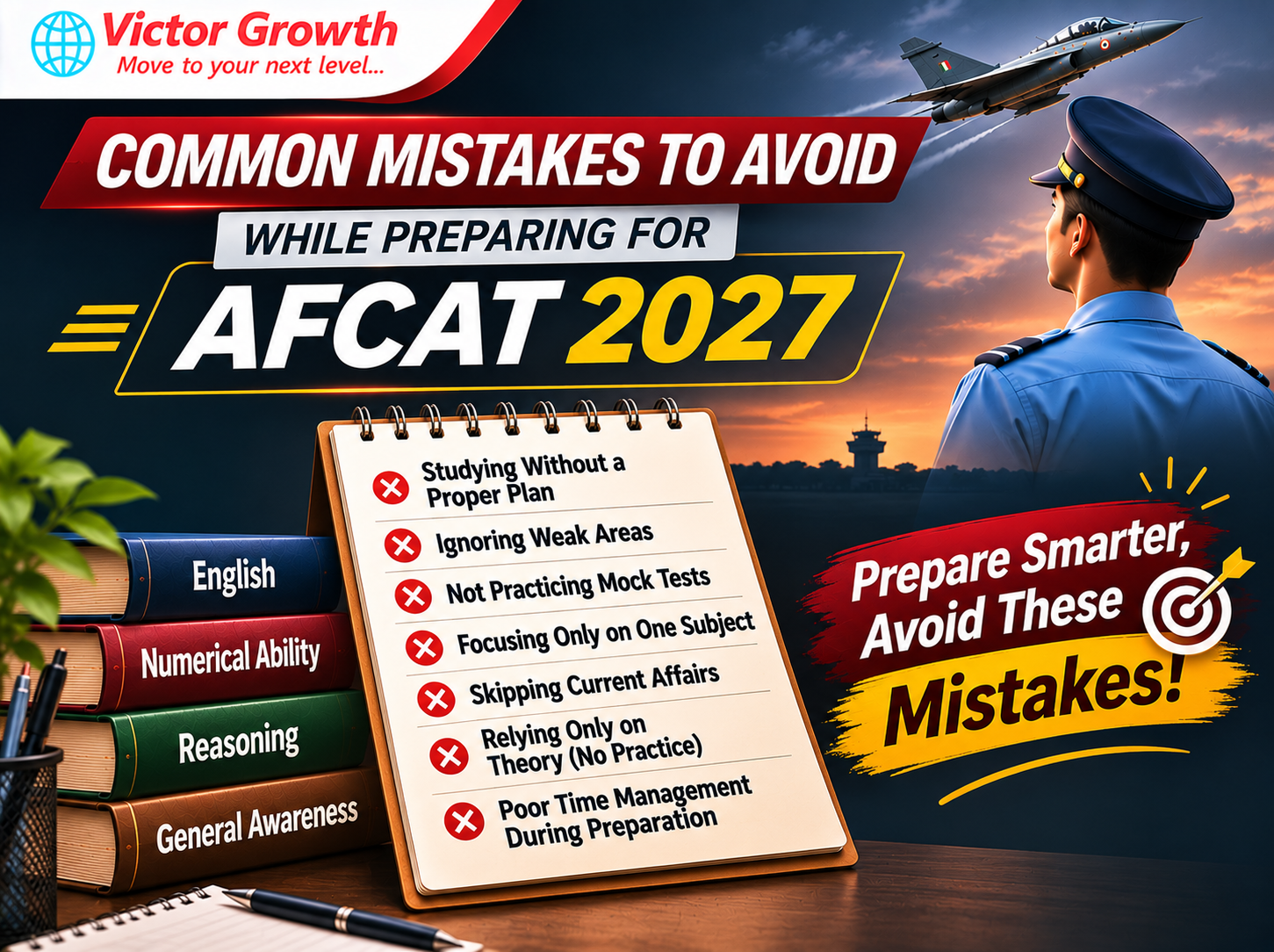
Preparing for AFCAT 2027 requires proper planning, consistent practice, and a clear understanding of the examination pattern. Many candidates work hard but fail to achieve their expected scores because of common preparation mistakes. Poor time management, ignoring important subjects, avoiding mock tests, and depending too much on guesswork can affect overall performance.
Identifying these mistakes early can help aspirants prepare more effectively and improve their chances of success.
Here are the most common mistakes to avoid while preparing for AFCAT 2027.
1. Starting Preparation Without Understanding the Syllabus
One of the biggest mistakes is beginning preparation without knowing the complete AFCAT syllabus and examination pattern.
AFCAT covers four major sections:
General Awareness
Verbal Ability in English
Numerical Ability
Reasoning and Military Aptitude
How to avoid it: Understand the syllabus first, identify the topics in each section, and prepare a realistic study plan. This helps prevent unnecessary study and ensures balanced preparation.
2. Ignoring Weak Subjects
Some candidates spend most of their time studying subjects they already understand while avoiding difficult topics. This creates an imbalance in preparation.
For example, students who are uncomfortable with Mathematics may repeatedly postpone Numerical Ability practice.
How to avoid it:
Identify your weak subjects through practice tests.
Give additional time to difficult topics.
Start with basic concepts before moving to advanced questions.
Practise a small number of questions every day.
Consistent practice is more effective than avoiding difficult subjects.
3. Depending Only on Study Materials
Collecting too many books, PDFs, and online resources can create confusion. Some aspirants spend more time searching for materials than actually studying.
How to avoid it:
Choose a limited number of reliable books and resources. Complete the basic study materials before moving to additional resources. Use previous year question papers and topic-wise MCQs to understand the examination requirements.
4. Neglecting Current Affairs and General Awareness
General Awareness requires regular preparation. Studying current affairs only a few days before the examination can make revision difficult.
Important areas include:
National and international current affairs.
Indian history and geography.
Defence exercises and developments.
Science and technology.
Awards and honours.
Sports events.
Government schemes.
Important appointments and summits.
How to avoid it: Read current affairs regularly, prepare short notes, and revise important events every week.
5. Not Practising Mock Tests
Reading textbooks alone is not enough to prepare for an online competitive examination. Candidates need to understand how to manage time and answer questions under examination conditions.
How to avoid it:
Start with topic-wise tests.
Gradually practise full-length mock tests.
Follow the actual examination time limit.
Analyse incorrect answers.
Track your performance after every test.
Mock tests help identify weak areas and improve confidence.
6. Poor Time Management
Some candidates spend too much time solving difficult questions and leave easy questions unanswered.
AFCAT provides a limited time to complete 100 questions. Therefore, candidates must learn to distribute their time wisely.
How to avoid it:
Attempt familiar questions first.
Avoid getting stuck on lengthy calculations.
Move on when a question takes too long.
Keep time for reviewing difficult questions.
Practise completing tests within the given duration.
Remember, effective time management is not about solving every question quickly. It is about using the available time wisely.
7. Ignoring Negative Marking
AFCAT has negative marking, so random guessing can reduce your score.
How to avoid it:
Understand the marking scheme:
Correct answer: +3 marks.
Incorrect answer: -1 mark.
Unattempted question: 0 marks.
Read questions carefully and avoid unnecessary attempts. Focus on accuracy rather than attempting questions simply to increase your total attempts.
8. Memorising Without Understanding Concepts
Memorising formulas, shortcuts, and answers without understanding the underlying concepts can create problems when questions are presented differently.
This is particularly common in Numerical Ability and Reasoning.
How to avoid it:
Understand the basic concepts first.
Learn why a formula works.
Practise different question patterns.
Revise formulas regularly.
Solve questions independently before checking solutions.
9. Avoiding Revision
Studying a topic once does not guarantee that you will remember it during the examination. Without revision, candidates may forget important facts, formulas, vocabulary, and concepts.
How to avoid it:
Follow a simple revision routine:
Daily: Revise the topics studied that day.
Weekly: Review all completed topics.
Monthly: Take a test covering previously studied subjects.
Maintain a separate notebook for important formulas, facts, and frequently repeated mistakes.
10. Ignoring Physical and AFSB Preparation
Clearing the AFCAT written examination is an important step, but candidates should also understand the subsequent selection process.
The selection process includes the Air Force Selection Board (AFSB), followed by applicable assessments such as medical examination and merit-based selection.
How to avoid it:
Understand the AFSB selection stages.
Develop communication skills.
Practise expressing your thoughts clearly.
Improve general awareness.
Maintain physical fitness.
Learn about officer-like qualities and leadership.
Do not wait until the written examination is over to become familiar with the selection process.
11. Following an Unrealistic Study Timetable
Preparing for too many hours without proper breaks can lead to stress and inconsistent performance. Some candidates create ambitious timetables but struggle to follow them.
How to avoid it:
Prepare a practical daily timetable that includes all four AFCAT subjects, revision, and question practice.
Subject / Activity | Daily Time |
|---|---|
English | 20 minutes |
General Awareness | 25 minutes |
Numerical Ability | 30 minutes |
Reasoning | 25 minutes |
Revision and MCQs | 20 minutes |
Total | 2 hours |
Adjust the schedule according to your strengths, weaknesses, and available study time.
12. Choosing Coaching Without Proper Research
Choosing a coaching institute without checking its teaching quality, study materials, and examination support can affect preparation.
Students searching for the best NDA coaching in Kerala should compare institutes based on faculty experience, syllabus coverage, mock tests, study materials, and individual academic support.
Victor Growth Coaching Centre in Kochi provides guidance for defence examination aspirants. Candidates preparing for AFCAT should ensure that their chosen programme specifically covers the AFCAT syllabus, online examination practice, and AFSB preparation. NDA and AFCAT are separate examinations with different eligibility requirements and selection processes.
Frequently Asked Questions (FAQs)
1. What are the most common mistakes in AFCAT 2027 preparation?
Ignoring weak subjects, avoiding mock tests, poor time management, neglecting revision, and depending on guesswork are some common mistakes.
2. Is studying only textbooks enough for AFCAT?
No. Candidates should combine textbook learning with MCQ practice, previous year question papers, mock tests, and regular revision.
3. How important are mock tests for AFCAT preparation?
Mock tests help candidates understand the examination pattern, improve speed, identify weak areas, and manage time effectively.
4. Should I attempt every question in AFCAT?
No. Since incorrect answers carry negative marks, candidates should focus on answering questions accurately rather than attempting everything through guesswork.
5. How can beginners avoid mistakes while preparing for AFCAT?
Beginners should understand the syllabus, build strong fundamentals, follow a realistic timetable, practise daily, and revise regularly.
6. When should I start preparing for AFSB?
It is beneficial to understand the AFSB process and gradually develop communication, reasoning, leadership, and general awareness skills alongside written examination preparation.
7. Can coaching help me prepare better for AFCAT 2027?
Yes. Good coaching can provide structured guidance, study materials, regular tests, and feedback. However, consistent self-study and practice remain essential.
Conclusion
Success in AFCAT 2027 depends not only on how much you study but also on how effectively you prepare. Avoiding common mistakes such as poor planning, irregular revision, ignoring weak subjects, and skipping mock tests can make your preparation more productive.
Stay consistent, practise regularly, analyse your mistakes, and follow a realistic study plan. With the right strategy and dedication, you can improve your performance and move closer to your goal of joining the Indian Air Force.