At the Bloomberg New Economy Forum in New Delhi in October 2026, External Affairs Minister S. Jaishankar highlighted how countries increasingly use control over essential resources, financial systems and supply chains to gain geopolitical influence. He described the global environment as a “world of chokepoints”, where economic dependencies can become instruments of strategic pressure.
What Is the Weaponisation of Money and Resources?
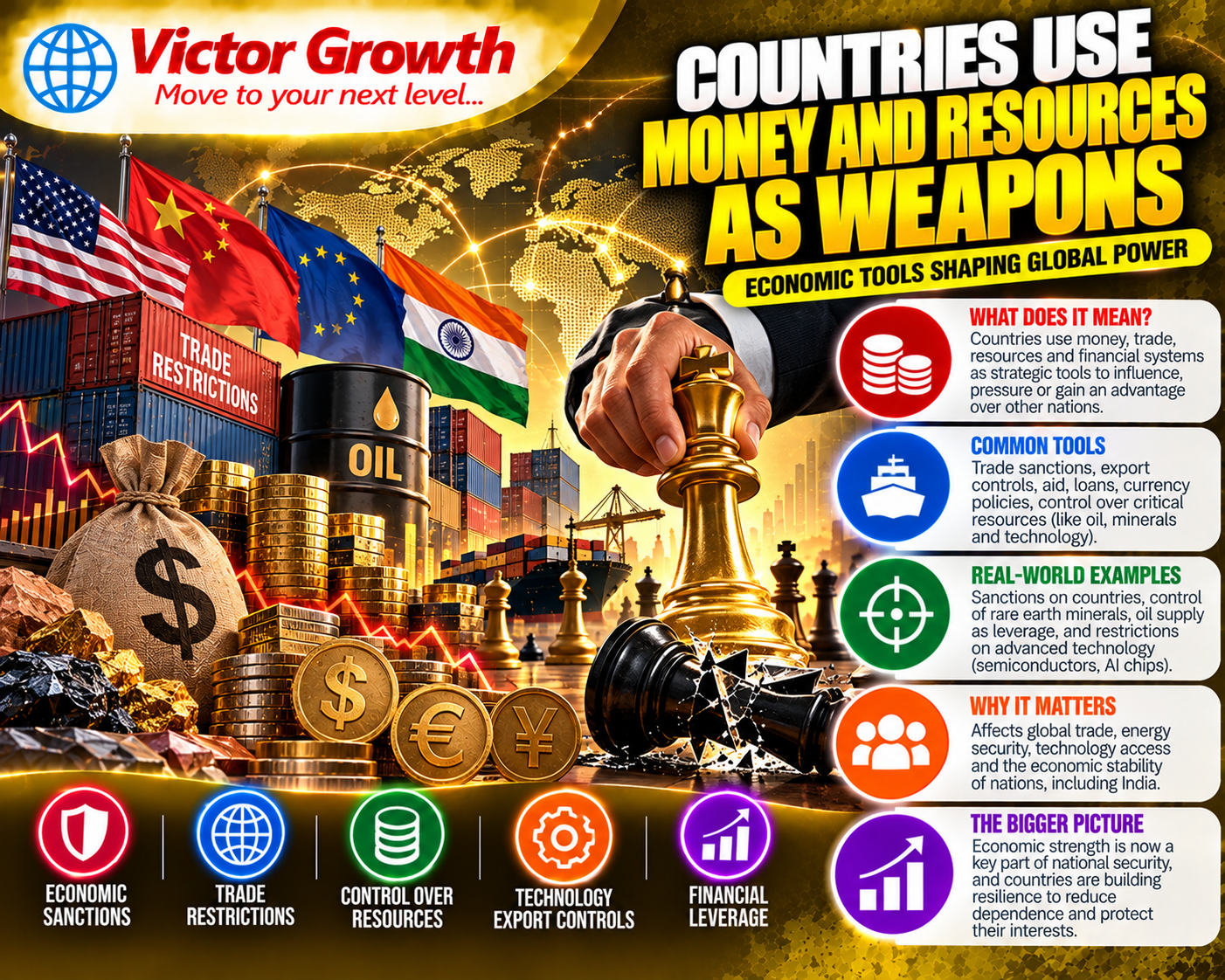
The weaponisation of money and resources refers to the use of economic power, financial systems, essential commodities or control over supply chains to influence another country’s decisions.
Instead of relying only on military force, countries may use economic restrictions to impose costs on rivals and advance national interests.
Major Forms of Economic Weaponisation
1. Financial sanctions
Countries may freeze assets, restrict access to international banking systems or limit financial transactions to pressure another government.
2. Critical minerals
Restrictions on minerals such as lithium, cobalt and rare earth elements can affect electronics, electric vehicles, renewable energy and defence manufacturing.
3. Energy supplies
Restrictions on oil and natural gas exports can increase energy prices and create economic pressure on importing countries.
4. Technology and semiconductors
Export controls on advanced chips, manufacturing equipment and specialised technology can limit another country’s technological development.
5. Strategic sea routes
Disruptions in important maritime chokepoints can affect global trade, fuel supplies and transportation costs.
Why Are Countries Using These Tools?
Geopolitical influence: To influence the foreign policy decisions of other countries.
National security: To restrict access to technologies or resources considered strategically sensitive.
Economic competition: To protect domestic industries and strengthen technological leadership.
Strategic leverage: To use dependence on essential supplies as a bargaining tool.
Such measures can exert pressure without direct military confrontation, but they may also trigger retaliation and disrupt global markets.
Implications for India
India is vulnerable to external disruptions because it imports significant quantities of crude oil and depends on international supply chains for several critical minerals and advanced technologies.
The weaponisation of resources can increase inflation, raise manufacturing costs, affect energy security and slow down industrial development.
India can reduce these risks through:
Energy diversification: Sourcing energy from multiple countries and expanding renewable energy.
Critical Mineral Mission: Strengthening domestic exploration, processing, recycling and overseas mineral partnerships.
Strategic reserves: Maintaining reserves of essential commodities, including crude oil.
Domestic manufacturing: Promoting indigenous production of semiconductors, electronics and defence equipment.
International cooperation: Building resilient supply chains through partnerships with trusted countries.
Challenges and the Way Forward
Complete self-sufficiency is difficult and expensive in an interconnected global economy. India must balance domestic production with international trade, diversify suppliers and strengthen strategic reserves.
Greater cooperation through multilateral institutions is also necessary to prevent economic restrictions from escalating into wider conflicts.
UPSC Exam Relevance
Prelims: Critical minerals, strategic sea routes, economic sanctions and energy security.
GS Paper II: International relations, global institutions and India’s foreign policy.
GS Paper III: Indian economy, supply-chain resilience, energy security and strategic industries.
Possible UPSC Mains Question: How does the weaponisation of financial systems and critical resources affect India’s economic and strategic security? Suggest suitable measures to reduce these vulnerabilities.
Conclusion
The growing use of money, resources and supply chains as instruments of geopolitical power shows that economic security is closely linked to national security. For India, diversification, indigenous capabilities and strategic partnerships are essential to reduce vulnerabilities while remaining connected to the global economy.