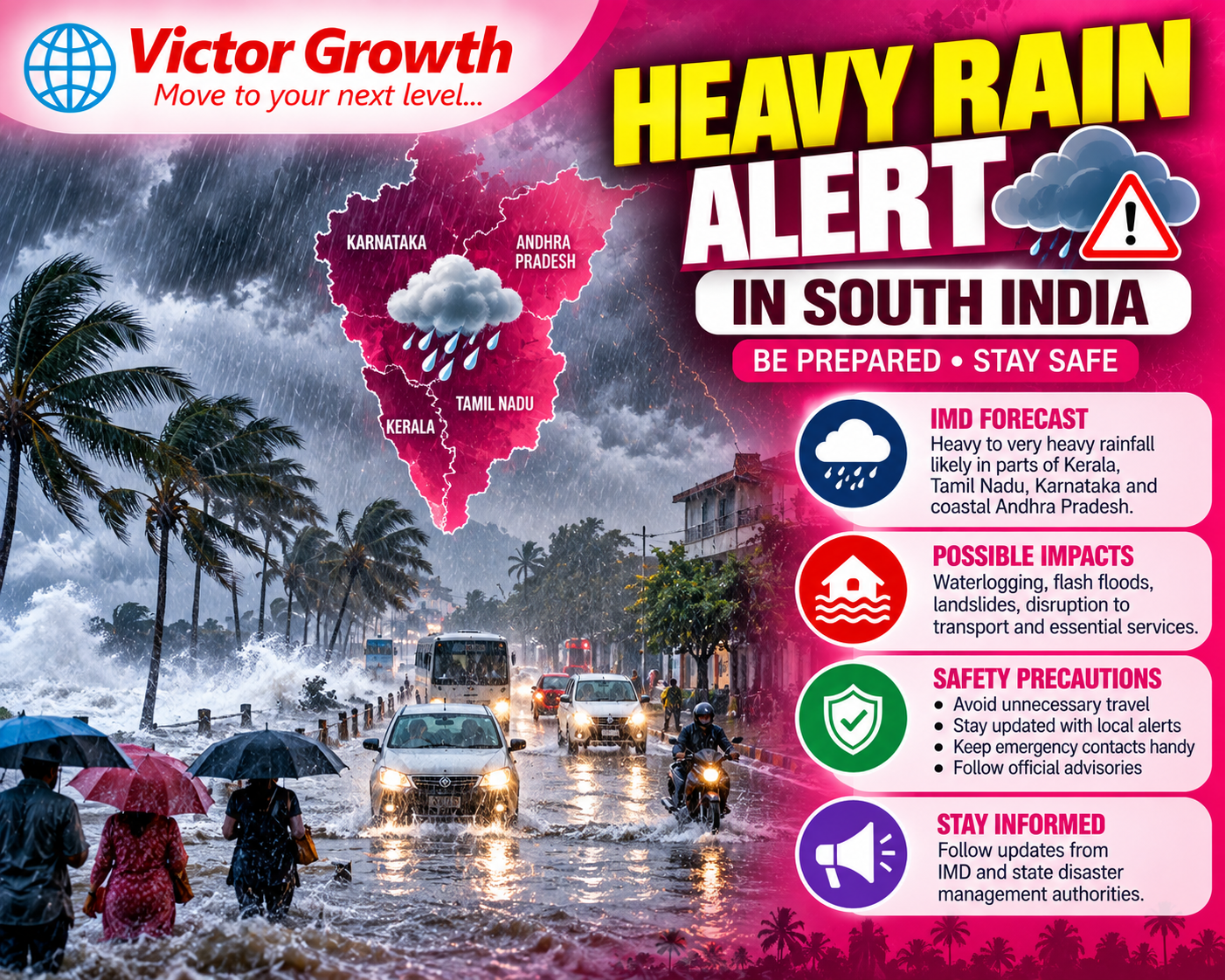
The India Meteorological Department (IMD) has issued alerts for heavy rainfall, thunderstorms, lightning and gusty winds across parts of South India during the first half of October 2026.
As of 6 October 2026, heavy rainfall warnings are in place for parts of Kerala, Tamil Nadu, Puducherry and South Interior Karnataka. Kerala is expected to experience heavy-rain spells on 6, 9 and 10 October, while Tamil Nadu and Puducherry have multiple heavy-rain warning days through 10 October.
The IMD has also forecast fairly widespread to widespread rainfall over Kerala and Mahe during 6–11 October.
Why is South India Receiving Heavy Rain?
The rainfall is associated with post-monsoon atmospheric systems and favourable circulation patterns over the southern peninsula.
1. Cyclonic Circulations
Cyclonic circulations over areas such as the southeast Arabian Sea and north Tamil Nadu can enhance moisture convergence and atmospheric instability, contributing to rainfall over southern India.
2. Trough and Moisture Convergence
A trough extending from the Mannar region towards central India is also contributing to atmospheric instability and rainfall activity over parts of the peninsula.
3. Post-Monsoon Transition
October represents a transition from the Southwest Monsoon to the post-monsoon season. During this period, changing wind patterns and atmospheric circulation can produce intense rainfall over parts of southern and southeastern India.
Areas Under Rainfall Alert
The current IMD warnings particularly cover:
Kerala and Mahe
Tamil Nadu, Puducherry and Karaikal
South Interior Karnataka
Parts of Coastal Andhra Pradesh may experience thunderstorms, lightning and strong surface winds.
The IMD has also warned of thunderstorms and gusty winds in several areas, with winds potentially reaching 40–50 kmph and gusting to 60 kmph in some regions.
Why October Rainfall is Important for South India
Agriculture
Rainfall during October can influence:
Paddy cultivation
Soil moisture
Water availability
Rabi agricultural activities
Crop harvesting and post-harvest operations
Water Resources
Rainfall contributes to reservoir storage and groundwater recharge, although intense short-duration rainfall can also increase runoff rather than effective groundwater recharge.
Urban Flooding
Rapid urbanisation has increased the vulnerability of cities to flooding because of:
Encroachment of drainage channels
Impermeable surfaces
Inadequate storm-water drainage
Loss of wetlands and urban lakes
Landslides
Heavy rainfall in the Western Ghats and other hilly areas can increase the risk of landslides, particularly where slopes have been disturbed by construction and road development.
Heavy Rain vs Very Heavy Rain
UPSC aspirants should remember the IMD rainfall classification:
| Category | 24-hour rainfall |
|---|---|
| Heavy Rain | 64.5–115.5 mm |
| Very Heavy Rain | 115.6–204.4 mm |
| Extremely Heavy Rain | More than 204.4 mm |
These classifications are useful for understanding weather warnings and disaster-management alerts.
Disaster Management Measures
Heavy rainfall requires a coordinated response involving:
Early-warning systems
Flood forecasting
Drainage management
Reservoir regulation
Landslide monitoring
Evacuation of vulnerable communities
Emergency medical and relief services
The effectiveness of disaster management depends not only on rainfall forecasts but also on last-mile communication and local preparedness.
UPSC Relevance
Prelims
Important concepts:
IMD rainfall classifications
Post-monsoon season
Cyclonic circulation
Trough
Southwest Monsoon withdrawal
Northeast Monsoon
Western Ghats and orographic rainfall
Flood and landslide risk
Mains – GS Paper I
Indian monsoon
Post-monsoon weather
Rainfall variability
Western Ghats
Extreme weather events
GS Paper III
Disaster management
Urban flooding
Climate-resilient infrastructure
Agricultural impacts
Early-warning systems
Possible UPSC Mains Question
“Extreme rainfall events during the transition from the southwest monsoon to the post-monsoon season pose increasing challenges to South India. Discuss the causes and suggest measures for improving climate-resilient disaster management.”
Conclusion
The heavy rain alert in South India during October 2026 highlights the complexity of India’s post-monsoon weather. Cyclonic circulations, moisture convergence and changing seasonal wind patterns can produce intense rainfall even as the Southwest Monsoon withdraws.
For UPSC aspirants, the event provides a useful case study linking Indian climatology, monsoon transition, extreme rainfall, urban flooding, landslides, agriculture and disaster management.