The UPSC Civil Services Examination has a vast syllabus covering subjects such as History, Geography, Polity, Economy, Environment, Science and Technology, Ethics and Current Affairs. Completing the syllabus once is not enough. Aspirants need to revise repeatedly, practise questions and continuously strengthen their understanding.
Regular revision is one of the most important habits for UPSC success. For aspirants searching for the Best IAS Coaching in Kerala, a coaching program that provides structured revision, tests and study materials can make the preparation process more systematic.
Why Is Revision Important for UPSC?
UPSC preparation involves learning a large amount of information over an extended period. Without revision, even well-understood concepts can gradually be forgotten.
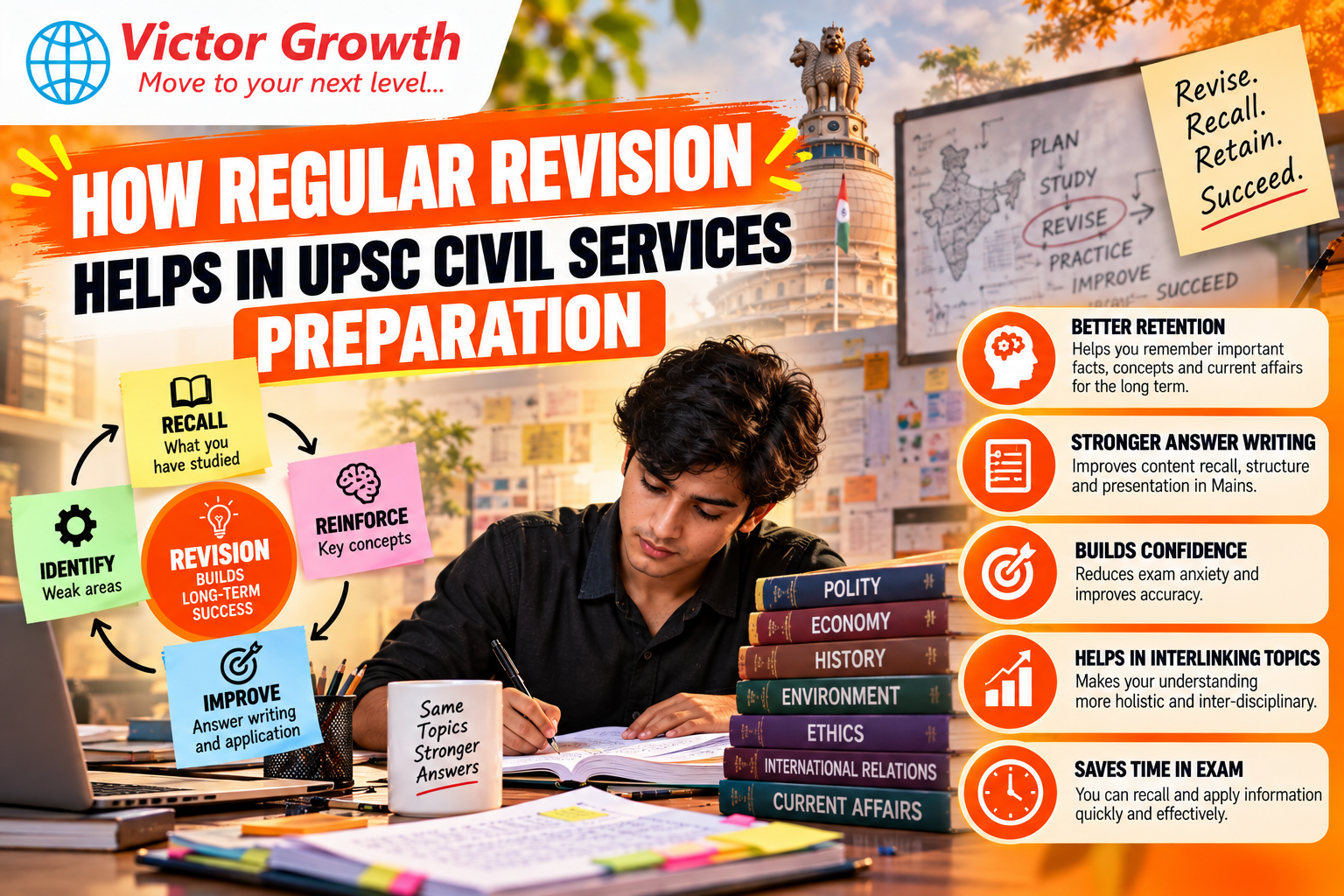
Regular revision helps with:
Better retention
Faster recall
Stronger conceptual clarity
Improved accuracy
Better answer writing
Effective use of current affairs
Greater confidence during examinations
The objective is not to keep reading the same material repeatedly without purpose. Effective revision should involve active recall, practice and analysis.
1. Improves Memory and Retention
Repeated exposure to important concepts strengthens memory.
For example, after studying Indian Polity, an aspirant can revise the topic using:
Short Notes → PYQs → MCQs → Revision Test
This is generally more effective than simply rereading the same chapter several times.
2. Helps Cover the Vast UPSC Syllabus
UPSC has an extensive syllabus. Revision ensures that topics studied months earlier do not disappear from memory while new subjects are being covered.
Aspirants should therefore allocate specific time for revision rather than treating it as an activity to be done only before the examination.
3. Improves Prelims Performance
Prelims requires quick recall and accurate decision-making.
Regular revision helps aspirants remember:
Constitutional provisions
Historical events
Geographical concepts
Economic terms
Environmental facts
Government schemes
Current developments
Revision combined with MCQ practice can improve both speed and accuracy.
4. Strengthens Mains Answer Writing
Revision is also important for Mains because aspirants need to recall information quickly while writing answers.
Regular revision allows candidates to build a ready knowledge base of:
Examples
Case studies
Government schemes
Reports
Constitutional provisions
Committee recommendations
Data and statistics
Contemporary developments
This can make answers more relevant and analytical.
5. Helps Connect Static Subjects with Current Affairs
One of the most effective forms of revision is connecting static knowledge with current events.
For example:
Static Polity + Current Constitutional Issue
Static Economy + Recent Economic Policy
Static Environment + Current Climate Development
This approach makes information more useful for both Prelims and Mains.
How to Create an Effective UPSC Revision Strategy
A simple revision cycle can be:
First Revision
Within a few days of completing a topic.
Second Revision
After a few weeks.
Third Revision
During monthly consolidation.
Final Revision
Closer to the examination.
The exact timing can vary, but the principle is simple: revise before you forget.
Use Tests as Revision Tools
Mock tests are not only for measuring performance. They are also powerful revision tools.
After every test:
Identify incorrect answers.
Understand why they were wrong.
Revise the relevant topic.
Add important points to your notes.
Revisit the topic later.
This creates a continuous:
Study → Revise → Test → Analyse → Improve → Revise
cycle.
How UPSC Coaching in Kerala Can Support Revision
A structured UPSC coaching program in Kerala can help aspirants maintain consistency through:
Structured study schedules
Concise study materials
Revision classes
Current-affairs compilations
Prelims mock tests
Mains test series
Previous-year question analysis
Performance evaluation
Personal mentorship
For students searching for the Best IAS Coaching in Kerala, the ability of an institute to support revision and testing should be an important consideration.
Victor Growth – Structured UPSC Preparation
Victor Growth, Kochi provides UPSC Civil Services preparation through online and offline learning options, supported by study materials, mock tests, mentorship and structured academic guidance.
The preparation approach encourages aspirants to combine learning, revision, practice and evaluation throughout their UPSC journey.
Frequently Asked Questions
1. How many times should I revise for UPSC?
There is no fixed number. Important topics should be revised repeatedly, with increasing emphasis on active recall and question practice.
2. When should I start revision?
Revision should begin from the beginning of your preparation. Do not wait until the entire syllabus is completed.
3. Is revision more important for Prelims or Mains?
It is important for both. Prelims requires quick factual and conceptual recall, while Mains requires the ability to recall and apply knowledge analytically.
4. Should I make separate revision notes?
Concise revision notes can be very useful, particularly for large subjects and current affairs. Avoid making notes so detailed that they become another textbook.
5. Can mock tests be used for revision?
Yes. Analysing mistakes in mock tests and revising the related topics is an effective way to strengthen weak areas.
6. How can the best IAS coaching in Kerala help with revision?
A good coaching institute can provide structured revision schedules, concise materials, revision tests, current-affairs compilations, mock tests and mentorship.
Conclusion
UPSC preparation is not about how much you study once, but how much you can remember and apply when the examination arrives.
Regular revision strengthens memory, improves recall, supports answer writing and helps aspirants perform better in both Prelims and Mains.
For aspirants looking for the Best IAS Coaching in Kerala, choose a program that combines quality teaching, concise study materials, regular revision, mock tests, answer-writing practice and personal mentorship.
Remember the simple formula:
Learn → Revise → Practise → Test → Analyse → Revise Again.
Consistent revision can turn months of study into knowledge that remains accessible when you need it most.