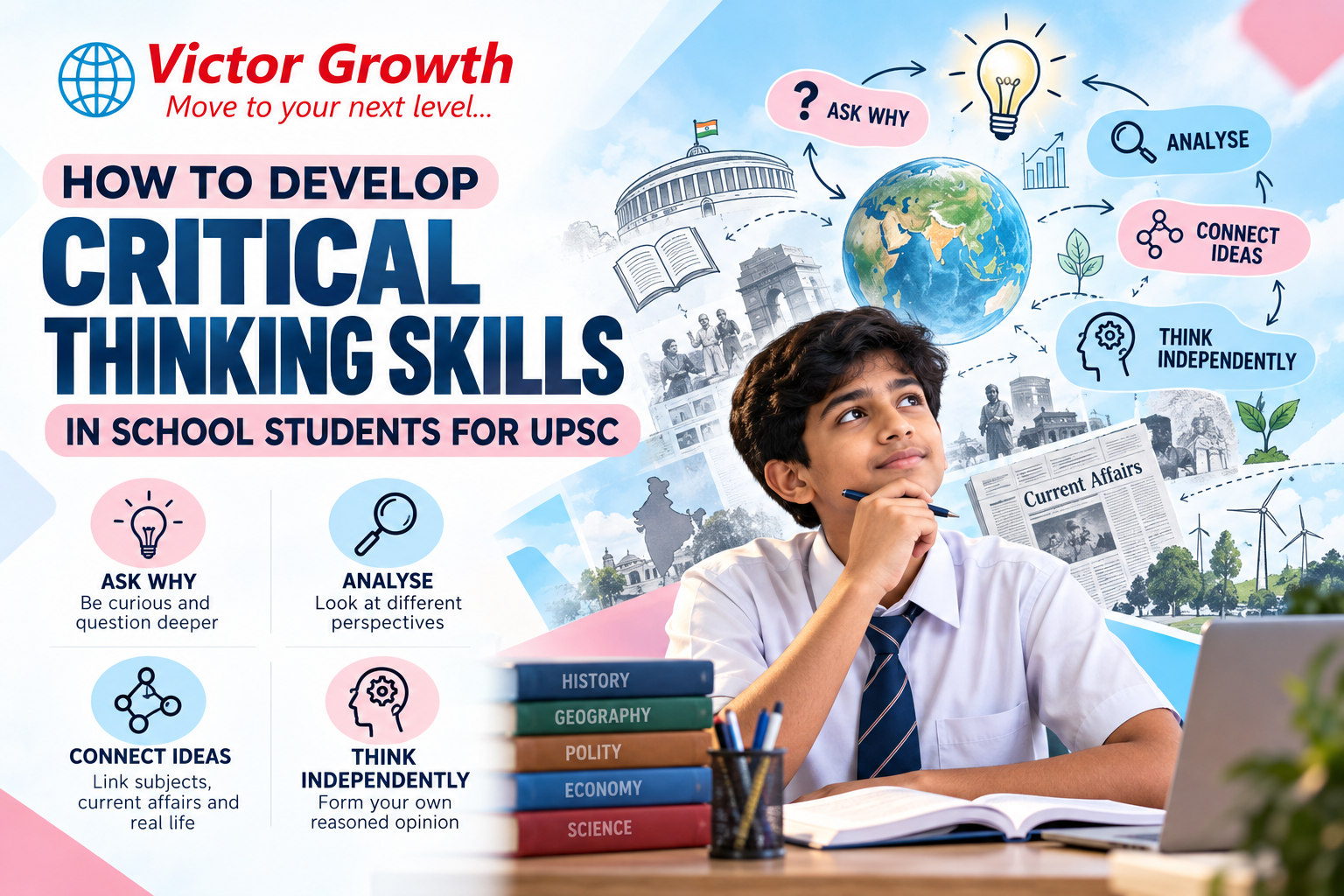
Critical thinking is an essential skill for students who aspire to become IAS officers. The UPSC Civil Services Examination requires aspirants to understand complex issues, analyse information, evaluate different viewpoints, and arrive at logical conclusions. Developing these abilities during school years can help students prepare for future competitive examinations while improving their overall academic performance.
IAS foundation preparation is not simply about memorising facts or studying advanced subjects early. It is about learning to ask meaningful questions, think independently, and understand the reasons behind events and decisions.
For parents searching for the Best IAS Coaching in Kerala, choosing a foundation programme that encourages analytical thinking, discussion, and problem-solving can help students build these skills gradually.
What Is Critical Thinking?
Critical thinking is the ability to examine information carefully, identify assumptions, evaluate evidence, and form reasoned opinions. Instead of accepting every statement as true, critical thinkers ask questions, consider alternative explanations, and distinguish facts from opinions.
For example, when students read a news report about climate change, they can explore its causes, examine the available evidence, understand its effects, and consider possible solutions. This approach encourages deeper learning rather than simple memorisation.
Why Is Critical Thinking Important for Future UPSC Aspirants?
Critical thinking supports several abilities that are valuable for civil services preparation.
Better comprehension: Students learn to identify the main argument and understand complex information.
Analytical ability: They become better at connecting facts, identifying causes, and examining consequences.
Problem-solving: They learn to consider different solutions before reaching a conclusion.
Balanced decision-making: They develop the habit of evaluating multiple viewpoints fairly.
Clear communication: They become more confident in expressing ideas with logical reasoning and supporting evidence.
These skills are useful in school examinations, debates, essay writing, and future competitive examinations.
7 Effective Ways to Develop Critical Thinking Skills in School Students
1. Encourage Students to Ask Questions
Curiosity is the starting point of critical thinking. Parents and teachers should encourage students to ask why, how, and what-if questions rather than simply memorising information.
For example, while studying the Indian Constitution, students can ask why fundamental rights are important and how democratic institutions protect citizens. Such questions encourage deeper understanding.
2. Develop Newspaper Reading Habits
Reading age-appropriate news articles helps students understand real-world issues and connect them with classroom learning.
After reading an article, students can consider three questions:
What happened?
Why did it happen?
What could be its possible consequences?
This simple practice helps develop comprehension, cause-and-effect reasoning, and awareness of current affairs.
3. Use Debates and Group Discussions
Debates allow students to explore different perspectives and explain their arguments. Topics such as environmental protection, technology in education, or the importance of public transport can encourage meaningful discussion.
Students should learn to listen respectfully, support their opinions with reasons, and change their views when presented with convincing evidence.
4. Teach Students to Distinguish Facts from Opinions
Critical thinkers understand the difference between verifiable information and personal interpretation.
Students can practise identifying factual statements, opinions, assumptions, and unsupported claims in news articles or online content. They should also learn to check the credibility of sources before accepting information.
This habit is especially valuable in an environment where information spreads rapidly through social media.
5. Connect School Subjects with Real-Life Problems
Students develop stronger analytical skills when they apply classroom concepts to practical situations.
For example, Geography lessons about water resources can lead to discussions about water conservation in Kerala. Science topics related to pollution can encourage students to explore its effects on public health and the environment.
Connecting concepts with everyday life makes learning relevant and encourages independent problem-solving.
6. Practise Puzzles, Quizzes, and Problem-Solving Activities
Logical puzzles, reasoning questions, educational games, and quizzes help students practise identifying patterns, comparing information, and finding solutions.
The emphasis should be on understanding the reasoning behind an answer rather than merely getting it right. Asking students to explain how they reached a conclusion makes these activities more effective.
7. Encourage Reading, Writing, and Reflection
Reading informative books exposes students to different ideas, while writing helps them organise their thoughts.
Students can maintain a short journal in which they summarise an article, explain an issue, or write their views on a topic. Reviewing their answers helps them identify gaps in their reasoning and improve the clarity of their arguments.
How IAS Foundation Coaching Supports Critical Thinking
A structured IAS foundation programme can provide opportunities for students to practise analytical thinking through discussions, current affairs sessions, quizzes, writing exercises, and guided problem-solving.
Victor Growth, located in Kadavanthra, Kochi, supports competitive examination preparation and foundation-oriented learning. Parents searching for the Best IAS Coaching in Kerala should look for programmes that encourage conceptual understanding, independent thinking, and age-appropriate learning rather than relying entirely on memorisation.
The objective is to help students become curious, informed, and confident learners while maintaining a healthy balance with their school education.
Conclusion
Critical thinking is a skill that develops through regular practice, curiosity, and exposure to different ideas. By encouraging questions, discussing current affairs, analysing information, solving problems, and expressing opinions with evidence, school students can gradually build abilities that will support future UPSC preparation.
Starting early does not mean studying the entire UPSC syllabus during school. It means developing the habit of thinking carefully, learning independently, and making reasoned decisions.
Frequently Asked Questions (FAQs)
1. Why is critical thinking important for UPSC preparation?
It helps aspirants analyse information, evaluate arguments, understand complex issues, and develop logical, balanced answers.
2. Can school students develop critical thinking skills early?
Yes. Reading, asking questions, solving puzzles, participating in discussions, and writing short explanations can help students develop these skills from an early age.
3. How can newspaper reading improve critical thinking?
It encourages students to examine events, understand causes and consequences, compare viewpoints, and distinguish facts from opinions.
4. Which activities improve critical thinking in school students?
Debates, quizzes, logical puzzles, group discussions, reading journals, and real-world problem-solving activities are useful options.
5. Is critical thinking more important than memorisation for UPSC?
Both have a role. Factual knowledge provides the foundation, while critical thinking helps students understand, apply, and evaluate that knowledge.
6. How can parents choose the Best IAS Coaching in Kerala for developing critical thinking?
Parents should look for programmes that include concept-based teaching, discussions, analytical exercises, current affairs activities, and supportive mentorship alongside regular school education.