
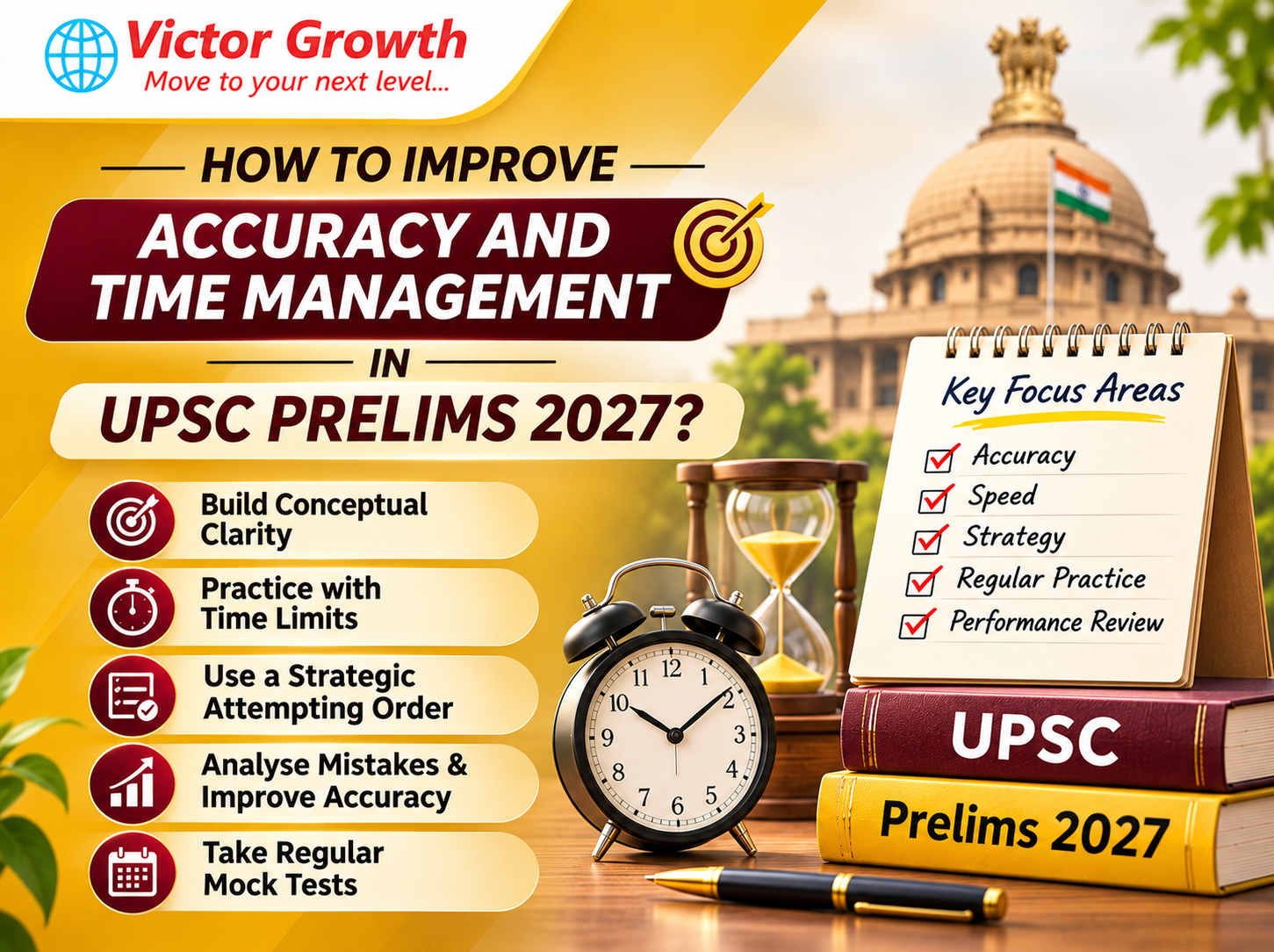
UPSC Civil Services Preliminary Examination is not just a test of knowledge; it also evaluates candidates’ accuracy, analytical thinking, and time-management skills. Many aspirants study extensively but struggle to achieve good scores because they make mistakes while answering questions or fail to manage the examination time effectively.
For UPSC Prelims 2027, candidates should focus on developing a balanced strategy that combines conceptual understanding, regular practice, smart elimination techniques, and proper time management.
1. Understand the UPSC Prelims Exam Pattern
Before improving accuracy and speed, understand the examination structure.
Particulars | General Studies Paper I | CSAT Paper II |
|---|---|---|
Total questions | 100 | 80 |
Maximum marks | 200 | 200 |
Duration | 2 hours | 2 hours |
Nature | Merit-based | Qualifying |
Qualifying requirement | No separate minimum | 33% |
Both papers include negative marking for incorrect answers. Therefore, candidates must balance the number of attempts with answer accuracy.
2. Build Strong Conceptual Knowledge
Accuracy begins with a clear understanding of the syllabus. Candidates who rely only on memorisation may struggle with statement-based and application-oriented questions.
How to improve conceptual clarity:
Read NCERT textbooks to understand basic concepts.
Refer to standard books for detailed subject knowledge.
Connect current affairs with static subjects.
Understand important facts, definitions, and concepts.
Revise difficult topics regularly.
Focus on History, Geography, Polity, Economy, Environment, and Science and Technology.
3. Practise Previous-Year Questions Regularly
Previous-year questions (PYQs) help aspirants understand how UPSC frames questions and tests conceptual knowledge.
Follow these methods:
Solve at least 10 years of available UPSC Prelims questions.
Practise subject-wise questions after completing each topic.
Understand why the correct option is right.
Analyse incorrect options.
Identify frequently tested concepts.
Maintain notes of important mistakes.
Do not memorise answers. Focus on understanding the concepts behind each question.
4. Develop Smart Elimination Techniques
Elimination is an important skill for improving accuracy in UPSC Prelims. Sometimes candidates may not know the exact answer but can eliminate incorrect options through conceptual understanding.
Useful elimination strategies:
Identify statements that contradict established facts.
Pay attention to words such as only, always, never, all, and none.
Compare statements carefully before selecting an option.
Eliminate options that contain clearly incorrect information.
Avoid assuming that a statement is correct simply because it sounds familiar.
Practise these techniques through mock tests rather than applying them blindly.
5. Improve Time Management During the Examination
Candidates get two hours for each Prelims paper. Spending too much time on difficult questions can affect the overall attempt.
Suggested time-management strategy for GS Paper I:
Time | Activity |
|---|---|
First 40 minutes | Attempt familiar and easier questions |
Next 45 minutes | Solve moderate and analytical questions |
Next 20 minutes | Revisit difficult questions |
Final 15 minutes | Review selected answers and ensure the OMR sheet is complete |
This is only a suggested approach. Adjust the timing based on your speed and mock test performance.
Avoid spending several minutes on a single confusing question. Move forward and return to it later if time permits.
6. Practise Mock Tests Under Exam Conditions
Mock tests help candidates develop speed, accuracy, and confidence.
To get better results:
Attempt full-length tests within the actual two-hour time limit.
Practise using an OMR-style answer sheet.
Avoid checking answers while taking the test.
Analyse incorrect and unanswered questions.
Track accuracy and time spent per question.
Work on weak subjects before attempting the next test.
Regular mock test analysis is more valuable than simply increasing the number of tests.
7. Avoid Blind Guessing and Reduce Negative Marking
UPSC Prelims has negative marking, so random guessing can reduce your score.
Follow these practices:
Attempt questions when you have sufficient knowledge or a reasonable basis for elimination.
Avoid selecting answers based only on intuition.
Do not change answers repeatedly without a valid reason.
Read every question carefully.
Maintain a balance between attempting questions and avoiding unnecessary risks.
Develop your attempt strategy through repeated mock tests.
8. Improve Reading Speed and Question Understanding
Sometimes candidates select incorrect answers because they misunderstand the question rather than lacking subject knowledge.
To improve comprehension:
Read questions carefully before looking at the options.
Identify what the question is actually asking.
Pay attention to negative words such as incorrect and not.
Practise statement-based questions.
Improve reading comprehension through regular newspaper reading and CSAT practice.
Careful reading can prevent avoidable mistakes.
9. Follow a Daily Practice Routine
Consistency is essential for improving accuracy and time management.
Activity | Suggested time |
|---|---|
Static subject revision | 1 hour |
Current affairs | 30 minutes |
Practice MCQs | 30 minutes |
CSAT practice | 30 minutes |
Mistake analysis | 15 minutes |
Adjust the schedule according to your preparation level and available study time.
10. Common Mistakes to Avoid
Avoid these mistakes while preparing for UPSC Prelims 2027:
Attempting questions without understanding them.
Spending too much time on difficult questions.
Ignoring negative marking.
Taking mock tests without analysing mistakes.
Neglecting CSAT preparation.
Memorising facts without understanding concepts.
Changing answers without proper reasoning.
Focusing on speed while ignoring accuracy.
Remember, speed without accuracy will not help you achieve a good score.
11. Choose the Right Coaching and Guidance
Proper academic guidance can help aspirants understand examination strategies, improve problem-solving skills, and identify weak areas. Regular mock tests, detailed answer explanations, and individual feedback are useful features to consider when selecting a coaching programme.
Students searching for the best NDA coaching in Kerala should compare faculty experience, teaching methods, study materials, and test facilities. However, NDA and UPSC Civil Services are different examinations. UPSC aspirants should choose a programme specifically designed for Civil Services preparation.
Frequently Asked Questions (FAQs)
1. How can I improve accuracy in UPSC Prelims 2027?
Improve conceptual understanding, practise previous-year questions, analyse mock tests, and avoid blind guessing.
2. How much time is available for UPSC Prelims GS Paper I?
Candidates get two hours to complete 100 questions in General Studies Paper I.
3. How many questions should I attempt in UPSC Prelims?
There is no fixed ideal number. The number of attempts should depend on your knowledge, accuracy, and ability to eliminate incorrect options.
4. Are mock tests important for improving time management?
Yes. Full-length mock tests help candidates practise under time limits and develop an effective question-solving strategy.
5. How can I avoid negative marking in UPSC Prelims?
Read questions carefully, avoid blind guessing, practise elimination techniques, and make informed attempts.
6. Should I practise CSAT along with General Studies?
Yes. CSAT is compulsory and qualifying in nature. Regular practice in mathematics, reasoning, and comprehension is important.
7. Can accuracy improve through daily practice?
Yes. Consistent MCQ practice, revision, and mistake analysis can gradually improve accuracy and confidence.
Conclusion
Improving accuracy and time management is essential for performing well in UPSC Prelims 2027. Focus on conceptual clarity, practise previous-year questions, develop elimination techniques, and attempt regular mock tests. Avoid blind guessing and learn to manage difficult questions without wasting valuable examination time. With consistent practice, proper revision, and the right preparation strategy, aspirants can improve their performance and approach the examination with confidence.