
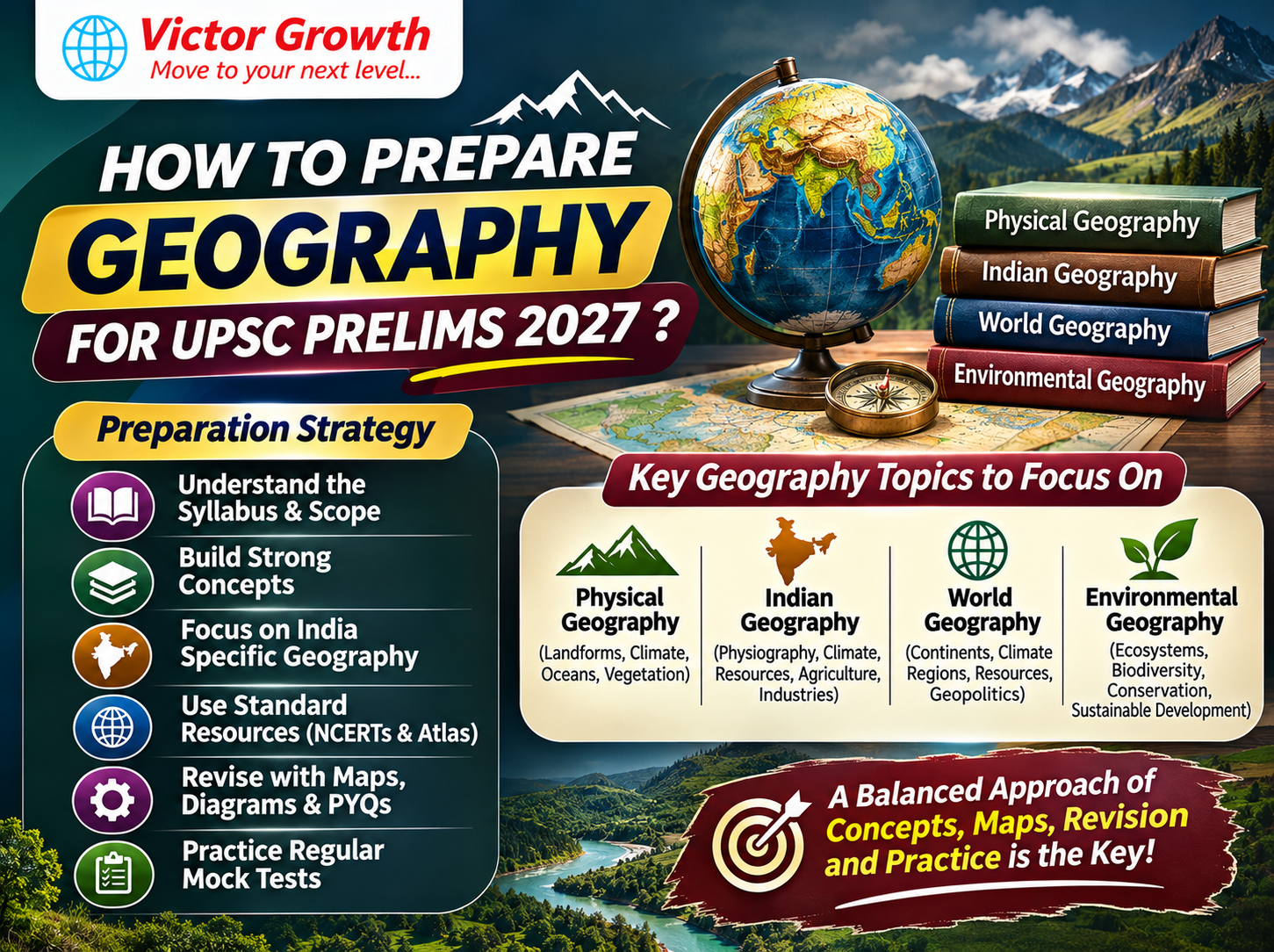
Geography is an important subject in the UPSC Civil Services Preliminary Examination. It covers the physical features of the Earth, climate, natural resources, agriculture, population, and geographical developments across India and the world. A good understanding of Geography helps candidates answer both conceptual and map-based questions in General Studies Paper I.
For UPSC Prelims 2027 aspirants, the key to preparing Geography is to understand basic concepts, practise map reading, select the right books, and connect geographical topics with current affairs. This guide explains how beginners can prepare Geography systematically.
1. Understand the Geography Syllabus
Before starting preparation, divide Geography into three major areas.
A. Physical Geography
Structure and interior of the Earth.
Rocks and minerals.
Plate tectonics and earthquakes.
Volcanoes and landforms.
Atmosphere and weather systems.
Ocean currents and tides.
Climate and natural vegetation.
B. Indian Geography
Physiographic divisions of India.
Himalayan and Peninsular river systems.
Indian monsoon and climatic conditions.
Soil types and agricultural patterns.
Natural resources and mineral distribution.
Industries, transport, and population.
Natural disasters and environmental challenges.
C. World Geography
Continents and oceans.
Major mountain ranges, rivers, and deserts.
Important climatic regions.
Natural resources and their distribution.
Important straits, seas, and geographical locations.
2. Choose the Best Books for Geography Preparation
Using limited and reliable study materials helps beginners avoid confusion.
Recommended resources:
NCERT Geography textbooks (Classes 6–12): Useful for building basic concepts in physical, Indian, and human geography.
Certificate Physical and Human Geography – Goh Cheng Leong: Helps understand climate, landforms, atmospheric processes, and physical geography.
Oxford Student Atlas: Useful for locating rivers, mountains, countries, oceans, and important geographical features.
Previous-Year UPSC Question Papers: Help understand the question pattern and important concepts.
Start with NCERT textbooks and gradually move towards reference books. Avoid collecting too many resources.
3. Focus on Important Geography Topics
Some topics require special attention during UPSC Prelims preparation.
Physical Geography
Understand plate tectonics, earthquakes, volcanoes, ocean currents, atmospheric circulation, pressure belts, winds, and climate patterns. These concepts help explain many geographical phenomena.
Indian Geography
Focus on India’s mountains, rivers, plains, plateaus, coastal regions, monsoon, soils, agriculture, and mineral resources. Understand the geographical reasons behind regional differences.
Climate and Monsoon
Study the factors influencing the Indian monsoon, seasonal wind patterns, cyclones, rainfall distribution, and El Niño and La Niña phenomena.
Resources and Agriculture
Prepare topics related to mineral resources, energy sources, cropping patterns, irrigation, major agricultural regions, and industrial locations.
4. Make Map Reading a Daily Habit
Map-based preparation is essential for Geography. Spend around 10–15 minutes daily practising maps.
Focus on:
Indian rivers and their tributaries.
Mountain ranges and important passes.
National parks and wildlife sanctuaries.
Important agricultural and mineral regions.
Neighbouring countries of India.
Important seas, straits, islands, and international locations.
Whenever an important geographical location appears in the newspaper, locate it on a map. This connects current affairs with static Geography.
5. Connect Geography with Current Affairs
UPSC often connects geographical concepts with recent developments. Therefore, candidates should follow important geographical news.
Focus on:
Cyclones and tropical storms.
Earthquakes and volcanic activity.
Floods, droughts, and landslides.
Climate change and extreme weather events.
River projects and water disputes.
Important environmental and geographical reports.
Changes in agricultural and natural resource patterns.
For example, when a cyclone develops in the Bay of Bengal, revise tropical cyclone formation, ocean temperatures, and coastal geography.
6. Follow a Daily Geography Study Plan
A simple timetable can help aspirants maintain consistency.
Activity | Suggested time |
|---|---|
Study a new Geography topic | 40 minutes |
Map practice | 15 minutes |
Revise previous concepts | 15 minutes |
Practise MCQs | 20 minutes |
At the end of each week, revise completed chapters and attempt a subject-wise test.
7. Practise Previous-Year Questions and Mock Tests
Regular question practice helps improve conceptual clarity and accuracy.
Solve previous-year UPSC Geography questions topic-wise.
Practise statement-based and map-based MCQs.
Revise important geographical locations.
Attempt subject-wise mock tests.
Analyse incorrect answers and revise weak topics.
Do not simply memorise geographical facts. Understand the reasons behind natural processes and geographical patterns.
8. Common Mistakes to Avoid
Studying Geography without understanding basic concepts.
Ignoring NCERT textbooks.
Memorising locations without practising maps.
Referring to too many books.
Neglecting Indian Geography.
Ignoring current affairs related to geographical events.
Skipping revision and mock tests.
A combination of conceptual learning, map practice, and regular revision is more effective than memorising isolated facts.
9. Choosing the Best UPSC Coaching in Kerala
Structured academic guidance can help beginners understand difficult geographical concepts and follow a systematic preparation plan.
When searching for the best UPSC coaching in Kerala, consider:
Experienced faculty with strong Geography subject knowledge.
Complete coverage of physical, Indian, and world Geography.
Map-based teaching and practical explanations.
Updated study materials and current affairs discussions.
Regular MCQ practice and mock examinations.
Doubt-clearing sessions and revision support.
Choose a coaching programme that encourages conceptual understanding and independent learning.
Frequently Asked Questions (FAQs)
1. Which is the best book for Geography for UPSC Prelims 2027?
NCERT Geography textbooks are useful for beginners. Goh Cheng Leong’s Certificate Physical and Human Geography is a widely used reference for physical geography. An atlas is also essential.
2. Is Geography difficult for UPSC beginners?
Geography can become easier when students understand basic concepts through diagrams, maps, and practical examples. Regular practice is important.
3. How important is map practice for UPSC Geography?
Map practice is very useful. It helps candidates remember geographical locations and understand the relationship between physical features and current events.
4. Should I study World Geography for UPSC Prelims 2027?
Yes. Candidates should cover important world geographical features, climatic regions, oceans, mountain ranges, and locations relevant to the syllabus and current affairs.
5. How much time should I spend on Geography daily?
Beginners can start with 1–1.5 hours daily, including concept study, map practice, revision, and MCQ solving. Adjust the time according to your overall timetable.
6. How can I find the best UPSC coaching in Kerala for Geography?
Compare faculty experience, subject coverage, teaching methods, map-based learning, study materials, mock tests, and revision support before selecting a coaching institute.
Conclusion
Preparing Geography for UPSC Prelims 2027 requires a combination of conceptual understanding, map reading, current affairs, and regular question practice. Start with NCERT textbooks, use reliable reference materials, and revise important geographical features consistently. With a structured study plan and suitable academic guidance, aspirants can strengthen their Geography preparation and improve their overall General Studies performance.