Choosing the right IAS foundation course is an important decision for parents whose children aspire to become IAS officers. For school students, the goal of foundation preparation should be to build strong academic concepts, improve general knowledge, develop critical thinking, and encourage consistent learning habits without affecting regular school studies.
With coaching institutes offering both online and offline classes, parents often wonder which option is better for their children. The answer depends on the student’s age, learning preferences, school schedule, location, and need for personal guidance.
For families searching for the Best IAS Coaching in Kerala, understanding the advantages and limitations of both learning formats can help them make an informed decision.
What Is an IAS Foundation Course for School Students?
An IAS foundation course introduces students to subjects and skills that may support their future UPSC Civil Services Examination preparation. Depending on the student’s age, learning may include History, Geography, Indian Polity, basic Economics, Science, current affairs, general knowledge, reading, writing, and analytical thinking.
The purpose is not to make school students complete the entire UPSC syllabus prematurely. Instead, it is to build a strong foundation while keeping school education, sports, hobbies, and personal development as priorities.
Online IAS Foundation Coaching: Advantages and Limitations
Online coaching allows students to attend classes through digital platforms, making it a convenient option for families across Kerala.
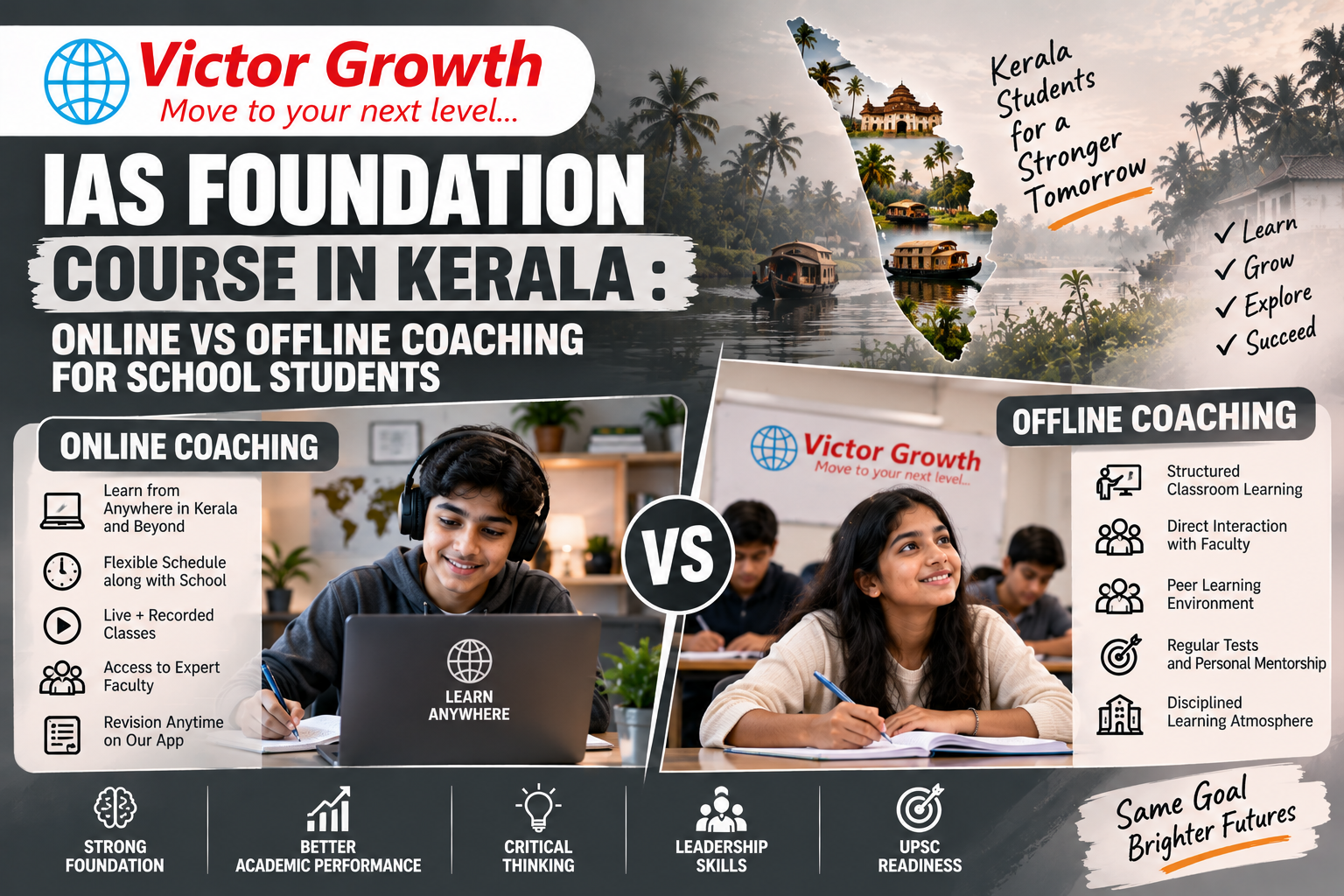
Advantages of online coaching
Convenience: Students can attend classes from home without travelling.
Flexible learning: Recorded lessons, when available, allow students to revisit difficult concepts.
Wider access: Students living far from major coaching centres can access structured learning.
Time savings: Reduced travel time can leave more room for schoolwork, sports, and rest.
Digital resources: Online quizzes, presentations, and learning materials can support revision.
Limitations of online coaching
Online learning requires reliable internet access, suitable devices, and the ability to remain focused during screen-based classes. Some students may find it harder to ask questions, participate actively, or maintain a regular routine without direct supervision.
Parents should check whether the course includes live interaction, doubt-clearing sessions, regular assessments, and appropriate guidance for school students.
Offline IAS Foundation Coaching: Advantages and Limitations
Offline coaching allows students to learn in a physical classroom with teachers and other learners. This format may be particularly helpful for children who benefit from direct interaction and a structured learning environment.
Advantages of offline coaching
Direct interaction: Students can ask questions and receive immediate clarification.
Classroom discipline: Fixed schedules can encourage consistency and regular attendance.
Peer learning: Group discussions, quizzes, and collaborative activities encourage participation.
Personal guidance: Teachers can observe student engagement and identify areas that need improvement.
Communication practice: Classroom presentations and discussions provide opportunities to build confidence.
Limitations of offline coaching
Travel time, transportation expenses, and fixed class schedules can make offline coaching less convenient. Families should also consider the distance from home and whether the timetable leaves sufficient time for schoolwork and extracurricular activities.
Online vs Offline IAS Foundation Coaching: A Comparison
| Factor | Online coaching | Offline coaching |
|---|---|---|
| Convenience | Learn from home | Requires travel |
| Teacher interaction | Depends on live support and course design | Direct classroom interaction |
| Flexibility | Often greater, especially with recordings | Usually follows fixed timings |
| Peer learning | Depends on online activities | Naturally supports classroom interaction |
| Revision | Recordings may be available | Usually depends on notes and revision sessions |
| Best suited for | Students needing flexibility or living far away | Students who benefit from structured classroom learning |
Neither format is automatically better for every student. The quality of teaching, level of interaction, suitability of the schedule, and student’s learning preferences matter more than the format alone.
How to Choose the Best IAS Coaching in Kerala for School Students
Before enrolling, parents should consider the following factors:
Age-appropriate syllabus: The programme should match the student’s academic level.
Teaching quality: Concepts should be explained clearly rather than taught through memorisation alone.
Current affairs and general knowledge: Learning should gradually introduce students to important events and issues.
Mentorship and feedback: Students should have opportunities to ask questions and understand their progress.
Balanced timetable: Classes should complement school education without creating excessive pressure.
Learning resources: Study materials, quizzes, revision support, and access to recorded lessons can be useful.
Victor Growth, located in Kadavanthra, Kochi, offers competitive examination coaching through different learning formats, including offline, online live, and recorded learning options. Parents exploring the Best IAS Coaching in Kerala can assess which available format best suits their child’s needs, schedule, and learning preferences.
Which Option Is Better for Your Child?
Choose online coaching if convenience, reduced travel, and flexible revision are your main priorities and your child can learn effectively in a digital environment.
Consider offline coaching if your child benefits from direct teacher interaction, classroom discipline, and regular peer activities.
A combination of online and offline learning may also be useful when available, allowing students to attend interactive classes and revise selected topics digitally.
Above all, foundation preparation should remain manageable. Students need adequate time for school examinations, physical activity, hobbies, family, and rest.
Conclusion
An IAS foundation course in Kerala can help school students develop the knowledge and learning habits needed for future UPSC preparation. Online coaching offers flexibility and convenience, while offline coaching provides direct interaction and a structured classroom environment.
When choosing between the two, parents should focus on teaching quality, mentorship, age-appropriate content, and a healthy balance with school life. The right programme is one that supports the child’s long-term development without unnecessary academic pressure.
Frequently Asked Questions (FAQs)
1. Is online or offline IAS foundation coaching better for school students?
Both can be effective. Online coaching offers flexibility, while offline coaching provides direct classroom interaction. The better choice depends on the student’s learning preferences and schedule.
2. Can students from other parts of Kerala attend online IAS foundation classes?
Yes. Online programmes can provide access to learning from home, subject to internet availability and the course’s admission and attendance requirements.
3. At what age can students join an IAS foundation course?
Students can begin age-appropriate foundation learning during their school years. The content and workload should suit their class level and academic responsibilities.
4. What should an IAS foundation course include?
Useful areas include conceptual learning, general knowledge, current affairs, reading, writing, analytical thinking, quizzes, and regular feedback.
5. Is offline coaching more effective for younger students?
Some younger students benefit from classroom structure and direct interaction, while others learn comfortably online. Parents should consider the child’s attention span, independence, and learning needs.
6. How can parents find the Best IAS Coaching in Kerala for school students?
Compare teaching methods, study materials, mentorship, interaction opportunities, class schedules, and student support. Choose a programme that complements school education and encourages balanced development.