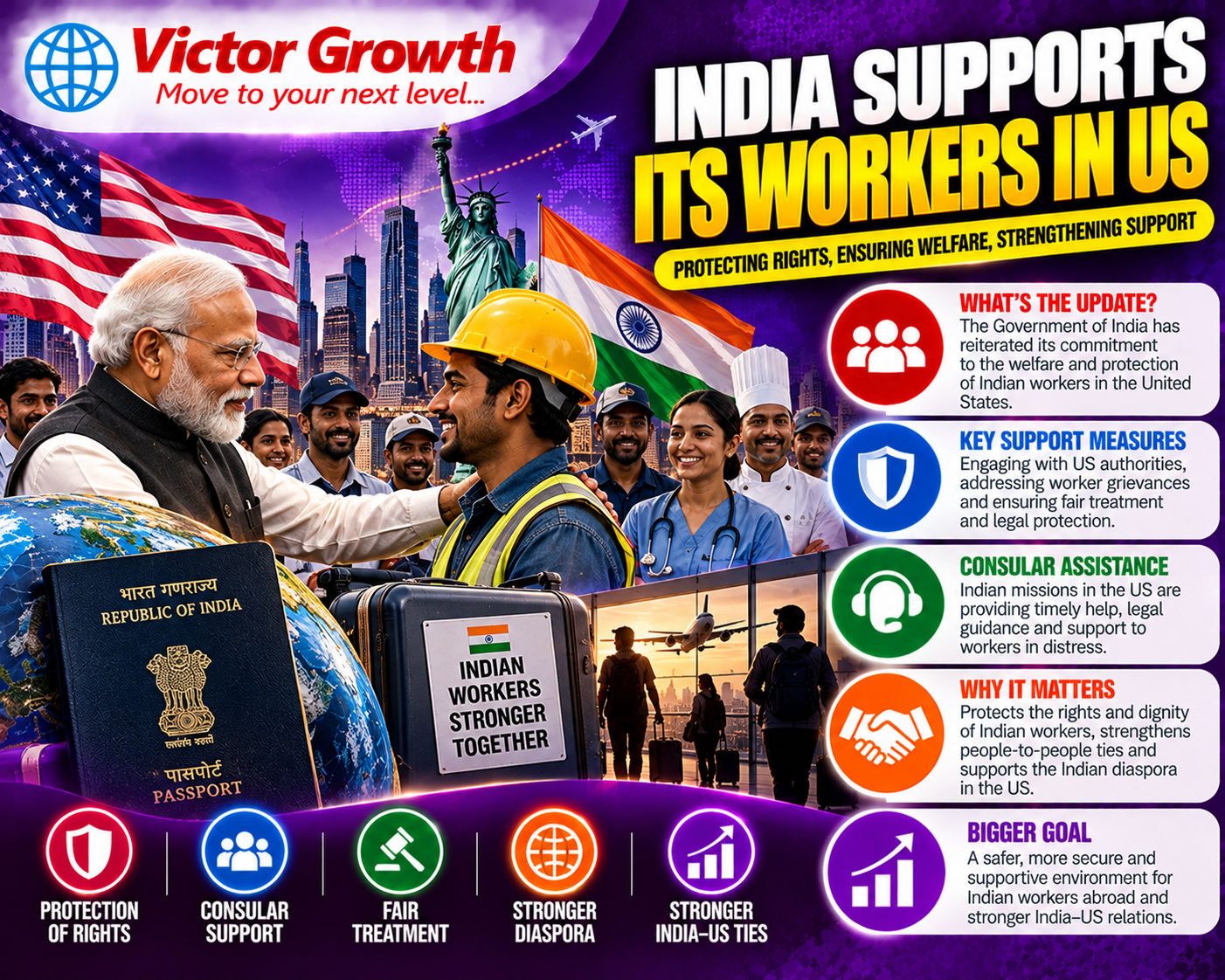
On 9 October 2026, India expressed concern over the United States’ suspension of certain Permanent Labor Certification (PERM) applications involving major technology companies. The Ministry of External Affairs stated that restrictions on skilled-worker mobility do not advance the shared interests of India and the US. India also defended the contributions of Indian professionals to the American economy and innovation ecosystem. <Cite refs={[“turn888397news4″,”turn888397search1”]}/>
What Is the PERM Programme?
The Permanent Labor Certification (PERM) programme is administered by the US Department of Labor. It is generally a key step in the employment-based immigration process through which an employer seeks to sponsor an eligible foreign worker for permanent residence, commonly known as a Green Card.
The recent suspension affects PERM applications involving selected technology companies, including Infosys, Tata Consultancy Services (TCS), Wipro, HCL Technologies, Cognizant, Microsoft, Adobe and Capgemini. It may delay eligible employees’ pathways to permanent residency. <Cite refs={[“turn888397search0″,”turn888397news5”]}/>
Important distinction: PERM is not the same as the H-1B visa programme. India’s government clarified that the PERM suspension does not, by itself, invalidate existing H-1B visas or change the immigration status of their holders and dependants. <Cite refs={[“turn888397search1″,”turn888397search0”]}/>
India’s Response
India emphasised that the movement of skilled professionals benefits both countries.
Protection of Indian professionals: India rejected descriptions of foreign workers as “indentured servants,” calling such language unwarranted and offensive.
Mutual economic benefits: Indian professionals contribute to research, innovation, productivity and competitiveness in the US.
Diplomatic engagement: India highlighted the importance of cooperation and policies that recognise the contributions of skilled migrants.
Workers’ welfare: Indian missions abroad and the Ministry of External Affairs provide consular assistance and welfare support to Indians facing difficulties overseas.
Why Are Indian Workers in the US Important?
Indian professionals play an important role in sectors such as information technology, engineering, healthcare, research and higher education. Their contributions support innovation and strengthen economic links between India and the United States.
However, changes in immigration policies can create uncertainty regarding employment, long-term residence, family stability and career planning. Such uncertainty can also affect companies’ recruitment strategies and the global competitiveness of the technology sector.
Significance for India–US Relations
The issue highlights the relationship between migration policy, economic cooperation and diplomacy.
Economic relations: Skilled-worker mobility supports trade, investment and technology partnerships.
Indian diaspora: Protecting the interests of overseas Indians is an important aspect of India’s foreign policy.
Technology cooperation: Access to skilled professionals strengthens innovation and research ecosystems.
Diplomatic challenges: Differences over immigration policy can create friction even when countries share broader economic and strategic interests.
Challenges and the Way Forward
India needs to continue diplomatic engagement with the US while supporting affected workers through reliable consular guidance. Indian technology companies can also diversify markets, strengthen local hiring strategies and reduce excessive dependence on particular visa pathways.
At the same time, both countries should seek transparent immigration procedures that balance domestic employment concerns with the economic benefits of international talent mobility.
UPSC Exam Relevance
Prelims: PERM programme, H-1B visas, Green Cards, Ministry of External Affairs and Indian diaspora.
GS Paper II: India–US relations, bilateral cooperation, diaspora issues and foreign policy.
GS Paper III: Indian IT industry, globalisation, employment and technology-sector competitiveness.
Possible UPSC Mains Question: Discuss the significance of skilled-worker mobility in India–US relations. How can India protect the interests of its overseas professionals amid changing immigration policies?
Conclusion
India’s response to the US restrictions on PERM applications underscores the importance of protecting Indian professionals while recognising the mutual benefits of skilled migration. Constructive diplomacy, worker support and diversified economic partnerships will be essential to managing emerging challenges in India–US relations.