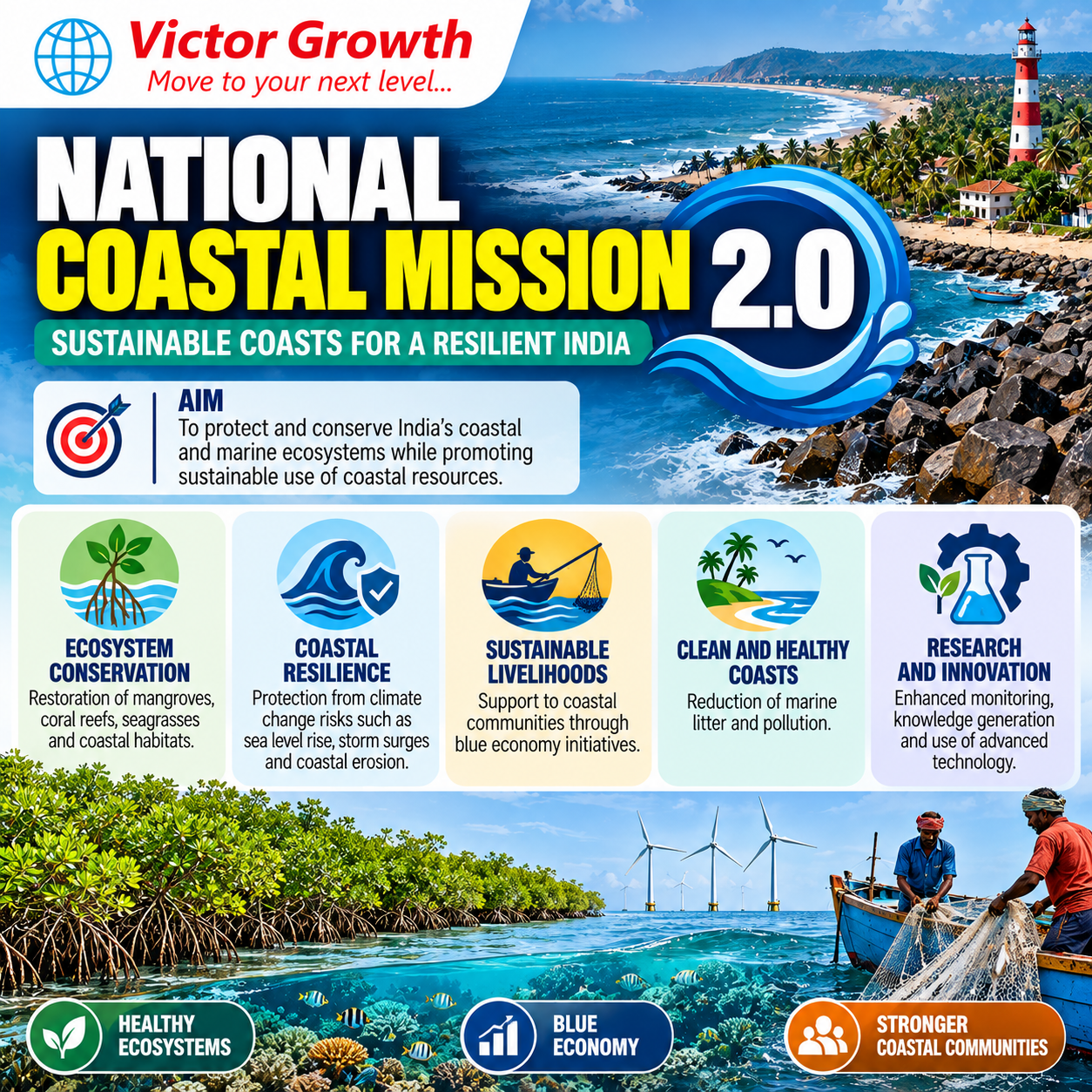
India’s long coastline supports millions of livelihoods and is central to trade, fisheries, tourism, biodiversity and the Blue Economy. At the same time, coastal regions face increasing risks from sea-level rise, coastal erosion, cyclones, flooding, pollution and ecosystem degradation.
Against this background, the Government of India launched the implementation guidelines for National Coastal Mission 2.0 (NCM 2.0) on 30 September 2026. The initiative aims to strengthen coastal resilience while supporting sustainable economic development.
For UPSC aspirants, NCM 2.0 is important for GS Paper I, GS Paper III, Environment, Disaster Management, Blue Economy and current affairs.
What is National Coastal Mission 2.0?
National Coastal Mission 2.0 is a Central Sector Scheme of the Ministry of Environment, Forest and Climate Change (MoEFCC).
It has an approved outlay of ₹767 crore and will be implemented up to 2030–31 across India’s nine coastal States and four Union Territories.
The mission seeks to integrate coastal conservation, climate resilience, scientific planning and sustainable economic development.
Major Objectives of NCM 2.0
The mission focuses on:
Strengthening coastal resilience
Conservation and restoration of coastal ecosystems
Biodiversity protection
Marine pollution management
Sustainable coastal tourism
Coastal vulnerability assessment
Spatial planning
Research and scientific monitoring
Capacity building
Supporting India’s Blue Economy
The approach represents a shift towards integrated coastal management, rather than treating individual coastal problems separately.
Why is NCM 2.0 Important?
1. Climate Change and Coastal Resilience
Coastal India is increasingly exposed to hazards such as:
Sea-level rise → Coastal erosion → Storm surges → Cyclones → Coastal flooding → Salinity intrusion
NCM 2.0 seeks to strengthen the resilience of coastal ecosystems and communities against these risks.
2. Ecosystem Restoration
Mangroves, coral reefs, wetlands and other coastal ecosystems provide important ecosystem services, including protection against waves and storm surges, carbon storage and habitat for biodiversity.
Restoring these ecosystems can therefore serve both conservation and climate-adaptation objectives.
3. Blue Economy
India’s coastal and marine resources support activities such as:
Fisheries
Shipping
Ports
Coastal tourism
Aquaculture
Renewable energy
Marine biotechnology
NCM 2.0 seeks to unlock this economic potential while maintaining ecological sustainability.
Spatial Planning and Scientific Management
One important feature of modern coastal management is the use of scientific and spatial planning.
Coastal areas have multiple and sometimes competing uses:
Ports + Fisheries + Tourism + Conservation + Settlements + Industry + Renewable Energy
Integrated planning can help reduce conflicts between development and environmental protection.
NCM 2.0 therefore emphasises spatial planning, research, vulnerability assessments and improved institutional coordination.
Pollution Management
Marine and coastal pollution from plastic waste, untreated sewage, industrial discharge and other sources threatens marine ecosystems and coastal livelihoods.
NCM 2.0 includes pollution management as one of its important intervention areas, complementing broader government initiatives for cleaner and healthier oceans.
NCM 2.0 and Disaster Management
The mission has direct relevance to disaster management because coastal ecosystems themselves can function as natural protective infrastructure.
For example:
Mangroves → Reduce wave energy and erosion
Coral reefs → Provide coastal protection
Wetlands → Store excess water
This approach is often described as ecosystem-based adaptation.
It can complement conventional infrastructure such as seawalls, embankments and cyclone shelters.
NCM 2.0 vs Traditional Coastal Development
The basic philosophy can be understood as:
Earlier approach: Development and environmental protection often considered separately.
NCM 2.0 approach: Ecology + climate resilience + livelihoods + spatial planning + Blue Economy.
This whole-of-government and stakeholder-based approach is intended to improve coordination between the Centre, coastal States/UTs and other stakeholders.
UPSC Relevance
Prelims
Remember:
NCM 2.0: National Coastal Mission 2.0
Ministry: Ministry of Environment, Forest and Climate Change
Type: Central Sector Scheme
Outlay: ₹767 crore
Implementation period: Till 2030–31
Coverage: 9 coastal States + 4 Union Territories
Key themes: Coastal resilience, ecosystem restoration, pollution management, biodiversity, sustainable tourism and Blue Economy
GS Paper I – Geography
Link NCM 2.0 with:
Coastal geomorphology
Coastal erosion
Sea-level rise
Cyclones
Coastal ecosystems
Human-environment interaction
GS Paper III – Environment & Disaster Management
Connect it with:
Climate adaptation
Marine pollution
Mangrove conservation
Biodiversity
Blue Economy
Ecosystem-based disaster management
Sustainable coastal development
Possible UPSC Mains Question
“National Coastal Mission 2.0 seeks to balance coastal conservation with the development of India’s Blue Economy. Discuss the significance of an integrated approach to coastal management in India.”
A good answer can follow:
Coastal challenges → NCM 2.0 → Ecosystem restoration → Climate resilience → Blue Economy → Way forward
Conclusion
National Coastal Mission 2.0 represents an integrated approach to India’s coastal future, combining environmental conservation with climate resilience and sustainable economic development.
Its success will depend on scientific planning, effective Centre–State coordination, community participation, ecosystem restoration and strong implementation mechanisms.
For UPSC aspirants, NCM 2.0 is an excellent case study connecting Climate Change + Coastal Geography + Biodiversity + Disaster Management + Blue Economy + Sustainable Development.