
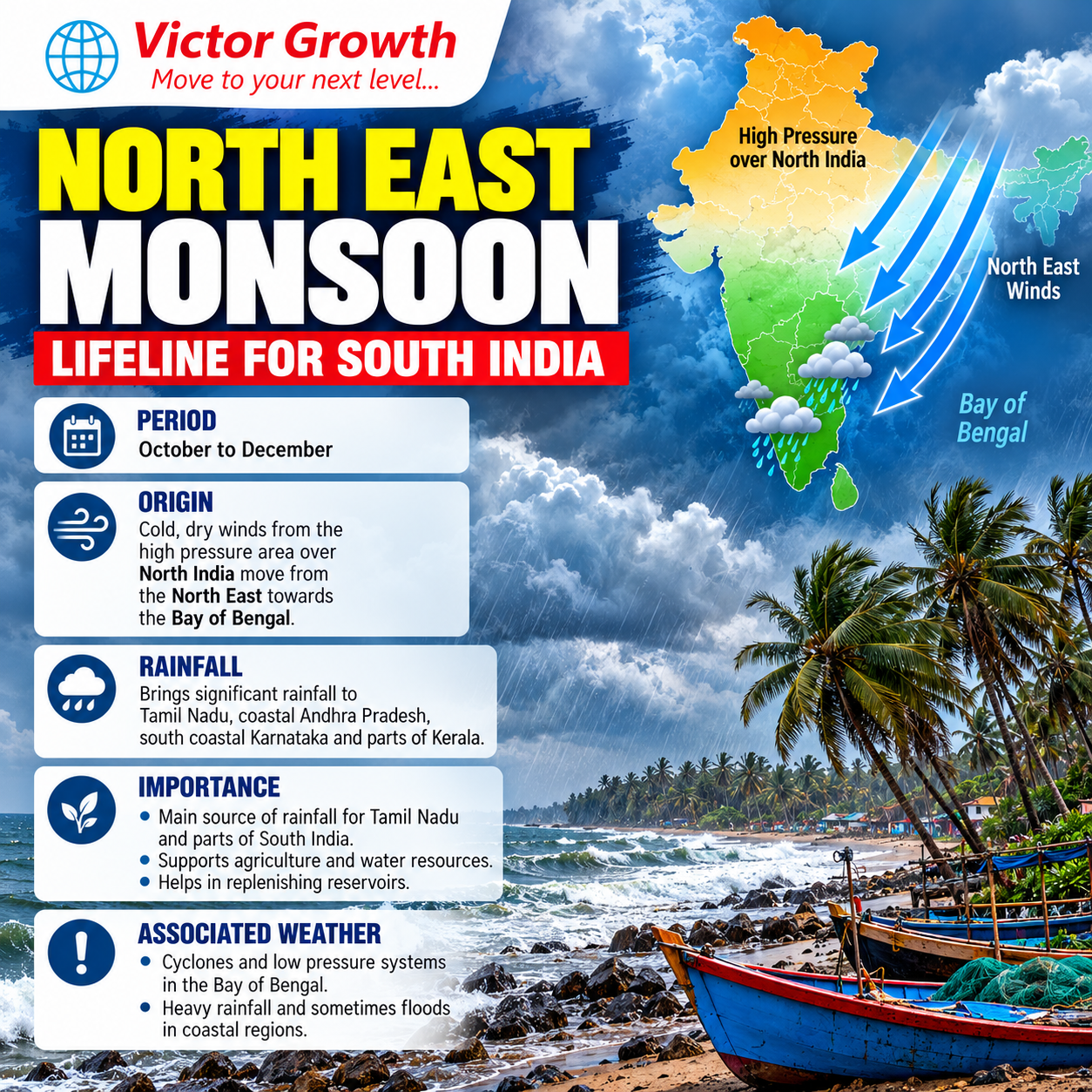
The Northeast Monsoon (NEM) is an important component of India’s climate system, particularly for Tamil Nadu, coastal Andhra Pradesh, Rayalaseema, Kerala and South Interior Karnataka. It occurs mainly during October–December and is also associated with the retreating phase of the Southwest Monsoon.
For UPSC aspirants, the Northeast Monsoon is an important topic under Indian Geography, climatology, agriculture, disaster management and climate variability.
What is the Northeast Monsoon?
The Northeast Monsoon refers to the seasonal reversal of winds following the withdrawal of the Southwest Monsoon.
During this period, winds generally blow from the northeast towards the southwest. As these winds travel across the Bay of Bengal, they acquire moisture and bring rainfall to parts of southern peninsular India.
The Northeast Monsoon season is generally considered the October–December period.
Why Does the Northeast Monsoon Occur?
The process is closely associated with the withdrawal of the Southwest Monsoon.
As the Sun’s apparent position moves southward, the Inter-Tropical Convergence Zone (ITCZ) also shifts towards lower latitudes. Atmospheric pressure patterns change, resulting in a reversal of the prevailing wind system.
The broad sequence is:
Withdrawal of Southwest Monsoon → Southward shift of ITCZ → Reversal of winds → Northeasterly winds → Moisture pickup from Bay of Bengal → Rainfall over southern India
Why Does Tamil Nadu Receive Heavy Northeast Monsoon Rain?
Tamil Nadu lies largely on the rain-shadow side of the Western Ghats during the Southwest Monsoon. Consequently, the Northeast Monsoon becomes its principal rainy season.
According to IMD, Tamil Nadu receives around 48% of its annual rainfall during October–December, making the performance of the Northeast Monsoon particularly important for the state’s agriculture and water resources.
The east coast also receives rainfall from Bay of Bengal weather systems, including low-pressure areas and cyclonic systems.
Areas Benefiting from the Northeast Monsoon
The principal Indian meteorological subdivisions receiving Northeast Monsoon rainfall are:
Tamil Nadu, Puducherry & Karaikal
Coastal Andhra Pradesh & Yanam
Rayalaseema
South Interior Karnataka
Kerala & Mahe
The rainfall pattern is not uniform across these regions.
Northeast Monsoon and Cyclones
The Bay of Bengal becomes an important source of weather systems during the post-monsoon season.
Low-pressure systems and tropical cyclones can bring very heavy rainfall, strong winds, storm surges and flooding to coastal areas.
Therefore, Northeast Monsoon rainfall is important not only for agriculture but also for disaster preparedness and coastal management.
Importance for Agriculture and Water Security
The Northeast Monsoon plays a major role in:
Rabi agriculture
Reservoir replenishment
Groundwater recharge
Drinking-water availability
Irrigation
Ecosystem maintenance
For Tamil Nadu in particular, a deficient Northeast Monsoon can have significant consequences for agriculture and water resources.
Northeast Monsoon and El Niño
An important UPSC concept is the relationship between El Niño and the Northeast Monsoon.
Unlike the Southwest Monsoon, where El Niño is generally associated with weaker rainfall over India, El Niño events have often been associated with enhanced Northeast Monsoon rainfall, although the relationship is not absolute. IMD research notes that El Niño generally enhances Northeast Monsoon rainfall, while La Niña tends to be associated with deficient rainfall, with exceptions.
This is a useful example of why ENSO does not affect all components of India’s monsoon system in the same way.
Northeast Monsoon vs Southwest Monsoon
| Feature | Southwest Monsoon | Northeast Monsoon |
|---|---|---|
| Main period | June–September | October–December |
| Dominant winds | Southwesterly | Northeasterly |
| Major moisture source | Arabian Sea & Bay of Bengal | Mainly Bay of Bengal |
| Major beneficiaries | Most of India | Southern Peninsular India |
| Important for Tamil Nadu | Relatively less | Principal rainy season |
| Associated weather systems | Monsoon depressions, low-pressure systems | Bay of Bengal lows and cyclones |
2026 UPSC Current Affairs Context
The Northeast Monsoon becomes particularly relevant during the October–December period, when the Southwest Monsoon withdraws and rainfall activity shifts towards southern peninsular India.
The IMD describes the Northeast Monsoon as the retreating phase of the Southwest Monsoon, characterised by a reversal of the surface and lower-tropospheric wind regime.
UPSC Relevance
Prelims
Focus on:
Northeast Monsoon period
Wind reversal
ITCZ migration
Bay of Bengal
Tamil Nadu’s rainfall pattern
El Niño and La Niña
Post-monsoon cyclones
GS Paper I – Geography
The topic can be linked with:
Indian monsoon system
Seasonal reversal of winds
ITCZ
Tropical cyclones
Regional rainfall distribution
Climate variability
GS Paper III – Environment & Disaster Management
It can be connected with:
Floods
Cyclones
Drought
Agricultural vulnerability
Water security
Early warning systems
Possible UPSC Mains Question
“The Northeast Monsoon is particularly important for the water security and agriculture of southern peninsular India. Explain its mechanism and discuss the factors influencing its variability.”
Conclusion
The Northeast Monsoon is a vital component of India’s climate system, particularly for southern peninsular states. Its interaction with the Bay of Bengal, tropical cyclones, ENSO and regional geography makes it an important topic for understanding India’s rainfall variability.
For UPSC preparation, study the Northeast Monsoon through the integrated framework of monsoon reversal + ITCZ + Bay of Bengal + Tamil Nadu rainfall + ENSO + cyclones + agriculture and disaster management.