Introduction
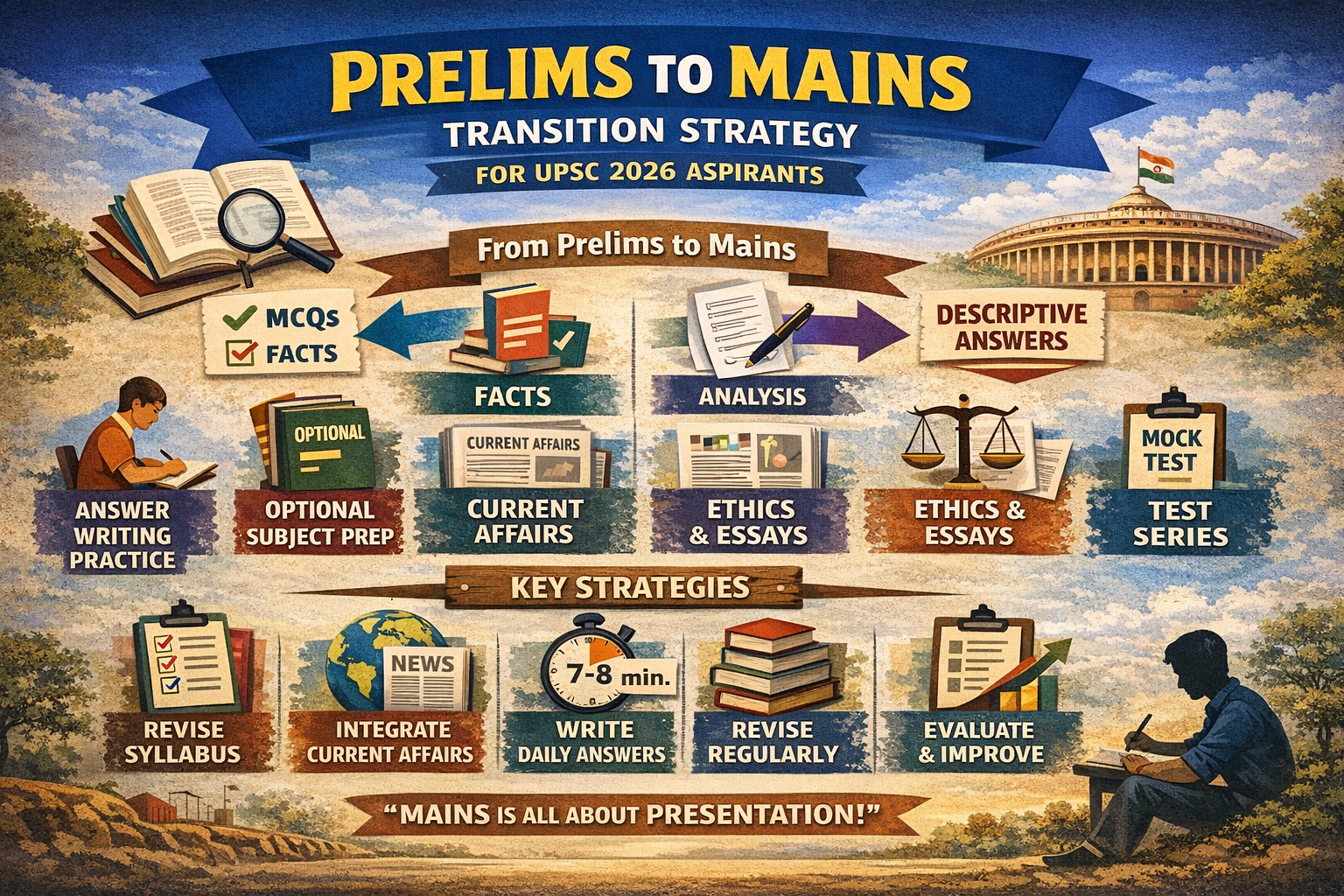
The Prelims-to-Mains transition is one of the most critical and decisive phases in the UPSC Civil Services Examination (CSE) journey. Every year, thousands of aspirants clear the Preliminary Examination, but only a fraction succeed in the Mains. The primary reason is not lack of knowledge, but lack of a structured transition strategy.
For UPSC 2026 aspirants, the competition is expected to be tougher, with evolving question trends, analytical answer demands, and increased emphasis on current affairs integration. This article provides a step-by-step, practical, and realistic strategy to smoothly transition from Prelims to Mains and maximize your chances of success.
Understanding the Prelims–Mains Gap
Nature of Prelims vs Mains
| Aspect | Prelims | Mains |
|---|---|---|
| Objective | Screening test | Merit-deciding |
| Question type | Objective (MCQs) | Descriptive |
| Focus | Facts, elimination | Analysis, articulation |
| Time per question | Seconds | 7–10 minutes |
| Answer style | Choose correct option | Structured writing |
👉 Key Insight: Clearing Prelims does NOT guarantee Mains success unless you consciously switch your preparation approach.
Why the Prelims-to-Mains Transition Is Challenging
Mental fatigue after Prelims
False confidence due to Prelims clearance
Poor answer writing practice
Inadequate revision of static subjects
Neglect of Ethics (GS Paper IV)
Optional subject backlog
Recognizing these challenges early helps in building a realistic transition plan.
Ideal Timeline for Prelims-to-Mains Transition (UPSC 2026)
Phase 1: Immediately After Prelims (Day 1–10)
Take 2–3 days rest for mental recovery
Begin light revision of GS Mains syllabus
Start answer writing basics
Avoid obsessing over Prelims cut-off discussions
Phase 2: Core Mains Preparation (Next 80–90 Days)
Full-length GS preparation
Optional subject revision
Essay & Ethics practice
Regular test series
Step-by-Step Prelims-to-Mains Transition Strategy
1. Shift Your Mindset from MCQs to Answers
Mains demands:
Clear arguments
Logical flow
Multidimensional analysis
Crisp conclusions
Action Step:
Write at least 2–3 answers daily from Day 5 after Prelims.
2. Revisit the UPSC Mains Syllabus Line by Line
Many aspirants read books but ignore the syllabus itself.
✔ Break each GS paper syllabus into micro-topics
✔ Link current affairs to syllabus keywords
✔ Prepare content under headings like:
Introduction
Body (dimensions)
Conclusion
3. Integrate Current Affairs with Static Subjects
UPSC increasingly asks static + current combined questions.
Example:
Polity + Supreme Court judgments
Geography + climate reports
Economy + budget & RBI updates
Best Sources:
Monthly current affairs magazines
Government reports (Economic Survey, ARC, NITI Aayog)
4. Master Answer Writing (MOST CRITICAL)
Ideal Mains Answer Structure
Intro: Definition / Data / Context (2–3 lines)
Body:
Headings
Diagrams / flowcharts
Examples / case studies
Conclusion:
Way forward
Constitutional values
SDGs
👉 Practice timed answers (7–10 minutes per question).
5. Ethics (GS Paper IV) – Start Early
Ethics is high scoring but often ignored.
Focus on:
Definitions of key terms
Thinkers and quotes
Case study practice
Real-life examples
📌 Prepare examples from administration, social life, and personal experiences.
6. Optional Subject Strategy
Optional contributes 500 marks – a game changer.
✔ Revise syllabus completely
✔ Practice previous year questions
✔ Write 2–3 optional answers daily
✔ Revise notes multiple times
Avoid starting new optional topics during Mains phase.
7. Essay Preparation – Continuous Process
Essay is not about language alone.
Prepare:
Quotes and anecdotes
Philosophical interpretations
Contemporary examples
Balanced arguments
Write 1 essay every 10–15 days, get it evaluated.
8. Test Series & Feedback Loop
Join a Mains Test Series for:
Time management
Answer improvement
Content enrichment
🔁 Analyze every test:
Weak areas
Repetition mistakes
Presentation issues
Common Mistakes to Avoid During Transition
❌ Waiting for Prelims result
❌ Ignoring answer writing
❌ Studying only current affairs
❌ Overloading resources
❌ Skipping Ethics & Essay
Smart Daily Study Plan (Sample)
| Component | Time |
|---|---|
| GS static | 4–5 hours |
| Current affairs | 1–1.5 hours |
| Answer writing | 2 hours |
| Optional | 3 hours |
| Revision | 1 hour |
Final Words for UPSC 2026 Aspirants
The Prelims-to-Mains transition is not about studying more, but studying differently. Those who start early, write regularly, and revise smartly will always have an edge.
👉 Remember:
“Mains is not a knowledge test, it is a presentation test.”
Stay disciplined, trust the process, and keep refining your answers.
Frequently Asked Questions (FAQ)
Q1. When should I start Mains preparation after Prelims?
Immediately after Prelims, ideally within 5–7 days, without waiting for results.
Q2. Is answer writing necessary even before Prelims result?
Yes. Early answer writing builds confidence and improves speed and structure.
Q3. How many answers should I write daily for Mains?
Start with 2–3 answers daily, gradually increase to 6–8 answers.
Q4. Should I focus more on optional or GS during transition?
Both are equally important. However, ensure optional syllabus completion early.
Q5. Is joining a Mains test series mandatory?
Not mandatory, but highly recommended for feedback and performance tracking.
Q6. How important is Ethics in Mains?
Ethics (GS IV) is one of the highest scoring papers and should not be ignored.
Q7. Can self-study aspirants succeed in the Prelims-to-Mains transition?
Absolutely. With a clear strategy, disciplined answer writing, and revision, self-study aspirants perform exceptionally well.