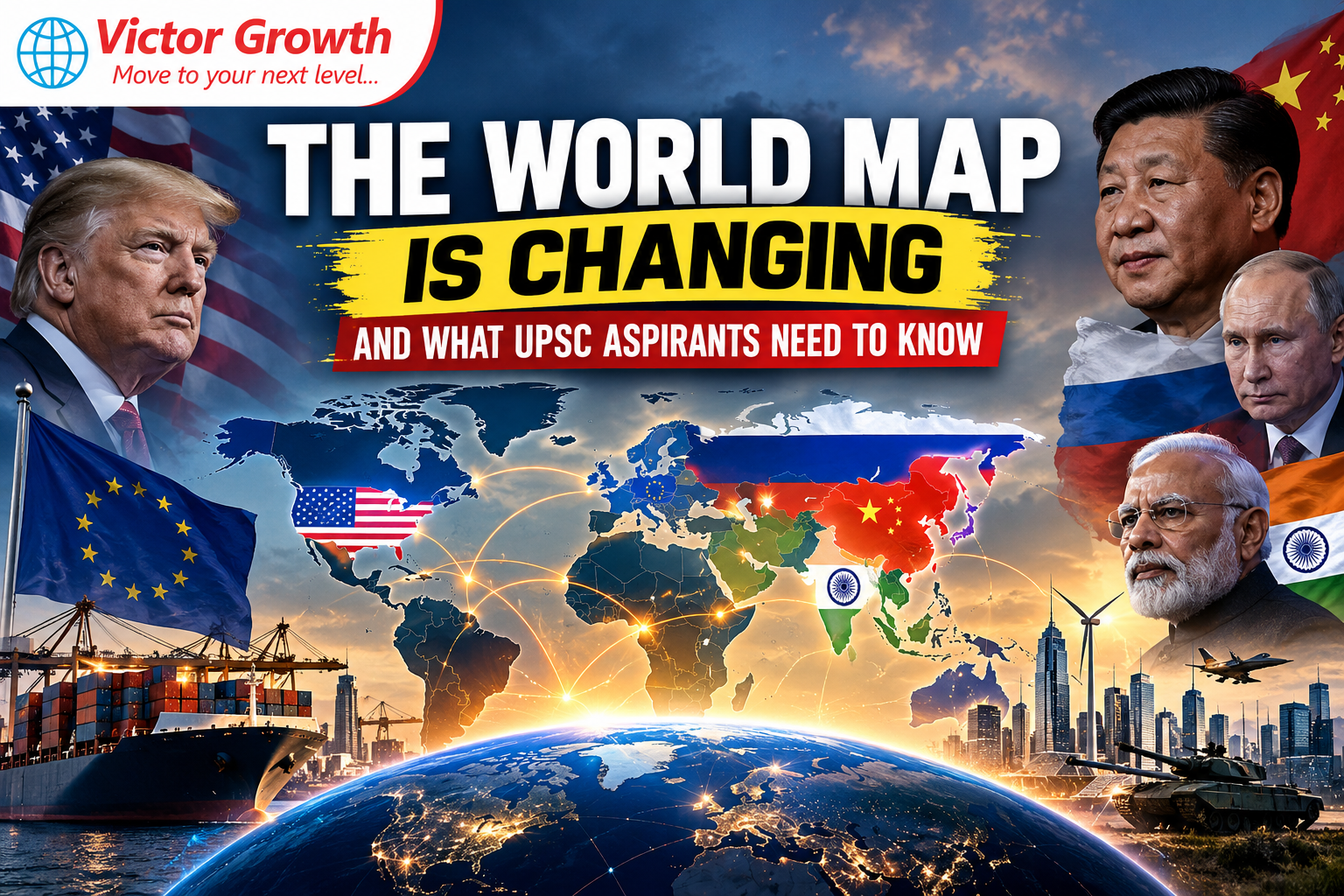
The political map of the world may appear unchanged, but the strategic map of the world is changing rapidly.
Power is shifting, alliances are being reorganised, new trade corridors are emerging, and regions such as the Indo-Pacific and Arctic are gaining strategic importance.
For UPSC aspirants, understanding these changes is essential because geography, international relations, economy and current affairs are increasingly interconnected.
1. Shift Towards a Multipolar World
The post-Cold War world was largely dominated by the United States. Today, power is increasingly distributed among several major players.
Important centres of power include:
USA
China
European Union
Russia
India
Japan
Other emerging powers
This transition is often described as the movement towards a more multipolar world order.
UPSC Focus
Understand how India’s strategic autonomy allows it to maintain partnerships with different powers based on national interests.
2. The Rise of the Indo-Pacific
The Indo-Pacific has become one of the world’s most important geopolitical regions.
It connects the Indian Ocean and Pacific Ocean and includes major economic centres, trade routes and strategic chokepoints.
Important locations:
South China Sea
Strait of Malacca
Indian Ocean
Taiwan Strait
Andaman & Nicobar Islands
Why is it important for India?
India’s geographical position gives it a central role in the Indian Ocean and strengthens its engagement with countries such as Japan, Australia, ASEAN members and the United States.
Remember: QUAD, SAGAR, Act East Policy and IPOI.
3. West Asia and Strategic Chokepoints
West Asia remains important because of energy resources, conflicts and maritime trade routes.
Three locations are particularly important:
Strait of Hormuz
Connects the Persian Gulf with the Gulf of Oman.
Bab-el-Mandeb
Connects the Red Sea with the Gulf of Aden.
Suez Canal
Connects the Mediterranean Sea with the Red Sea.
Any disruption in these routes can affect global trade, energy prices and India’s economy.
4. Russia-Ukraine Conflict and European Security
The Russia-Ukraine conflict has changed Europe’s security environment.
It has affected:
NATO
European defence policies
Energy security
Food security
Black Sea geopolitics
Russia-Europe relations
Finland and Sweden joining NATO have also changed the strategic geography of Northern Europe.
UPSC Map Focus
Locate:
Russia – Ukraine – Finland – Sweden – Baltic Sea – Black Sea
5. The Arctic Is Becoming Important
The Arctic was traditionally studied mainly from the perspective of climate and physical geography.
Today, it is also becoming important for:
Natural resources
Shipping routes
Critical minerals
Military strategy
Climate change
Countries surrounding the Arctic include Russia, Canada, the United States, Norway, Denmark through Greenland, Iceland, Sweden and Finland.
UPSC Connection
Climate Change + Resources + Shipping + Geopolitics
6. Economic Corridors Are Changing Global Geography
Modern geopolitics is increasingly about connectivity.
Important corridors for India include:
INSTC
International North-South Transport Corridor
Connects India with Iran, Central Asia, Russia and Europe through a multimodal network.
IMEC
India-Middle East-Europe Economic Corridor
A proposed connectivity framework linking India with the Middle East and Europe.
CPEC
China-Pakistan Economic Corridor
A major component of China’s Belt and Road Initiative.
UPSC Concept
Connectivity = Trade + Infrastructure + Strategic Influence
7. Critical Minerals: The New Geopolitical Resource
The energy transition is creating growing demand for:
Lithium
Cobalt
Nickel
Graphite
Rare earth elements
Copper
These are essential for:
Electric vehicles
Batteries
Renewable energy
Electronics
Defence technologies
Therefore, critical minerals are becoming strategically important.
For India, securing reliable mineral supply chains is an important economic and national-security concern.
8. The Indian Ocean Is Increasingly Important
India’s location at the centre of the Indian Ocean gives it major strategic importance.
Important chokepoints include:
Strait of Hormuz
Bab-el-Mandeb
Strait of Malacca
Sunda Strait
Lombok Strait
India’s Andaman & Nicobar Islands are particularly important because of their proximity to major maritime routes connecting the Indian and Pacific Oceans.
9. Technology Is Creating a New Geopolitical Map
Geopolitics is no longer limited to land and oceans.
Strategic competition now includes:
Semiconductors
Artificial Intelligence
Cybersecurity
Satellites
Submarine cables
Data centres
Digital infrastructure
This has created a new concept of digital and technological geopolitics.
10. What Does the Changing World Mean for India?
India is navigating a complex international environment.
India maintains important relationships with:
USA + Russia + Europe + Japan + Australia + ASEAN + Gulf countries + BRICS + SCO
India’s approach is often associated with strategic autonomy—maintaining the freedom to pursue its national interests while working with different partners.
India’s advantages include:
Strategic geographical location
Large economy
Young population
Large diaspora
Growing technological capabilities
Strong diplomatic engagement
The UPSC Map Formula
Whenever you see a new international issue in the newspaper, ask five questions:
1. WHERE?
Locate it on the world map.
2. WHAT?
What is happening there?
3. WHY?
Why is the location strategically important?
4. WHICH?
Which countries or organisations are involved?
5. INDIA?
How does it affect India’s interests?
10 Locations Every UPSC Aspirant Should Know
| Location | Why Important? |
|---|---|
| Strait of Hormuz | Global energy |
| Bab-el-Mandeb | Red Sea shipping |
| Suez Canal | Europe-Asia trade |
| Strait of Malacca | Indo-Pacific trade |
| South China Sea | Maritime disputes |
| Black Sea | Russia-Ukraine & trade |
| Arctic | Climate, resources & security |
| Caspian Sea | Energy & Central Asia |
| Andaman & Nicobar | India’s maritime strategy |
| Panama Canal | Global maritime trade |
Final Takeaway
The world map is changing not necessarily because borders are changing, but because the balance of power, trade routes, alliances, resources and strategic influence is changing.
For UPSC, don’t study world geography and international relations separately.
Think of the chain:
LOCATION → GEOGRAPHY → RESOURCES → TRADE → SECURITY → GLOBAL POWER → INDIA
Understanding this connection can help you answer questions in Prelims, GS Paper 1, GS Paper 2, Essay and the UPSC Interview.
For UPSC preparation, never read international current affairs without looking at the map.