
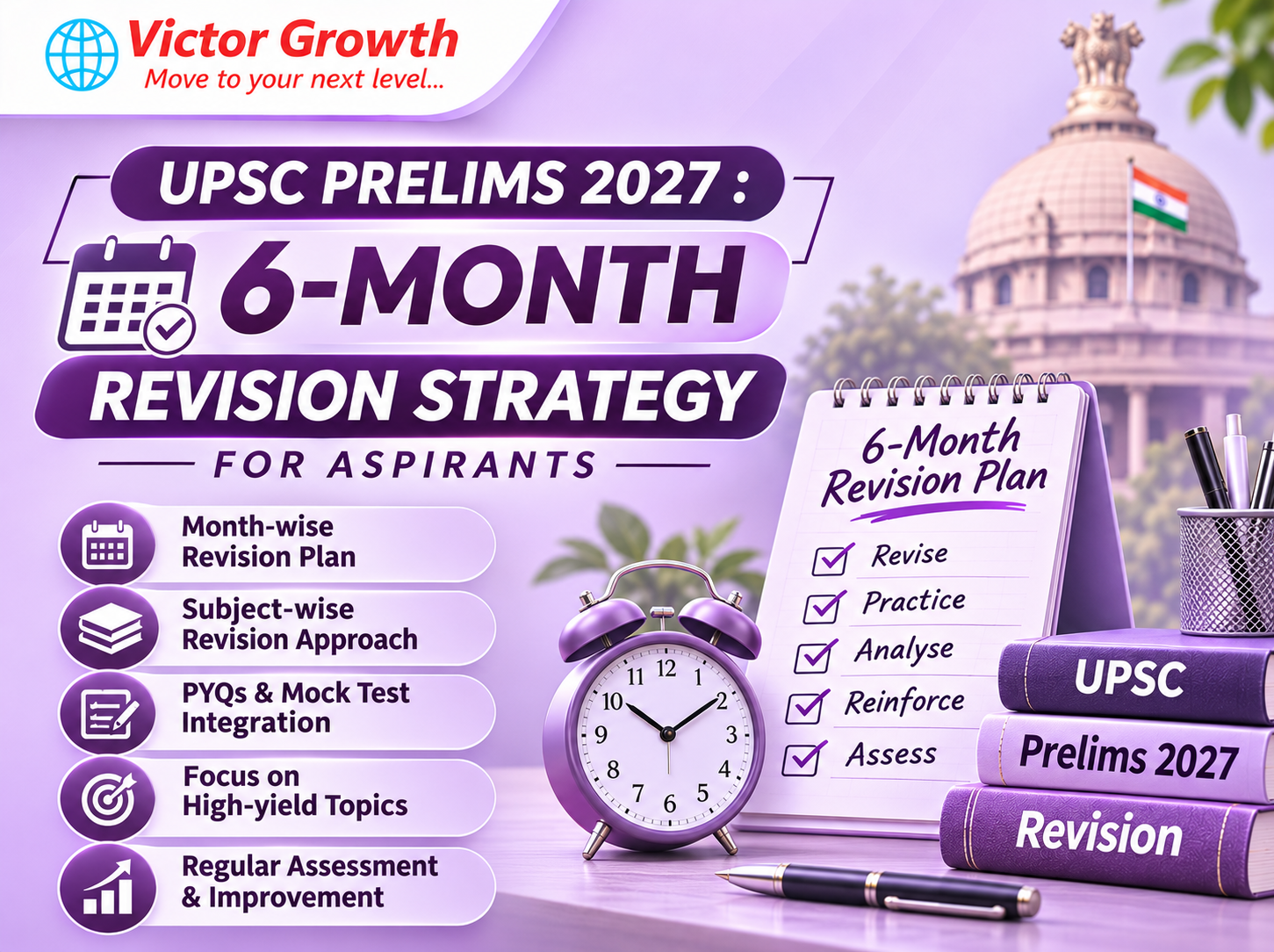
Preparing for UPSC Civil Services Prelims 2027 requires consistent learning, regular revision, and extensive question practice. While completing the syllabus is important, revision plays an equally significant role in retaining information and improving examination performance.
With only six months left before the examination, aspirants should focus on strengthening their concepts, revising important topics, practising previous-year questions, and attempting mock tests. A well-planned six-month revision strategy can help candidates cover the syllabus systematically without unnecessary stress.
1. Why Is a 6-Month Revision Strategy Important?
A structured revision plan helps aspirants make better use of their preparation time.
Better Retention: Repeated revision helps remember important concepts and facts.
Improved Accuracy: Revisiting topics reduces conceptual mistakes.
Time Management: A fixed schedule prevents unnecessary delays.
Identifying Weak Areas: Mock tests and practice questions reveal topics that need improvement.
Exam Confidence: Regular revision helps candidates approach the examination with greater confidence.
2. Month-Wise UPSC Prelims 2027 Revision Strategy
Divide the six months into different preparation phases. Adjust the plan according to your existing syllabus coverage.
Month 1: Revise Basic Concepts
Focus on strengthening the fundamentals of all major subjects.
Revise NCERT textbooks and standard reference books.
Cover important topics in History, Geography, Polity, and Economy.
Prepare short notes for difficult concepts.
Start solving subject-wise previous-year questions.
Identify weak areas that require additional attention.
Month 2: Complete Subject-Wise Revision
Focus on completing the first round of revision across the syllabus.
Revise Indian Polity and Constitution.
Cover Ancient, Medieval, and Modern History.
Revise Physical and Indian Geography.
Strengthen basic economic concepts.
Practise topic-wise MCQs after every subject.
Month 3: Focus on Environment and Science & Technology
Give special attention to subjects connected with current affairs.
Revise biodiversity and ecosystems.
Study climate change and environmental conventions.
Cover important space missions and biotechnology developments.
Follow defence and emerging technologies.
Connect current affairs with static concepts.
Month 4: Previous-Year Questions and Mock Tests
Shift towards examination-oriented preparation.
Solve at least 10 years of available UPSC Prelims PYQs.
Attempt subject-wise and full-length mock tests.
Analyse incorrect answers.
Revise important facts and concepts.
Identify frequently repeated themes.
Month 5: Intensive Revision and Practice
Focus on improving accuracy and reducing mistakes.
Revise all short notes.
Practise full-length General Studies mock tests.
Solve CSAT previous-year papers.
Revise current affairs and important government schemes.
Maintain a separate notebook for mistakes.
Month 6: Final Revision
The final month should be dedicated mainly to revision and examination practice.
Revise important topics from every subject.
Go through previous-year questions again.
Revise current affairs notes.
Attempt mock tests based on your performance and stamina.
Practise OMR marking and time management.
Avoid starting too many new resources.
3. Subject-Wise Revision Priorities
Organising revision subject-wise helps ensure that no major area is neglected.
Subject | Important revision areas |
|---|---|
History | Freedom struggle, ancient and medieval history, art and culture |
Geography | Physical geography, Indian geography, climate and maps |
Polity | Constitution, fundamental rights, Parliament and constitutional bodies |
Economy | GDP, inflation, banking, taxation and monetary policy |
Environment | Biodiversity, ecosystems, climate change and conventions |
Science & Technology | Space, biotechnology, AI and defence technology |
Current Affairs | Government schemes, reports and important developments |
Also allocate regular time for CSAT, including comprehension, mathematics, and logical reasoning.
4. Follow a Daily Revision Timetable
A practical daily schedule helps aspirants balance revision, current affairs, and practice questions.
Time | Activity |
|---|---|
6:00 AM – 7:30 AM | Static subject revision |
7:30 AM – 8:00 AM | Current affairs |
10:00 AM – 12:00 PM | Subject-wise preparation |
2:00 PM – 3:00 PM | Practice MCQs and PYQs |
4:00 PM – 5:00 PM | CSAT practice |
7:00 PM – 8:00 PM | Revision and mistake analysis |
Adjust the timetable according to your availability and preparation level. Working professionals and college students can divide the same activities into shorter sessions.
5. Importance of Mock Tests During Revision
Mock tests help evaluate how effectively you have revised the syllabus.
Follow these methods:
Begin with subject-wise tests.
Gradually move towards full-length mock tests.
Analyse every incorrect answer.
Identify topics where accuracy is low.
Practise completing papers within two hours.
Avoid repeating the same mistakes.
Remember that mock test analysis is as important as attempting the test.
6. How to Revise Current Affairs Effectively
Current affairs should be revised throughout the six-month period.
Focus on:
Important government schemes and programmes.
Union Budget and Economic Survey highlights.
Reports and indices.
International organisations and agreements.
Environmental developments.
Science and technology updates.
Prepare concise monthly notes and connect important developments with static subjects. Avoid collecting unnecessary information during the final months.
7. Common Mistakes to Avoid During the Final Six Months
Many aspirants lose valuable preparation time because of poor revision planning.
Avoid these mistakes:
Starting new books instead of revising completed materials.
Ignoring previous-year questions.
Taking mock tests without analysing performance.
Neglecting CSAT preparation.
Making lengthy notes during the final months.
Spending too much time on one subject.
Comparing your preparation with other aspirants.
Sacrificing sleep to complete unrealistic targets.
Focus on revising limited resources multiple times rather than studying everything once.
8. Choose the Right Coaching and Academic Guidance
Proper guidance can help aspirants follow a systematic revision plan, understand important examination topics, and improve their performance through regular assessments.
Students searching for the best NDA coaching in Kerala should compare faculty experience, study materials, test series, and academic support. However, NDA and UPSC Civil Services have different syllabuses and examination patterns. UPSC aspirants should choose a programme specifically designed for Civil Services preparation, including Prelims revision and mock tests.
Frequently Asked Questions (FAQs)
1. Is six months enough to revise for UPSC Prelims 2027?
Yes, six months can be sufficient for focused revision if you have already covered a substantial portion of the syllabus. Your preparation level and consistency will determine how effectively you use this time.
2. How many times should I revise the UPSC syllabus?
Try to complete at least two or three focused revision cycles, depending on your preparation level and available time.
3. Should I read new books during the final six months?
Avoid collecting new resources. Focus on revising standard books, NCERTs, short notes, and previous-year questions.
4. How many mock tests should I attempt during the revision period?
There is no fixed number. Take regular subject-wise and full-length tests, ensuring that you analyse every test properly.
5. Should I prepare for CSAT during the six-month revision period?
Yes. CSAT is a compulsory qualifying paper. Practise mathematics, logical reasoning, and comprehension regularly.
6. How much time should I spend on current affairs?
Around 30–60 minutes daily is a practical starting point. Focus on important developments and revise monthly notes.
7. What should I do in the last month before UPSC Prelims 2027?
Prioritise short notes, important facts, PYQs, current affairs revision, and mock tests. Avoid starting major new resources.
Conclusion
A well-planned six-month revision strategy can make UPSC Prelims 2027 preparation more organised and effective. Divide your preparation into monthly targets, revise every subject systematically, practise previous-year questions, and evaluate your performance through mock tests. Give equal importance to General Studies and CSAT, and avoid unnecessary study materials. Consistency, focused revision, and proper time management are essential for approaching the examination with confidence.