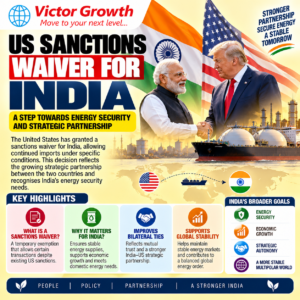
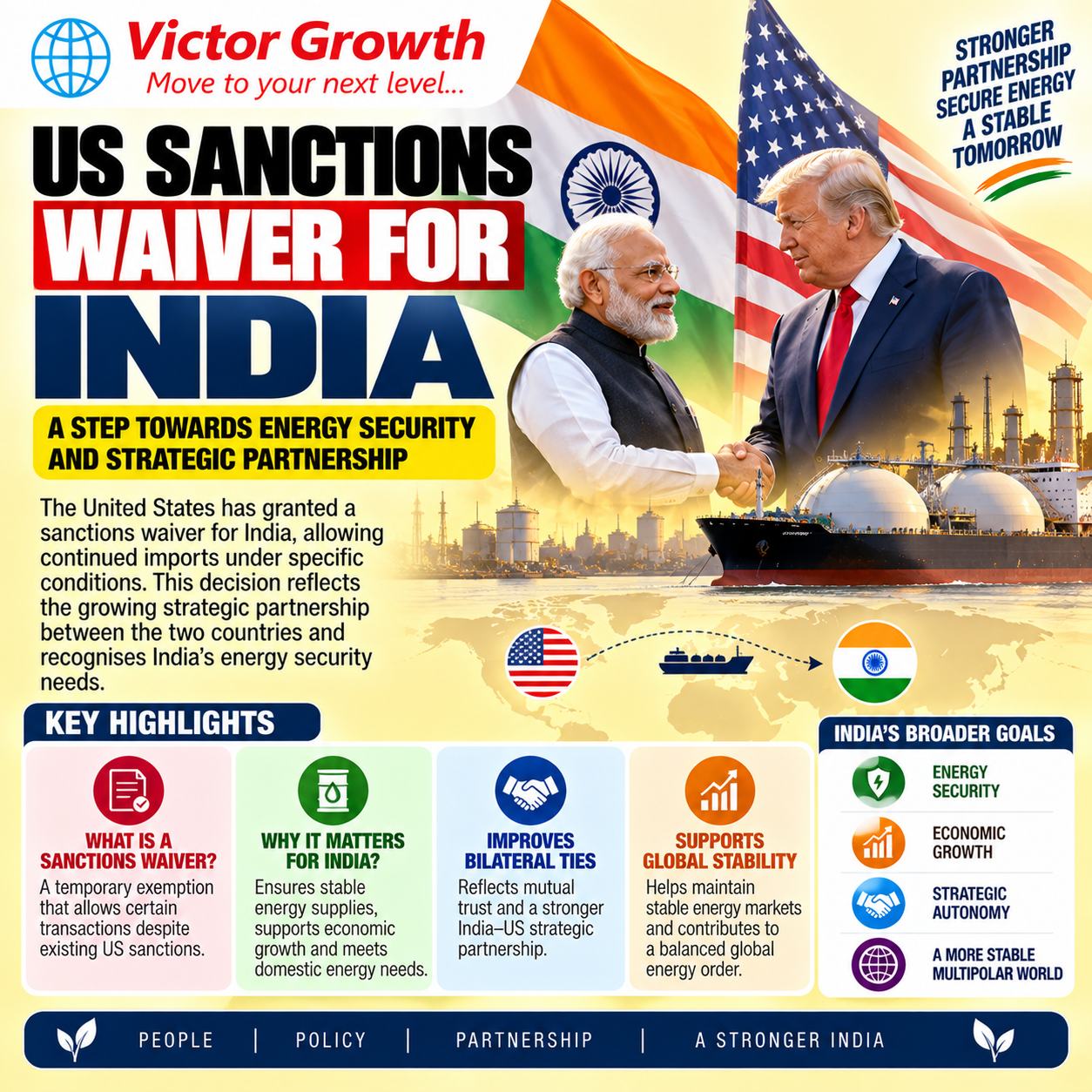
On 16 October 2026, US President Donald Trump issued an executive order waiving key sanctions, restrictions and tariff provisions under the Lindsey O. Graham Sanctioning Russia and Iran Act of 2026. The decision came shortly before the new measures were due to take effect and could provide relief to countries such as India that import Russian oil. The US administration justified the waiver on grounds of national interest. <Cite refs={[“turn425659search0″,”turn425659news24”]}/>
The development is significant for India because of its dependence on imported crude oil and its economic relationship with Russia.
What Is a Sanctions Waiver?
A sanctions waiver is a temporary or conditional exemption from specified restrictions imposed by a government. It may permit certain transactions or activities that would otherwise be restricted under a particular law.
In this case, the US President invoked Section 115 of the Graham Act to waive provisions of the new legislation. This does not mean that all existing US sanctions against Russia have been removed. <Cite refs={[“turn425659search0″,”turn425659news25”]}/>
Why Is the Waiver Important for India?
1. Energy Security
India imports a substantial share of its crude oil requirements. Access to multiple suppliers, including Russia, helps diversify energy sources and reduce the risk of supply disruptions.
2. Inflation Management
Crude oil prices affect transportation, manufacturing and household energy costs. Greater flexibility in oil procurement may help India manage imported inflation, although the actual impact depends on global prices and supply conditions.
3. India–Russia Relations
India and Russia maintain longstanding cooperation in energy, defence and other sectors. India has consistently emphasised that energy procurement decisions must consider national interests, commercial viability and energy security.
4. India–US Relations
The waiver may ease one source of tension in bilateral economic relations. However, trade negotiations, strategic cooperation and differences over Russia will continue to influence the relationship.
5. Strategic Autonomy
The issue highlights India’s effort to maintain independent foreign-policy choices while engaging with multiple major powers and protecting its economic interests.
Challenges and Concerns
Policy uncertainty: Changes in US sanctions and tariff measures can complicate long-term energy planning.
Geopolitical pressure: India must balance relations with the United States, Russia and other partners.
Oil-price volatility: A sanctions waiver does not guarantee lower crude prices or uninterrupted supplies.
Compliance risks: Indian companies must verify which transactions, entities and activities remain subject to existing restrictions.
Way Forward
India should diversify its energy suppliers, strengthen strategic petroleum reserves, expand domestic renewable energy and maintain diplomatic engagement with major partners. Indian companies should also conduct careful legal and financial due diligence before entering transactions involving sanctioned entities.
UPSC Exam Relevance
Prelims: Economic sanctions, sanctions waivers, crude oil imports and strategic petroleum reserves.
Mains GS Paper II: India–US relations, India–Russia relations and strategic autonomy.
Mains GS Paper III: Energy security, inflation and the impact of global developments on the Indian economy.
Possible UPSC Mains Question: “India’s energy security requires balancing commercial interests, strategic autonomy and international geopolitical pressures.” Discuss in the context of US measures concerning Russian oil.
Conclusion
The US sanctions waiver offers potential flexibility for India’s energy trade, but it does not eliminate wider geopolitical and compliance risks. India’s long-term strategy should focus on diversified energy supplies, stronger domestic energy capacity and a balanced foreign policy that safeguards national interests.
SEO Title: US Sanctions Waiver for India: UPSC Current Affairs
Meta Description: Understand the October 2026 US sanctions waiver, its implications for India’s Russian oil imports, energy security, strategic autonomy and UPSC preparation.
URL Slug: us-sanctions-waiver-india-upsc-current-affairs