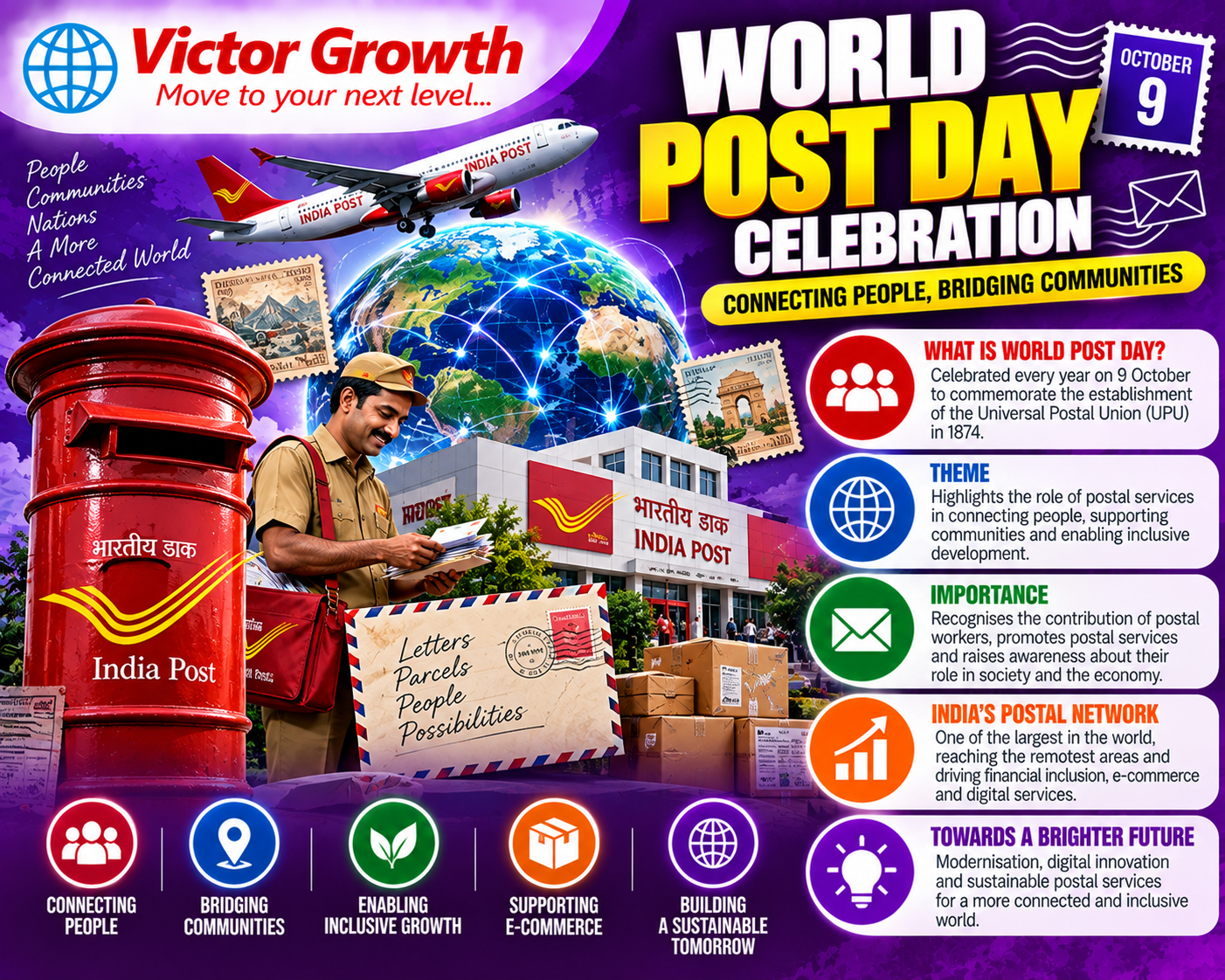
World Post Day is celebrated on 9 October every year to highlight the importance of postal services in communication, economic development and social inclusion.
In 2026, the theme is “World Post Day: One Postal Network, Infinite Possibilities.” India Post is observing National Postal Week from 9 to 15 October 2026, highlighting the modernisation of postal services, financial inclusion, digital empowerment and technology-driven service delivery. <Cite refs={[“turn830961search0″,”turn830961search2”]}/>
History of World Post Day
World Post Day commemorates the establishment of the Universal Postal Union (UPU) on 9 October 1874 in Bern, Switzerland.
The day was declared World Post Day by the UPU Congress held in Tokyo, Japan, in 1969. It is now observed worldwide to recognise the contribution of postal services to communication and development. <Cite refs={[“turn830961search1”]}/>
The UPU is a specialised agency of the United Nations that facilitates international postal cooperation and helps establish common rules for international mail exchange.
Theme of World Post Day 2026
The theme, “One Postal Network, Infinite Possibilities,” highlights how a connected global postal system can support individuals, businesses and communities.
Postal services today extend beyond delivering letters. They support e-commerce, parcel logistics, financial services and access to essential public services. The theme also underlines the continuing importance of human connection in an increasingly digital world. <Cite refs={[“turn830961search3″,”turn830961search2”]}/>
Significance of World Post Day
1. Communication and Connectivity
Postal networks connect remote villages, small towns and urban centres. They remain important for citizens who have limited access to digital communication.
2. Financial Inclusion
Post offices help extend access to savings and other financial services, particularly in rural and underserved areas.
3. Support for E-commerce
Postal and parcel networks help small businesses reach customers across geographical boundaries, supporting trade and entrepreneurship.
4. Digital Transformation
Modern postal services increasingly use digital tracking, online booking, electronic payments and technology-enabled delivery systems to improve efficiency.
5. Employment and Social Inclusion
Postal networks create employment and provide a public-service connection for elderly people, rural communities and citizens who may face barriers to accessing digital services.
India Post: Modernisation and Initiatives
India Post, operating under the Department of Posts, Ministry of Communications, is one of India’s important public-service networks.
During National Postal Week 2026, India Post is highlighting several modernisation initiatives:
N-Gen Post Offices: Modern postal service spaces designed around evolving citizen needs.
Jan Sewa Connect Post Offices: Initiatives aimed at making services more accessible and citizen-centric.
Dak Sewa App: A digital platform that improves access to postal services.
Dak Mitra App: A digital initiative supporting convenient postal and parcel services.
The National Postal Week programme also includes activities focused on financial inclusion, mail and parcels, philately, technology and innovation. <Cite refs={[“turn830961search2″,”turn830961search4”]}/>
Challenges Facing the Postal Sector
Despite technological progress, postal services face several challenges:
Competition from private courier and logistics companies
Declining dependence on traditional letters
Need for digital infrastructure and employee training
Cybersecurity and protection of customer data
Ensuring affordable services in remote areas
Modernising operations while maintaining universal access
A balanced approach combining technology, efficiency and human-centred service delivery is essential.
World Post Day and Sustainable Development
Postal networks can contribute to the United Nations Sustainable Development Goals (SDGs), particularly:
SDG 8: Decent Work and Economic Growth
SDG 9: Industry, Innovation and Infrastructure
SDG 10: Reduced Inequalities
SDG 11: Sustainable Cities and Communities
By connecting underserved regions to markets, information and public services, postal networks can promote inclusive development.
UPSC Relevance
Prelims: Important Facts
World Post Day: 9 October
Universal Postal Union established: 9 October 1874
Place of establishment: Bern, Switzerland
World Post Day declared: 1969, at the UPU Congress in Tokyo
UPU: Specialised agency of the United Nations
India Post: Department of Posts, Ministry of Communications
World Post Day 2026 theme: “One Postal Network, Infinite Possibilities”
Mains – GS Paper II
E-governance and public service delivery
Inclusive governance
Financial inclusion
Role of public institutions in rural development
Mains – GS Paper III
Digital infrastructure
Logistics and e-commerce
Technology and innovation
Employment and inclusive economic growth
Possible UPSC Mains Question
“Postal networks continue to play an important role in inclusive development despite the growth of digital communication. Discuss their relevance in India and suggest measures to modernise postal services.”
Conclusion
World Post Day 2026 highlights the continuing relevance of postal networks in a rapidly changing digital world. For India, modernising India Post can strengthen financial inclusion, improve logistics, support small businesses and make public services more accessible.
The future of postal services lies in combining technology and efficiency with affordability, reliability and human connection.