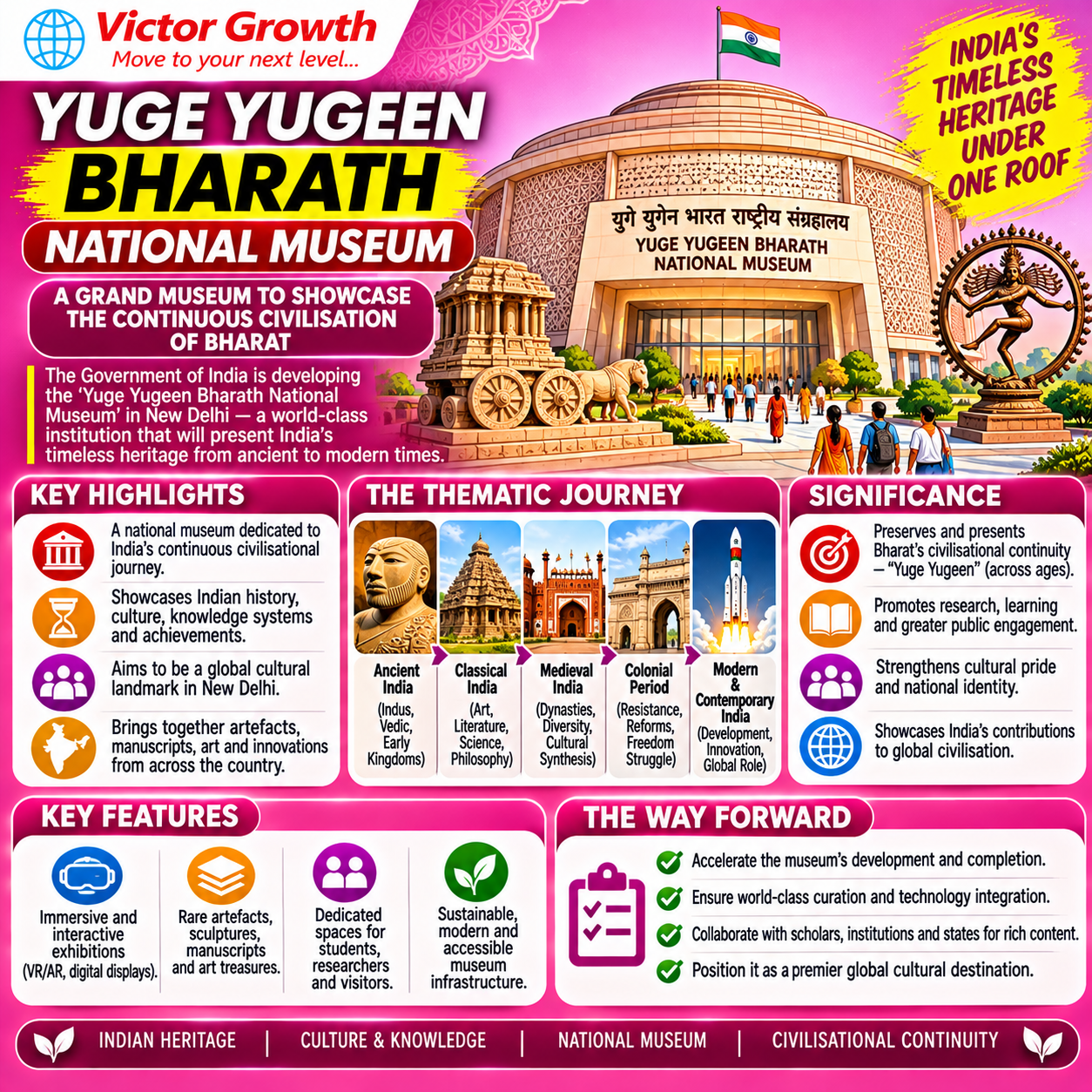
On 11 November 2026, the Cabinet Committee on Economic Affairs (CCEA) approved the development of the Yuge Yugeen Bharat Museum (YYBM) at the historic North and South Block complex in New Delhi.
With an estimated investment of ₹3,230 crore, the project aims to create one of the world’s largest museum display spaces and showcase India’s civilisational journey through its history, cultural traditions, knowledge systems and artistic heritage.
The project is expected to be completed by 2030–31, with the first gallery, themed ‘Adornment’, expected to open to the public in the later part of 2027. <Cite refs={[“turn414194search0″,”turn414194search2”]}/>
What Is the Yuge Yugeen Bharat Museum?
The Yuge Yugeen Bharat Museum, meaning ‘India through the Ages’, is a major national cultural institution being developed under the Ministry of Culture.
The project was first announced by the Prime Minister on 18 May 2023, during the inauguration of the International Museum Expo in New Delhi.
Its primary objective is to present India’s civilisational continuity, diversity and contributions to the world through an integrated presentation of tangible and intangible cultural heritage.
Key Features of the Project
Location: Historic North and South Block complex, New Delhi.
Estimated cost: ₹3,230 crore.
Proposed built-up area: Approximately 1,78,509 square metres.
Implementation period: FY 2026–27 to FY 2030–31.
Collection: Around 1.8 million objects have been identified from national and state museums, ASI site museums and private collections.
Visitor capacity: Designed to accommodate approximately one crore visitors annually.
First gallery: ‘Adornment’, expected to open in the later part of 2027.
The museum is expected to have the world’s largest display area, according to the government. <Cite refs={[“turn414194search0″,”turn414194search3”]}/>
Major Themes and Galleries
The museum will present India’s civilisational journey through thematic galleries, exhibitions and immersive experiences.
Important themes include:
Adornment: Evolution of jewellery, clothing, ornaments and aesthetic traditions in India.
Architecture and Cityscapes: India’s architectural heritage, urban settlements and historic cities.
Mathematics and Astronomy: Contributions of Indian scholars to mathematics, astronomy and scientific knowledge.
Languages and Scripts: Development of Indian languages, literary traditions and writing systems.
Faith and Spirituality: India’s diverse religious and philosophical traditions.
Bharat Connects – Trade and Ideas: India’s historical connections with other regions through trade, knowledge and cultural exchange.
The museum will also incorporate modern exhibition technologies, conservation facilities and visitor-friendly infrastructure. <Cite refs={[“turn414194search0″,”turn414194search2”]}/>
Adaptive Reuse of North and South Block
One of the most significant aspects of the project is the adaptive reuse of heritage buildings.
The North and South Blocks, located in the Central Vista area of New Delhi, historically housed important ministries of the Government of India.
Following the relocation of government offices, these iconic buildings are being repurposed as a public cultural institution.
Adaptive reuse involves giving an existing building a new function while preserving its architectural and heritage value.
This approach can:
Preserve historic architecture.
Reduce the need for new construction.
Give heritage buildings a meaningful public purpose.
Promote sustainable urban development.
Significance of the Yuge Yugeen Bharat Museum
1. Preservation of Cultural Heritage
The museum will provide a platform for preserving and showcasing India’s archaeological objects, manuscripts, sculptures, paintings, crafts and traditional knowledge.
2. Promoting India’s Soft Power
By presenting India’s cultural and intellectual contributions to international visitors, the museum can strengthen India’s cultural diplomacy and global image.
3. Education and Research
It will support academic research, historical studies, conservation science and public learning.
4. Cultural Tourism
The museum is expected to become a major national and international tourist destination, contributing to employment and the local economy.
5. Recognition of India’s Knowledge Systems
Dedicated galleries on mathematics, astronomy, architecture and languages can highlight India’s contributions to global knowledge traditions.
Challenges and Concerns
Despite its potential, the project faces important challenges:
Historical representation: The museum must present India’s diverse history through balanced, evidence-based interpretation.
Conservation: Valuable artefacts require specialised storage, restoration and climate-controlled display facilities.
Authenticity: Historical narratives should be supported by archaeological, literary and scientific evidence.
Accessibility: The museum should be inclusive and accessible to people from different social, linguistic and physical backgrounds.
Financial sustainability: Long-term maintenance and operational costs require careful planning.
Coordination: Bringing collections from different museums and private institutions requires strong documentation, conservation and institutional cooperation.
Way Forward
The museum should follow international standards of conservation, research and exhibition management. It must encourage collaboration among historians, archaeologists, scientists, universities and cultural institutions.
Digital archives, multilingual interpretation, accessible facilities and transparent curatorial practices can make the institution more inclusive.
Most importantly, the museum should represent India’s civilisational history in its full diversity, reflecting different regions, communities, languages, faiths and historical periods.
UPSC Examination Relevance
Prelims
Yuge Yugeen Bharat Museum and its location.
Ministry of Culture.
North and South Block and Central Vista.
Adaptive reuse of heritage buildings.
Tangible and intangible cultural heritage.
Mains – GS Paper I
Indian culture and heritage.
Art, architecture and historical traditions.
Preservation of cultural heritage.
Mains – GS Paper II
Government initiatives for heritage conservation.
Cultural diplomacy and India’s soft power.
Role of institutions in promoting education and research.
Mains – GS Paper III
Sustainable infrastructure and adaptive reuse.
Tourism as a driver of economic development.
Possible UPSC Mains Question:
“The Yuge Yugeen Bharat Museum represents an important initiative to preserve and showcase India’s civilisational heritage. Examine its significance for cultural preservation, tourism and India’s soft power.”
Conclusion
The Yuge Yugeen Bharat Museum is an ambitious initiative to bring India’s rich and diverse civilisational heritage under one institutional platform. By combining heritage conservation, modern museum technology, education and cultural diplomacy, it has the potential to become an important national institution. Its success will depend on historical accuracy, inclusive representation, professional conservation and long-term public engagement.