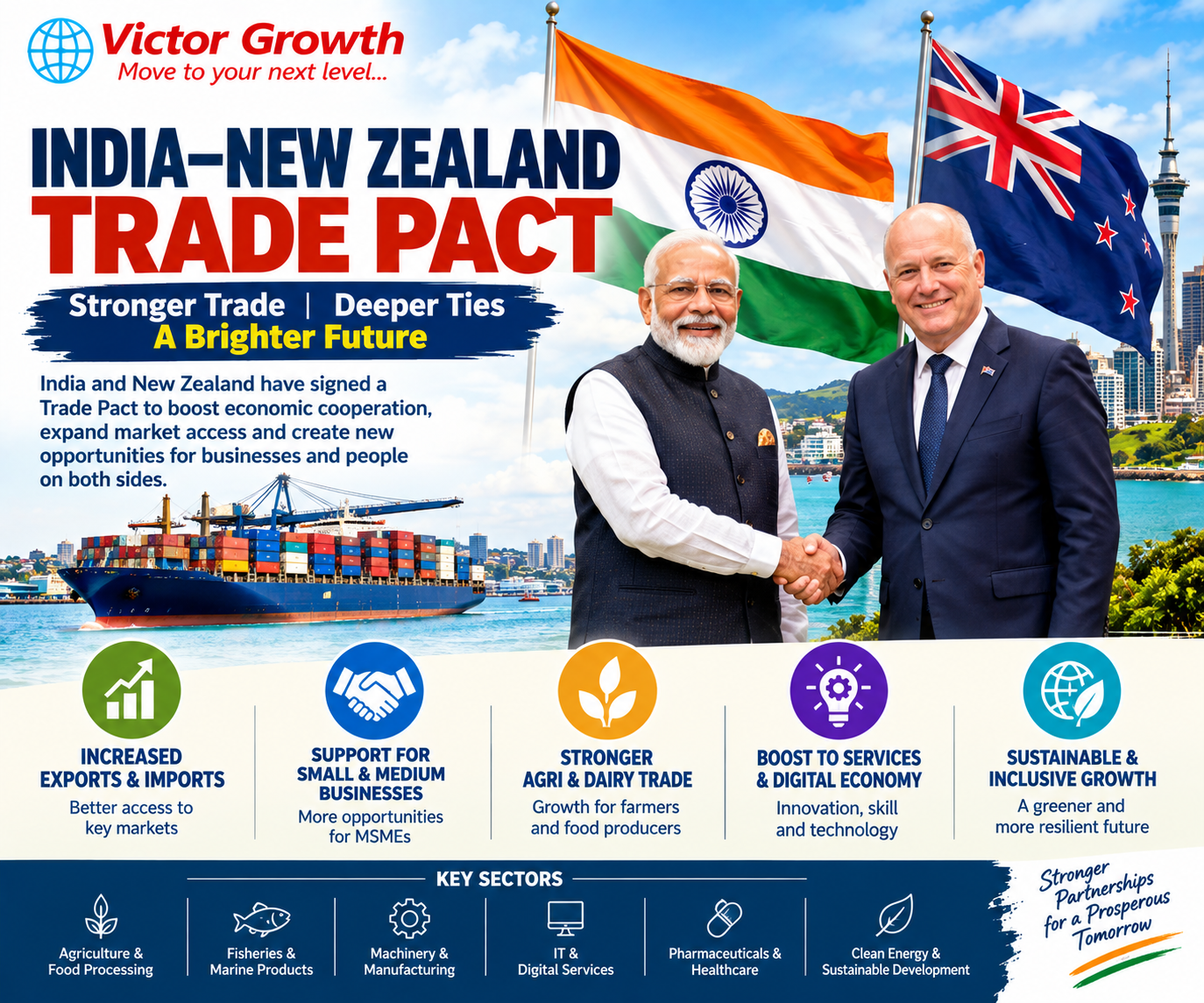
The India–New Zealand Free Trade Agreement (FTA) marks an important development in India’s trade engagement with the Indo-Pacific and developed economies. The agreement was signed on 27 April 2026 after negotiations concluded in December 2025. Following ratification by both countries, it is scheduled to enter into force on 20 October 2026.
For UPSC aspirants, the pact is important for understanding India’s trade policy, FTAs, Indo-Pacific strategy, services trade, investment, agriculture and economic diplomacy.
What is the India–New Zealand FTA?
A Free Trade Agreement is a treaty between countries that reduces or eliminates trade barriers, particularly tariffs, and establishes rules governing trade and economic relations.
India and New Zealand launched negotiations in March 2025. Five formal rounds were held before negotiations were substantively concluded on 22 December 2025.
The agreement covers:
- Trade in goods
- Trade in services
- Investment
- Rules of origin
- Customs and trade facilitation
- Intellectual property
- MSMEs
- Trade and sustainable development
- Economic cooperation
- Traditional knowledge and related areas
Key Features of the Trade Pact
1. Duty-Free Access for Indian Exports
New Zealand will provide zero-duty access for 100% of Indian tariff lines from the agreement’s entry into force.
Important Indian sectors expected to benefit include:
- Textiles and apparel
- Leather and footwear
- Gems and jewellery
- Engineering goods
- Processed foods
- Pharmaceuticals
- Agricultural products
The agreement is particularly significant for labour-intensive sectors and MSMEs.
2. India Protects Sensitive Sectors
India has not provided unrestricted market access across all sectors.
India offered tariff liberalisation on around 70% of tariff lines, covering approximately 95% of bilateral trade, while excluding sensitive sectors such as dairy and several agricultural products.
This reflects India’s effort to balance export opportunities with domestic producer interests.
3. Investment
New Zealand has committed to facilitate USD 20 billion of investment into India over 15 years.
Potential areas include:
- Agriculture
- Manufacturing
- Infrastructure
- Start-ups
- Other productive sectors
This could complement India’s objectives of attracting foreign investment and strengthening domestic production capacity.
4. Services and Mobility
The agreement also expands opportunities in services and professional mobility.
It covers areas such as:
- IT and professional services
- Construction
- Tourism
- Education
- Health-related services
- Traditional medicine
The pact provides mobility pathways including a dedicated quota of 5,000 Temporary Employment Entry visas for skilled Indians and 1,000 Working Holiday visas annually. It also provides post-study work opportunities for eligible STEM graduates and doctoral scholars.
Why is the FTA Important for India?
Export Diversification
The agreement gives Indian businesses greater access to the New Zealand market and can help diversify India’s export destinations.
Employment Generation
Greater exports from textiles, leather, food processing and other labour-intensive sectors can support employment and MSMEs.
Indo-Pacific Economic Engagement
New Zealand is an important country in the Indo-Pacific, and stronger economic ties complement India’s wider regional engagement.
Supply Chains
Access to inputs such as wooden logs, coking coal and metal scrap can support Indian manufacturing competitiveness.
India–New Zealand Trade: Strategic Context
The FTA is part of a broader strengthening of bilateral relations.
In July 2026, India and New Zealand established a Strategic Partnership and adopted a Roadmap to 2030. The two countries set an aspirational goal of doubling bilateral two-way trade in goods and services to NZ$7 billion by 2030.
The partnership also covers:
- Defence and maritime security
- Education
- Science and technology
- Disaster management
- Agriculture
- Climate cooperation
- People-to-people relations
- Regional and multilateral cooperation
Challenges
Despite the opportunities, implementation will require attention to:
- Non-tariff barriers
- Standards and certification
- Rules of origin
- Logistics and distance
- Competition in agricultural markets
- Ensuring MSMEs can effectively utilise the agreement
- Converting tariff preferences into actual export growth
An FTA provides market access, but business competitiveness, quality standards, logistics and productivity ultimately determine how effectively exporters use that access.
UPSC Relevance
Prelims
Remember:
- India–New Zealand FTA signed: 27 April 2026
- Negotiations concluded: 22 December 2025
- Entry into force: 20 October 2026
- Indian exports receiving zero-duty access: 100% of tariff lines
- India’s tariff liberalisation: Around 70% of tariff lines
- Investment commitment: USD 20 billion
- Sensitive sectors protected: Dairy and several agricultural products
GS Paper II – International Relations
The topic can be linked to:
- India–New Zealand relations
- Indo-Pacific
- Economic diplomacy
- Strategic partnerships
- Regional cooperation
GS Paper III – Indian Economy
Important themes include:
- Free Trade Agreements
- Export promotion
- Foreign investment
- MSMEs
- Trade diversification
- Services exports
- Global value chains
Possible UPSC Mains Question
“The India–New Zealand Free Trade Agreement reflects India’s growing engagement with developed economies in the Indo-Pacific. Examine its potential benefits and challenges for the Indian economy.”
Conclusion
The India–New Zealand FTA represents a broader shift towards deeper economic partnerships between India and developed economies. Its significance extends beyond tariff reduction to investment, services, skilled mobility, MSMEs and supply-chain cooperation.
For UPSC aspirants, the agreement should be studied as a case study of how trade policy, economic diplomacy and India’s Indo-Pacific strategy intersect.