
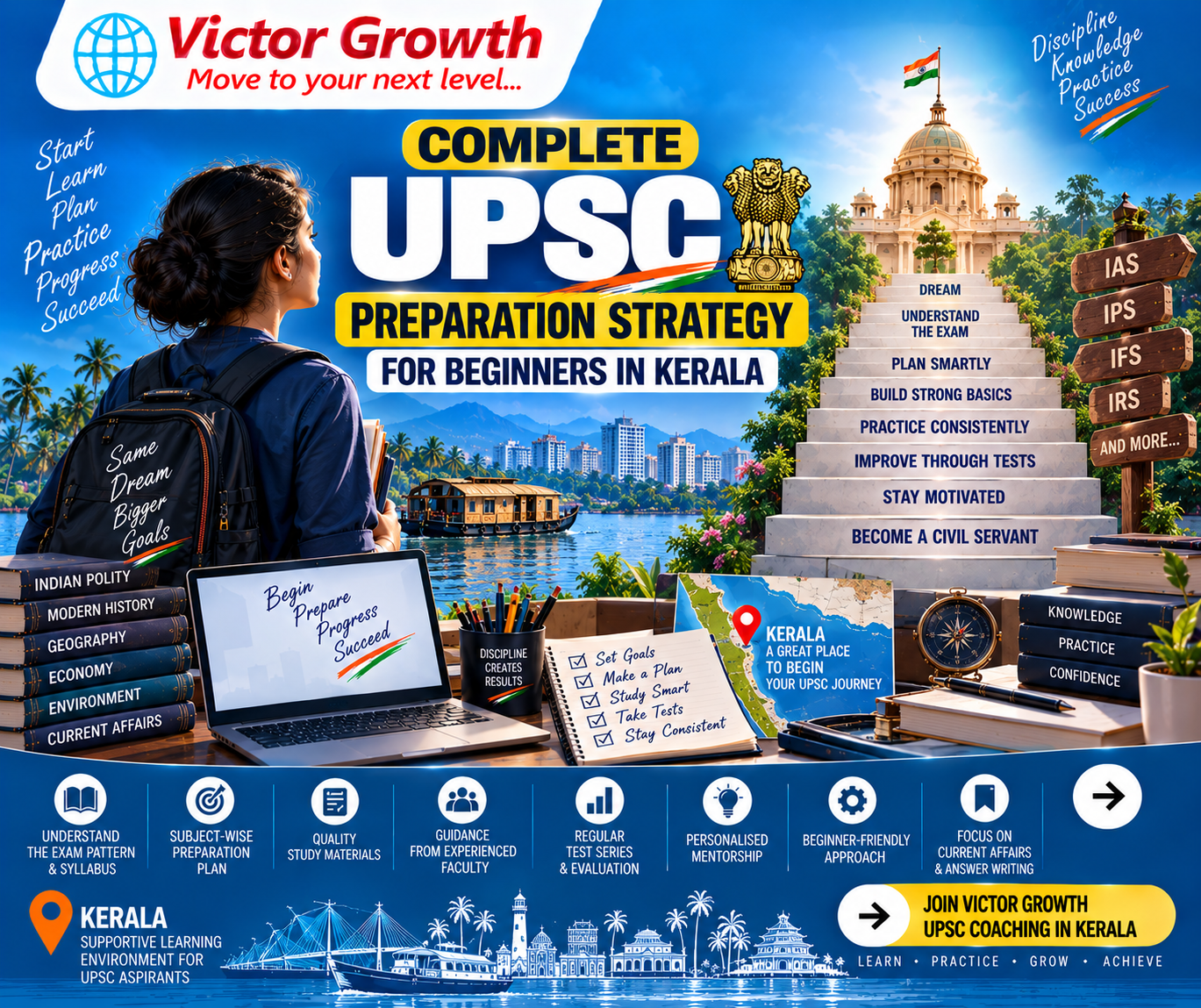
Starting UPSC Civil Services preparation can feel challenging because of the extensive syllabus and the different stages of the examination. Beginners need a clear plan that covers Prelims, Mains, current affairs, answer writing, revision and mock tests.
For aspirants in Kerala searching for the best IAS coaching in Kerala, structured guidance can help simplify the preparation process and create a consistent study routine.
1. Understand the UPSC Examination
Before beginning preparation, understand the broad structure of the Civil Services Examination.
The process includes:
- Preliminary Examination
- Main Examination
- Personality Test
Each stage requires a different preparation approach. Beginners should understand the syllabus and examination requirements before collecting study materials.
2. Start with the UPSC Syllabus
The UPSC syllabus should become your preparation checklist. Divide it into manageable subjects such as:
- History
- Geography
- Indian Polity
- Economy
- Environment
- Science and Technology
- Current Affairs
- Ethics
- Essay
- Optional Subject
Understanding the syllabus prevents unnecessary reading and helps you focus on relevant areas.
3. Build Strong Basic Concepts
Beginners should first focus on developing conceptual clarity. Start with basic-level resources before moving towards advanced material.
Avoid collecting too many books and study sources. Choose limited, reliable resources and revise them multiple times.
4. Develop a Current Affairs Routine
Current affairs are an important part of UPSC preparation. Follow important national and international developments consistently.
Instead of simply memorising news, try to understand:
- What happened?
- Why is it important?
- What are its implications?
- How does it relate to the UPSC syllabus?
Maintaining concise revision notes can make later revision easier.
5. Prepare for Prelims
Prelims preparation requires both knowledge and question-solving practice.
Focus on:
- Conceptual understanding
- Multiple-choice questions
- Previous year questions
- Revision
- Mock tests
- Elimination techniques
- Time management
Begin practising MCQs after developing sufficient understanding of the relevant topics.
6. Start Mains Preparation Early
Beginners should not wait until after Prelims to think about Mains. Gradually develop answer-writing skills during preparation.
Practise:
- Introduction
- Body
- Conclusion
- Use of examples
- Relevant facts and data
- Balanced arguments
- Diagrams or flowcharts where appropriate
Start with one or two answers and gradually increase the frequency.
7. Choose an Optional Subject Carefully
The optional subject plays an important role in the Mains examination. Consider your academic background, interest, availability of study material and comfort with the subject.
Do not select an optional subject solely because someone else recommends it.
8. Create a Realistic Study Schedule
Beginners should avoid creating unrealistic timetables with excessive study hours.
A practical daily routine can include:
Concept Study → Current Affairs → MCQ Practice → Answer Writing → Revision
The exact number of hours should depend on your academic or work commitments and your individual preparation level.
9. Use Mock Tests and Previous Year Questions
Previous year questions help you understand the nature of the examination. Mock tests provide additional practice and help identify weak areas.
After every test, analyse:
- Incorrect answers
- Topics that require revision
- Time-management problems
- Repeated mistakes
Test analysis is often more useful than simply checking the score.
10. Consider UPSC Coaching in Kerala
Structured UPSC coaching in Kerala can help beginners understand the syllabus, follow a study plan and receive guidance from experienced faculty.
A good programme should ideally provide:
- Complete syllabus coverage
- Study materials
- Current-affairs support
- Prelims test series
- Mains answer-writing practice
- Essay guidance
- Ethics preparation
- Mentoring
- Doubt-clearing sessions
- Regular performance analysis
When searching for the best IAS coaching in Kerala, compare these features instead of choosing an institute based only on advertisements or fees.
Common Mistakes Beginners Should Avoid
- Starting preparation without reading the syllabus
- Collecting too many books
- Ignoring revision
- Delaying answer writing
- Neglecting current affairs
- Avoiding mock tests
- Changing study plans frequently
- Trying to complete everything at once
A consistent and focused approach is more useful than constantly changing preparation strategies.
A Simple UPSC Roadmap for Beginners
Month 1–3: Understand the syllabus and build basic concepts.
Month 4–6: Complete major subjects and begin regular MCQ practice.
Month 7–9: Increase revision, previous year questions and mock tests while continuing Mains preparation.
Final Preparation Phase: Focus on revision, test practice, weak areas and examination-specific strategy.
The exact timeline can be adjusted according to the candidate’s starting level and examination schedule.
Final Thoughts
A successful UPSC preparation strategy begins with understanding the examination and building a strong foundation. Follow the syllabus, use limited study sources, maintain current-affairs notes, practise MCQs and answer writing, and revise consistently.
For beginners looking for the best IAS coaching in Kerala, choose a programme that complements your self-study with structured teaching, testing, mentoring and regular feedback. Ultimately, consistency and disciplined preparation remain essential.
Frequently Asked Questions
1. How should a beginner start UPSC preparation in Kerala?
Start by understanding the UPSC syllabus and examination pattern. Then build basic concepts, follow current affairs and gradually introduce MCQ and answer-writing practice.
2. Is UPSC coaching necessary for beginners?
Coaching is not compulsory, but structured guidance can help beginners understand the syllabus, select resources, follow a study plan and receive regular feedback.
3. How many hours should a beginner study for UPSC?
There is no fixed number of hours suitable for everyone. Focus on consistent and productive study according to your schedule and preparation level.
4. When should I start Mains answer writing?
It is useful to begin answer-writing practice after developing basic conceptual understanding rather than waiting until the end of the preparation cycle.
5. How important are current affairs for UPSC?
Current affairs are an important component of UPSC preparation and should be studied consistently and connected with the static syllabus.
6. How do I choose the best IAS coaching in Kerala?
Compare faculty, syllabus coverage, study materials, current-affairs support, Prelims test series, Mains answer-writing practice, mentoring and performance analysis before choosing.