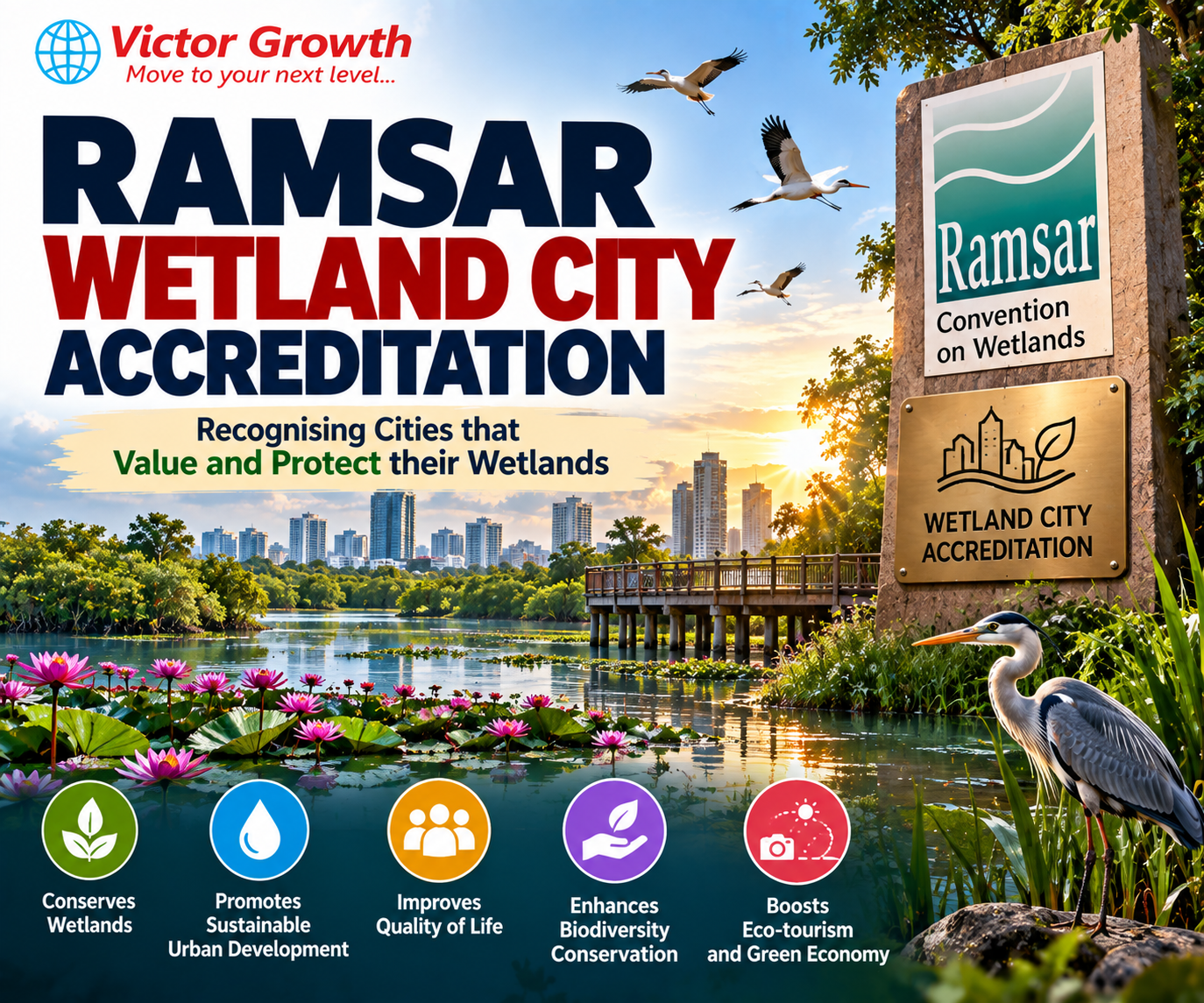
Wetlands are among the world’s most valuable ecosystems, supporting biodiversity, water security, flood regulation and livelihoods. With rapid urbanisation increasing pressure on wetlands, the Ramsar Convention on Wetlands introduced the Wetland City Accreditation (WCA) scheme to encourage cities to conserve and wisely use their urban and peri-urban wetlands.
For UPSC aspirants, the topic connects Environment, Biodiversity, Ramsar Convention, Urbanisation, Climate Change and Sustainable Development.
What is Ramsar Wetland City Accreditation?
The Wetland City Accreditation is a voluntary international recognition scheme under the Convention on Wetlands.
It was established through Resolution XII.10 at Ramsar COP12 in 2015 and subsequently updated through Resolution XIV.10 at COP14 in 2022.
The objective is to encourage cities that are closely associated with wetlands to:
- Conserve and restore wetlands
- Promote their wise use
- Integrate wetlands into urban planning
- Increase public awareness and participation
- Generate sustainable socio-economic benefits for local communities
- Improve urban resilience to environmental risks
Importantly, the accreditation can cover cities associated with Ramsar Sites as well as other important wetlands.
Why are Wetland Cities Important?
Urban wetlands provide several ecosystem services:
Flood Regulation
Wetlands can absorb and store excess water, helping reduce urban flooding.
Water Purification
Wetland ecosystems can trap sediments and pollutants and contribute to water-quality regulation.
Biodiversity Conservation
They provide habitat for birds, fish, amphibians, plants and other organisms.
Climate Resilience
Healthy wetlands can contribute to climate adaptation and strengthen the resilience of cities.
Livelihoods and Recreation
Wetlands support fisheries, tourism, recreation and other livelihood opportunities.
Thus, protecting wetlands is not simply an environmental issue—it is also an urban planning and sustainable development issue.
Criteria for Accreditation
A city seeking accreditation must demonstrate a sustained commitment to wetland conservation and wise use.
The assessment includes factors such as:
- Presence of wetlands within or around the city
- Importance of those wetlands for ecological and socio-economic functions
- Integration of wetland conservation into urban planning
- Existence of appropriate institutional arrangements
- Measures for conservation, restoration and sustainable management
- Public awareness and participation
- Management of threats such as pollution and encroachment
The detailed criteria are provided under the Ramsar Convention’s operational guidance.
India’s Ramsar Wetland Cities
India received its first Wetland City Accreditations when Indore and Udaipur were recognised under the Ramsar Convention.
They were among the 31 cities announced as newly accredited in January 2025 and formally recognised at Ramsar COP15.
1. Indore – Madhya Pradesh
Indore’s accreditation is associated with its efforts to conserve and manage urban wetlands, particularly the Sirpur Wetland, an important habitat for waterbirds.
2. Udaipur – Rajasthan
Udaipur is closely associated with a network of lakes and wetlands that are important for biodiversity, water management, tourism and the city’s ecological character.
India had earlier submitted applications for Indore, Bhopal and Udaipur, but Indore and Udaipur were the cities accredited in the first round.
Ramsar Site vs Ramsar Wetland City
This is an important distinction for UPSC Prelims.
| Ramsar Site | Wetland City Accreditation |
|---|---|
| Applies to a wetland | Applies to a city |
| Recognises wetlands of international importance | Recognises cities demonstrating commitment to wetland conservation |
| Primarily ecosystem/site focused | Urban planning and city-wetland relationship focused |
| Designation under the Ramsar Convention | Voluntary accreditation under the Convention |
Remember: A Wetland City is not itself a Ramsar Site.
How is the Accreditation Different from Ramsar Designation?
Ramsar designation primarily identifies and promotes the conservation and wise use of Wetlands of International Importance.
Wetland City Accreditation takes the concept into the urban environment, encouraging municipalities to incorporate wetlands into planning and governance.
This makes WCA particularly relevant in the context of:
Urbanisation → Wetland degradation → Flooding & biodiversity loss → Ecosystem-based urban planning
Latest Development: 2026–2028 Accreditation Cycle
The Ramsar Convention issued a 2026 call for applications for the next Wetland City Accreditation cycle.
Cities that meet the criteria can submit applications through their country’s Administrative Authority or National Focal Point. Applications for the 2026–2028 cycle are to be forwarded to the Ramsar Secretariat by 31 December 2026.
The accreditation normally remains valid for two COP cycles, or approximately six years under ordinary circumstances, after which renewal is required.
UPSC Relevance
Prelims
Remember these facts:
- Wetland City Accreditation → Ramsar Convention
- Introduced → COP12, 2015
- Updated → COP14, 2022
- India’s first accredited cities → Indore and Udaipur
- Ramsar COP15 → Victoria Falls, Zimbabwe, 2025
- WCA → Voluntary accreditation
- Ramsar Site ≠ Wetland City
GS Paper I – Geography
- Wetlands
- Urbanisation
- Ecosystem services
- Flood management
- Human-environment interaction
GS Paper III – Environment
- Ramsar Convention
- Biodiversity conservation
- Wetland degradation
- Climate adaptation
- Ecosystem-based management
- Sustainable urban development
Possible UPSC Mains Question
“Urban wetlands provide critical ecological services but face increasing pressure from rapid urbanisation. Discuss the significance of Ramsar Wetland City Accreditation in promoting sustainable urban development.”
Way Forward
Indian cities can strengthen wetland conservation through:
- Integrating wetlands into master plans
- Preventing encroachment and pollution
- Creating effective wetland management authorities
- Restoring degraded urban wetlands
- Promoting citizen participation
- Using wetlands as part of urban flood-management strategies
- Strengthening scientific monitoring and ecological inventories
Conclusion
The Ramsar Wetland City Accreditation represents a shift from viewing wetlands as isolated ecosystems to recognising them as an integral part of sustainable and resilient cities.
India’s accreditation of Indore and Udaipur provides an important example of integrating wetland conservation with urban development. As Indian cities expand, protecting urban wetlands can simultaneously support biodiversity, flood resilience, water security and quality of life.
For UPSC aspirants, the topic should be studied through the combined lens of Ramsar Convention + Wetland Conservation + Urbanisation + Climate Resilience + Sustainable Development.