The India–EFTA Trade and Economic Partnership Agreement (TEPA) is an important milestone in India’s engagement with European economies. More than a conventional trade agreement, TEPA links trade, investment, employment, sustainable development and closer economic cooperation.
For UPSC aspirants, the agreement is important for understanding India’s trade policy, FTAs, European relations, investment, sustainable development and the role of economic interdependence in promoting peace.
What is EFTA?
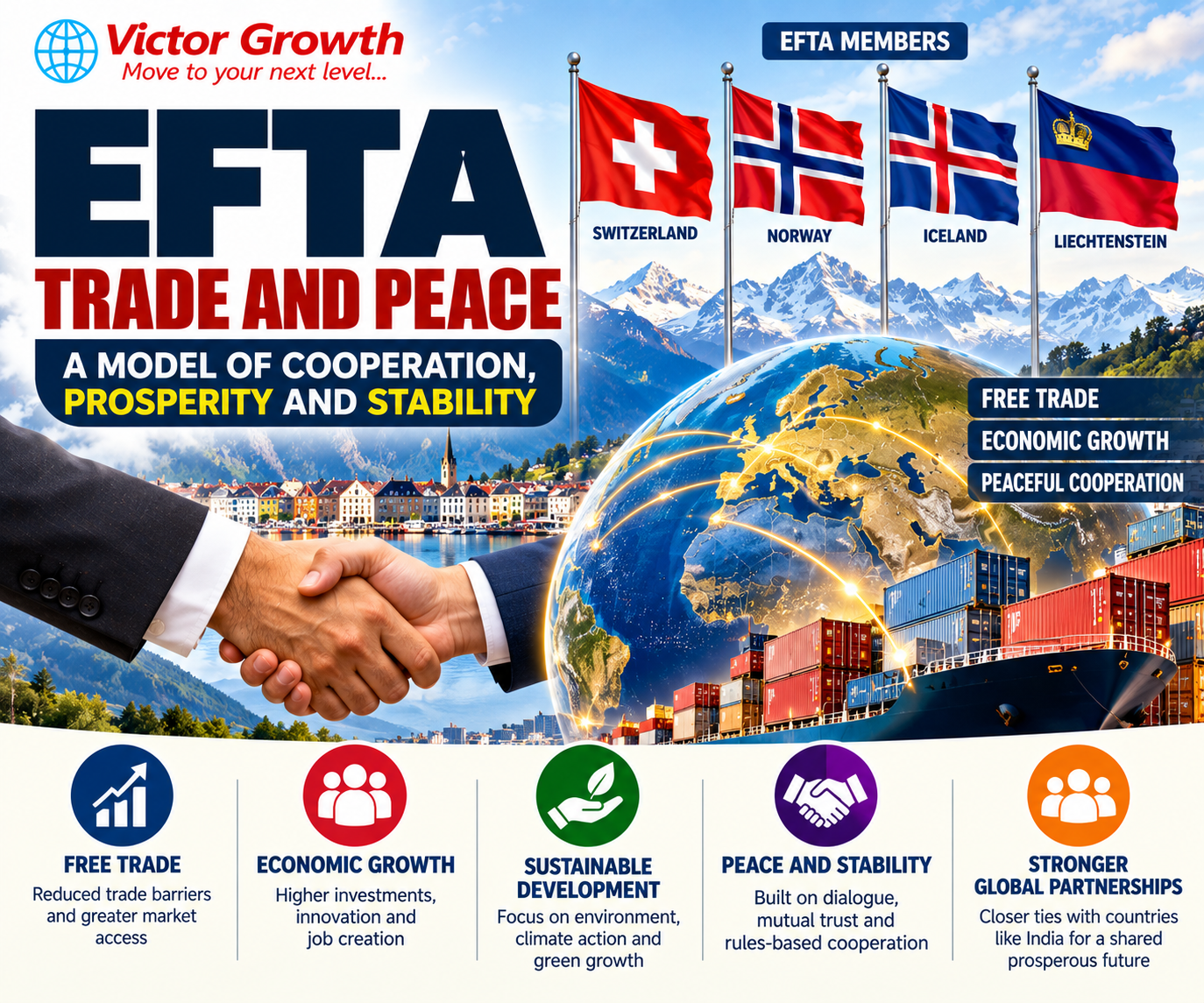
The European Free Trade Association (EFTA) is an intergovernmental organisation comprising four countries:
- Iceland
- Liechtenstein
- Norway
- Switzerland
EFTA was established in 1960 to promote free trade and economic integration among its members. It is different from the European Union (EU).
India–EFTA Trade and Economic Partnership Agreement
India and EFTA signed TEPA on 10 March 2024 in New Delhi after negotiations that began in 2008 and involved 21 rounds. The agreement entered into force on 1 October 2025.
TEPA covers:
- Trade in goods
- Trade in services
- Investment promotion
- Intellectual property rights
- Trade facilitation
- Government procurement
- Competition
- Trade and sustainable development
- Dispute settlement
Thus, TEPA goes considerably beyond simple tariff reduction.
The $100 Billion Investment Commitment
One of the most significant features of TEPA is EFTA’s commitment to promote investment of US$100 billion in India over 15 years, with an objective of supporting one million direct jobs.
This is particularly significant because it links trade liberalisation with investment and employment generation. The Indian government has described this as the first FTA signed by India in which such a foreign-investment commitment was secured.
Potential areas include:
- Manufacturing
- Renewable energy
- Pharmaceuticals
- Engineering
- Healthcare
- Food processing
- Financial services
- Maritime industries
- Technology and innovation
How Can Trade Contribute to Peace?
The phrase “trade and peace” reflects the broader idea of economic interdependence.
When countries become more economically interconnected through trade, investment and supply chains, they develop additional incentives to maintain stable relations and resolve disputes through dialogue.
TEPA’s preamble itself emphasises the development of close and lasting relations, mutually beneficial economic cooperation and sustainable development.
However, economic interdependence does not automatically eliminate geopolitical conflicts. Its contribution to peace is better understood as creating additional channels for cooperation and dialogue.
Sustainable Development and Trade
TEPA contains a dedicated Trade and Sustainable Development component.
It connects trade with:
- Environmental protection
- Labour standards
- Climate action
- Biodiversity
- Sustainable agriculture
- Sustainable fisheries
- Responsible business conduct
This reflects the growing trend of incorporating ESG and sustainability considerations into international trade agreements.
Why is TEPA Important for India?
1. Investment
EFTA countries possess significant financial and technological capabilities. Greater investment can contribute to India’s manufacturing and infrastructure ambitions.
2. Employment
Investment-linked job creation can support India’s objective of generating productive employment.
3. Technology and Skills
Greater economic engagement can facilitate technology transfer, innovation and access to specialised skills.
4. Export Opportunities
Improved market access can benefit Indian exporters, particularly in manufacturing and services.
5. Supply-Chain Resilience
Closer economic relationships can help diversify India’s international supply chains and strengthen economic resilience. EFTA and India have highlighted resilient and better-integrated supply chains as an objective of TEPA.
Challenges
The agreement also presents challenges:
- Indian companies must meet high European quality and sustainability standards.
- Domestic industries may face greater competition.
- Investment commitments need effective implementation.
- Rules of origin and regulatory requirements can affect utilisation of trade preferences.
- The benefits of an FTA depend on India’s ability to improve logistics, productivity and export competitiveness.
Therefore, signing an FTA is only the beginning; effective utilisation determines its economic impact.
UPSC Relevance
Prelims
Remember:
EFTA members → Iceland, Liechtenstein, Norway, Switzerland
India–EFTA TEPA signed → 10 March 2024
TEPA entered into force → 1 October 2025
Investment objective → US$100 billion over 15 years
Employment objective → 1 million direct jobs
GS Paper II – International Relations
- India–Europe relations
- Economic diplomacy
- Multilateralism
- Strategic partnerships
- Trade as an instrument of international cooperation
GS Paper III – Economy
- Free Trade Agreements
- FDI
- Employment generation
- Manufacturing
- Global value chains
- Sustainable development
- Trade liberalisation
Possible UPSC Mains Question
“Economic interdependence can create additional incentives for peaceful and stable international relations. Discuss with reference to the India–EFTA Trade and Economic Partnership Agreement.”
Conclusion
The India–EFTA TEPA demonstrates how modern trade agreements increasingly extend beyond tariffs to include investment, employment, services, sustainability and institutional cooperation.
For India, the agreement offers opportunities to attract investment, strengthen manufacturing and integrate more deeply with European markets. At a broader level, sustained economic engagement can create institutionalised channels of cooperation and dialogue, contributing to a more stable international environment.
For UPSC preparation, TEPA should therefore be studied through the interconnected themes of Trade + Investment + Employment + Sustainable Development + International Relations + Peace.