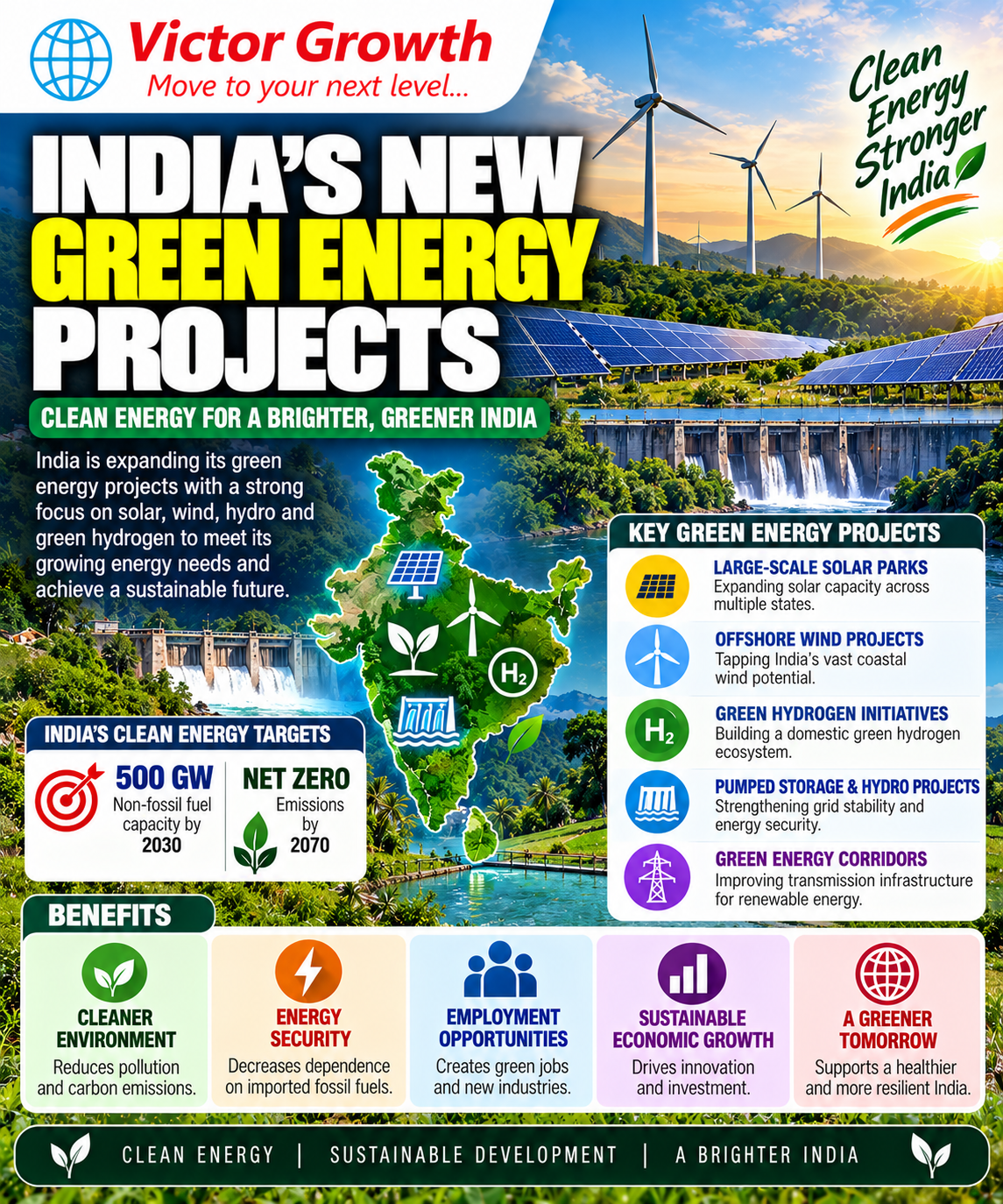
India is rapidly expanding its renewable-energy infrastructure to meet rising electricity demand, improve energy security and achieve its climate commitments.
As of 31 July 2026, India had crossed 300 GW of installed non-fossil electricity capacity, with solar, wind, hydro, bio-power and nuclear energy together accounting for more than 54% of total installed generation capacity.
Several major green-energy initiatives launched or expanded in 2026 are particularly important for UPSC preparation.
Major New Green Energy Initiatives
1. Green Energy Corridor – Phase III
The Union Cabinet approved Green Energy Corridor Phase III (GEC-III) in 2026.
Key features include:
Renewable-energy evacuation capacity of up to 135 GW
50 GWh Battery Energy Storage Systems (BESS)
Total outlay of about ₹1.86 lakh crore
Central Financial Support of ₹54,082 crore
Target completion by FY 2032-33
The project aims to strengthen intra-state transmission networks and address renewable-energy intermittency, congestion and peak-hour demand.
2. Pradhan Mantri Surya Sarovar Yojana
The government approved the Pradhan Mantri Surya Sarovar Yojana (PM-SSY) for large-scale floating solar photovoltaic projects.
The scheme provides for:
5,000 MW of floating solar projects
Co-located energy storage systems
At least 10,000 MWh of storage capacity
Total outlay of ₹5,070 crore
Implementation during FY 2026-27 to FY 2030-31
Floating solar can reduce land requirements while making use of reservoirs and other suitable water bodies.
3. Expansion of Green Hydrogen
India is also developing green hydrogen as an important component of industrial decarbonisation.
Under the National Green Hydrogen Mission:
3,000 MW/year of electrolyser manufacturing capacity has been awarded.
About 8.62 lakh tonnes per annum of green hydrogen production capacity has been awarded.
Green ammonia production is being developed for use in the fertiliser sector.
In 2026, the government also approved 12 pilot projects involving 70 hydrogen-powered vehicles and 16 hydrogen refuelling stations across 21 routes.
India’s Renewable Energy Progress
India’s renewable-energy capacity has expanded substantially. As of 31 August 2026, total renewable capacity stood at about 295.55 GW, including approximately 168 GW of solar and 58.5 GW of wind. Total non-fossil capacity, including nuclear, exceeded 304 GW.
Solar remains the major driver of India’s renewable-energy expansion, while wind power continues to grow, particularly in states such as Gujarat and Tamil Nadu.
Why Are These Projects Important?
Energy Security
Greater use of domestic renewable resources can reduce dependence on imported fossil fuels.
Climate Action
Renewable energy helps reduce the carbon intensity of electricity generation and supports India’s climate commitments.
Grid Stability
Large-scale renewable deployment requires transmission networks, battery storage and flexible power systems. GEC-III directly addresses this challenge.
Green Industrialisation
Green hydrogen, electrolyser manufacturing, batteries and solar manufacturing can create new industrial supply chains and employment.
Challenges
India’s green-energy transition faces several challenges:
Intermittency of solar and wind power
Land and environmental concerns
High storage requirements
Transmission bottlenecks
Financing requirements
Critical-mineral dependence
Need for domestic manufacturing and recycling
Therefore, India’s transition requires an integrated approach involving renewable generation + storage + transmission + energy efficiency + green manufacturing.
UPSC Relevance
Prelims
Important facts:
Green Energy Corridor Phase III: 135 GW renewable evacuation capacity
GEC-III storage: 50 GWh BESS
PM Surya Sarovar Yojana: 5,000 MW floating solar
National Green Hydrogen Mission: launched in 2023
Solar and wind are major components of India’s renewable-energy expansion.
Mains
GS Paper III:
Renewable energy
Energy security
Climate change
Green hydrogen
Infrastructure and technology
Essay: Energy transition, sustainable development and India’s pathway to a low-carbon economy.
Possible UPSC Mains Question
“India’s transition towards green energy requires more than renewable generation. Discuss the importance of energy storage, transmission infrastructure and green hydrogen in India’s energy transition.”
Conclusion
India’s new green-energy projects demonstrate a shift from simply increasing renewable-generation capacity towards building an integrated clean-energy ecosystem. Solar, wind, floating solar, green hydrogen, battery storage and transmission infrastructure will collectively shape India’s energy transition.
For UPSC aspirants, the topic should be studied through the interconnected themes of energy security, climate change, technology, infrastructure and sustainable development.