
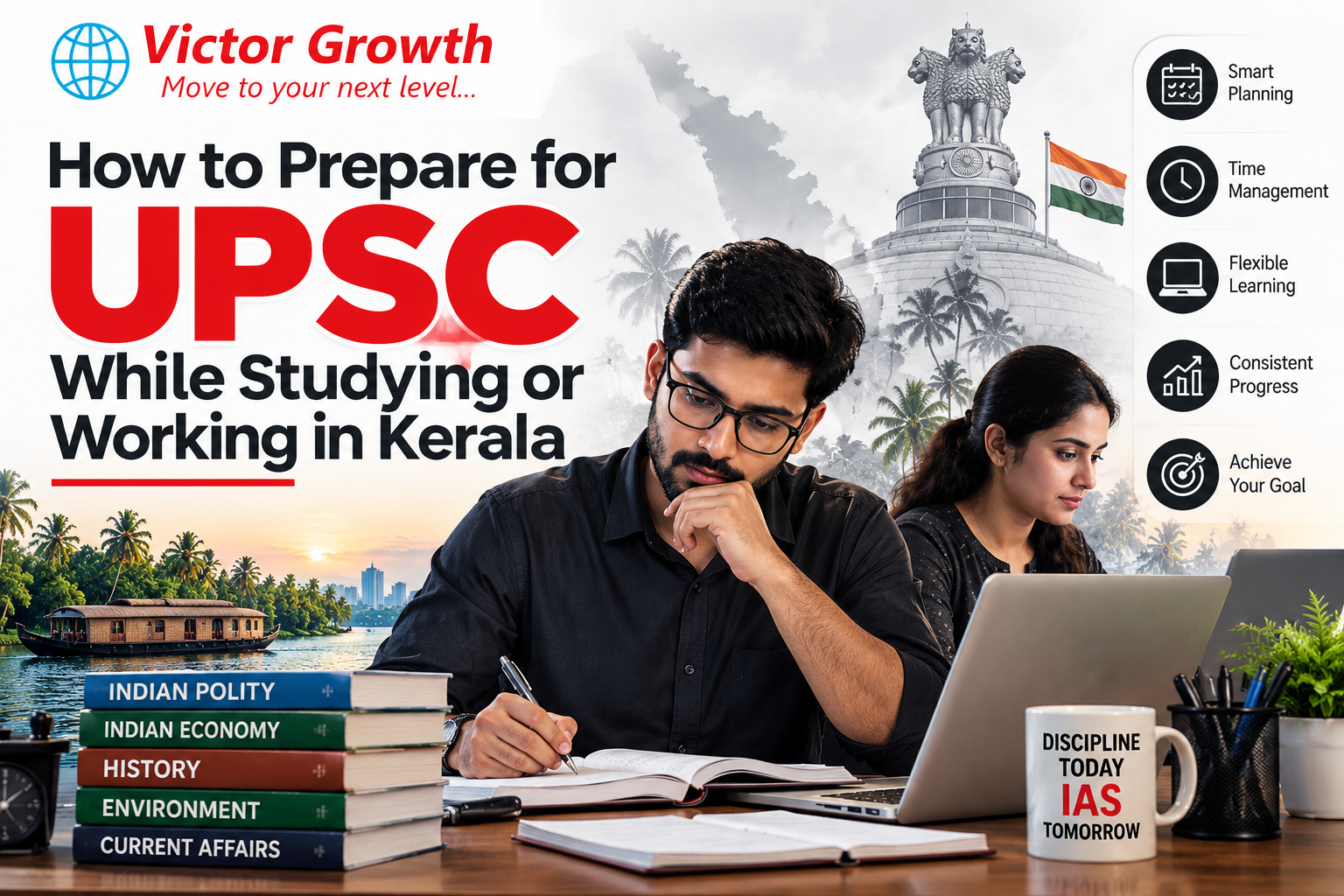
Preparing for the UPSC Civil Services Examination while pursuing a degree or working a full-time job can be challenging, but it is possible with proper planning, consistency and realistic daily targets.
For many aspirants in Kerala, the key challenge is balancing college, employment and personal responsibilities with the extensive UPSC syllabus. A structured study plan, the right resources and guidance from a reputed UPSC coaching institute in Kerala can make this process more manageable.
Can You Prepare for UPSC While Studying or Working?
Yes. Many UPSC aspirants begin their preparation alongside college or employment.
The objective should not be to study for extremely long hours every day. Instead, focus on consistent, high-quality study hours and gradually increase preparation time as the examination approaches.
A practical approach is:
Daily Study + Weekend Intensive Preparation + Regular Revision + Test Practice
1. Create a Realistic Study Schedule
Students and working professionals should create a timetable based on their actual availability.
For example:
Weekdays
1–2 hours: Static subjects
30–45 minutes: Current affairs
30 minutes: Revision or MCQ practice
Weekends
3–5 hours of focused study
One or more mock tests
Mains answer-writing practice
Weekly revision
Planning for the following week
The exact schedule can vary depending on college timings, work responsibilities and individual preparation levels.
2. Start with the UPSC Syllabus and PYQs
Before collecting books or joining multiple courses, understand the UPSC syllabus and previous-year questions.
The syllabus provides the framework for preparation, while PYQs help you understand how UPSC converts syllabus topics into questions.
This prevents students from spending excessive time on topics that have limited relevance to the examination.
3. Follow Limited and Reliable Study Materials
Working professionals and college students have limited preparation time. Therefore, collecting too many books, PDFs and online resources can become counterproductive.
Focus on:
NCERTs
Standard reference books
UPSC PYQs
Reliable current-affairs resources
Concise revision notes
Prelims test series
Mains answer-writing material
A structured UPSC coaching program in Kerala can help reduce resource overload by providing organised study materials and a defined preparation plan.
4. Use Your Commute and Small Time Slots
Students and professionals can use short periods of available time productively.
For example:
Listen to current-affairs discussions during travel
Revise short notes during breaks
Practise MCQs during free periods
Read important articles during lunch breaks
Revise previously studied topics before sleeping
Small study sessions can become valuable when used consistently.
5. Prepare Prelims and Mains Together
Avoid completely separating Prelims and Mains preparation.
While studying a topic, try to understand both its objective and analytical dimensions.
For example, while studying Indian Polity:
Prelims: Constitutional provisions, articles, institutions and factual concepts
Mains: Governance, constitutional issues, federalism, accountability and contemporary examples
This integrated approach helps save time and creates better conceptual understanding.
6. Make Weekends Count
For working professionals and college students, weekends can provide longer uninterrupted study periods.
Use weekends for:
Completing difficult topics
Full-length mock tests
Mains answer writing
Essay practice
Revision
Current-affairs consolidation
Analysing mistakes
However, maintaining adequate rest is also important for long-term consistency.
7. Take Regular Mock Tests
Time management is particularly important for candidates preparing alongside college or employment.
Regular UPSC mock tests help aspirants measure progress and identify weak areas.
The objective should not simply be to obtain a high score. Analyse every test and identify:
What did I get wrong? Why did I get it wrong? What should I revise?
8. Consider UPSC Coaching in Kerala
For students and professionals who find it difficult to create a preparation strategy independently, structured coaching can provide valuable support.
A good IAS coaching institute in Kerala can offer:
Structured study plans
Expert faculty
Study materials
Current-affairs guidance
Prelims mock tests
Mains answer-writing practice
Performance evaluation
Personal mentorship
Online and offline learning options
This can be particularly useful for aspirants who have limited time because of college or work.
Why Choose the Best IAS Coaching in Kerala?
When selecting the Best IAS Coaching in Kerala, working professionals and students should pay particular attention to flexibility.
Look for programs that provide:
Flexible Classes + Recorded Sessions + Quality Study Materials + Mock Tests + Mentorship + Current Affairs + Answer-Writing Support
Online or hybrid learning can be especially useful when attending every classroom session is difficult.
Victor Growth – UPSC Coaching in Kerala
Victor Growth, Kochi provides UPSC Civil Services preparation through online and offline learning options, with structured study materials, mock tests, mentorship and examination-oriented guidance.
Flexible learning options can help students and working professionals integrate UPSC preparation into their existing schedules.
Frequently Asked Questions
1. Can I prepare for UPSC while working full-time?
Yes. It requires realistic planning and consistent study rather than trying to study for extremely long hours every day.
2. How many hours should a working professional study for UPSC?
There is no fixed number. Even a few focused hours on weekdays combined with longer weekend sessions can create meaningful progress when maintained consistently.
3. Can college students start UPSC preparation?
Yes. College can be a good time to build fundamentals, understand the syllabus, read standard books and gradually develop answer-writing and current-affairs habits.
4. Is UPSC coaching necessary for working professionals?
Not necessarily. However, coaching can provide structure, study materials, tests and mentorship, which may help professionals make better use of their limited preparation time.
5. Is online UPSC coaching suitable for working professionals?
Online coaching can be convenient because recorded classes and flexible schedules allow professionals to study around their work commitments.
6. How do I choose the best IAS coaching in Kerala while working?
Look for flexible timings, recorded classes, concise study materials, regular tests, answer-writing evaluation and accessible mentorship.
Conclusion
Preparing for UPSC while studying or working requires discipline, realistic planning and consistency. You do not need to completely abandon your studies or career to begin preparing for the Civil Services Examination.
By combining self-study, limited and reliable resources, regular revision, mock tests and structured guidance, students and working professionals in Kerala can build a sustainable UPSC preparation strategy.
For those seeking the Best IAS Coaching in Kerala, choose a program that fits your schedule and provides the right combination of flexibility, study materials, mock tests, mentorship and comprehensive UPSC guidance.