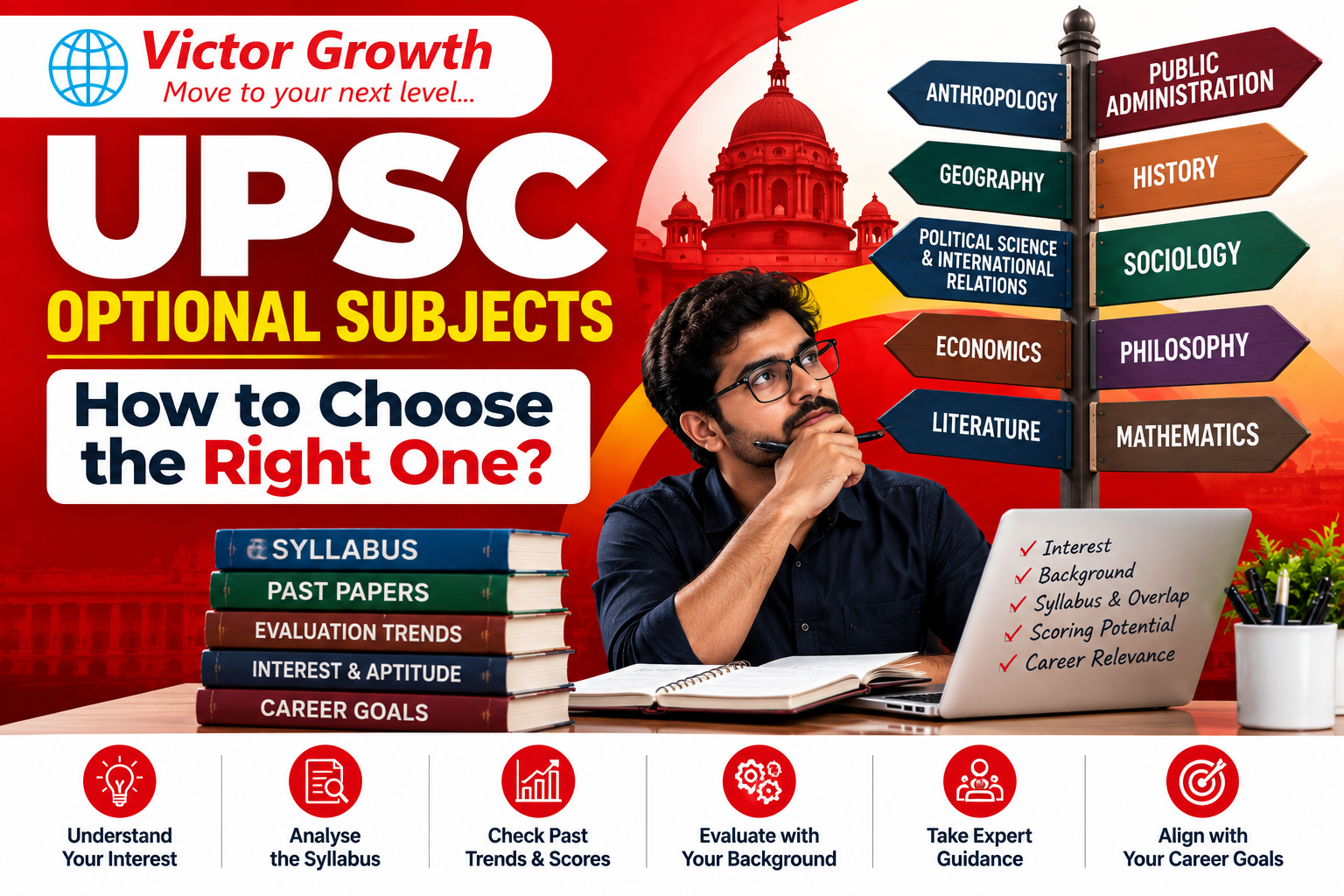
Choosing the right UPSC Optional Subject is an important decision in Civil Services Mains preparation. The Optional Subject consists of two papers of 250 marks each, making it a significant part of the written examination.
There are many optional subjects available, including subjects from humanities, sciences, engineering, commerce and literature. Therefore, aspirants should make their choice based on their interest, background, syllabus, available resources and preparation strategy, rather than simply following what other candidates choose.
For aspirants searching for the Best IAS Coaching in Kerala, understanding the factors involved in selecting an Optional Subject can help them make a more informed decision.
What Is the UPSC Optional Subject?
In the UPSC Civil Services Main Examination, candidates select one Optional Subject, which has two papers.
Each paper carries 250 marks, making the Optional worth 500 marks in the Mains written examination.
The available choices include subjects such as:
History
Geography
Sociology
Political Science & International Relations
Public Administration
Anthropology
Philosophy
Economics
Psychology
Law
Commerce & Accountancy
Mathematics
Physics
Chemistry
Engineering subjects
Medical Science
Agriculture
Literature subjects
Candidates should always refer to the latest UPSC notification for the current list and syllabus.
Factors to Consider When Choosing an Optional
1. Your Interest in the Subject
Interest is one of the most important factors.
UPSC Optional preparation requires extensive reading, multiple revisions and answer-writing practice. Choosing a subject that genuinely interests you can make this long preparation process more manageable.
Ask yourself:
Can I study this subject consistently for several months?
2. Educational Background
Your graduation or academic background can be useful when selecting an Optional.
For example, candidates with a strong academic foundation in a particular subject may already have conceptual familiarity and study resources.
However, having a degree in a subject is not mandatory for choosing it as an Optional.
3. Syllabus Size and Manageability
Compare the syllabus of the subjects you are considering.
Look at:
Number of topics
Depth of the syllabus
Overlap with General Studies
Availability of study material
Revision requirements
Previous-year questions
A subject should be manageable within your available preparation time.
4. Overlap with General Studies
Some Optional subjects have significant conceptual overlap with General Studies.
For example, subjects such as History, Geography, Political Science, Sociology and Public Administration may have areas that complement portions of the General Studies syllabus.
However, overlap should not be the only reason for choosing an Optional. Interest, aptitude and the ability to write good answers are equally important.
5. Availability of Study Material and Guidance
Before selecting an Optional, check whether you can access:
Standard books
Quality notes
Previous-year questions
Test series
Experienced faculty
Answer-writing guidance
This is particularly relevant for aspirants preparing through UPSC coaching in Kerala, where the availability of specialised Optional guidance may vary between institutes.
6. Analyse Previous-Year Questions
Previous-year questions can provide valuable insight into the nature of an Optional Subject.
Study several years of questions and ask:
Do I understand the questions?
Can I identify what the examiner is asking?
Can I develop answers to these questions?
Do I find the subject interesting?
This exercise can be more useful than simply relying on recommendations from friends or online discussions.
Common Mistakes to Avoid
Choosing an Optional Because It Is Popular
A popular subject is not automatically the right subject for every aspirant.
Choosing Based Only on “Scoring” Claims
Marks can vary from candidate to candidate and across examinations. Avoid choosing an Optional solely because someone claims that it is highly scoring.
Selecting Without Checking the Syllabus
Read the complete syllabus before making a decision.
Changing Optional Repeatedly
Frequent changes can waste valuable preparation time. Compare your options carefully before committing.
Ignoring Answer-Writing Requirements
Read sample answers and practise writing before finalising your subject. Knowing the content is only one part of Optional preparation.
How to Select Your Optional: A Simple Process
Follow these steps:
Step 1: Shortlist 2–3 subjects
Step 2: Read their complete syllabi
Step 3: Analyse previous-year questions
Step 4: Check available books and guidance
Step 5: Study introductory topics from each subject
Step 6: Write a few practice answers
Step 7: Compare your interest, understanding and comfort level
Step 8: Finalise one subject and prepare consistently
How UPSC Coaching in Kerala Can Help
A structured IAS coaching institute in Kerala can help aspirants understand the syllabus, analyse previous-year questions and develop an Optional preparation strategy.
Before choosing an institute, check whether it provides:
Experienced Optional Faculty + Study Material + PYQ Analysis + Answer Writing + Test Series + Personal Guidance
Victor Growth – UPSC Optional Guidance
Victor Growth, Kochi provides structured UPSC Civil Services preparation with study materials, mentorship, test practice and guidance for different stages of the examination.
Aspirants can evaluate their Optional choice based on their academic background, interests, syllabus requirements and preparation strategy rather than choosing solely based on popularity.
Frequently Asked Questions
1. Which is the best Optional Subject for UPSC?
There is no single best Optional for every candidate. The right choice depends on interest, academic background, syllabus, resources and answer-writing comfort.
2. Should I choose my graduation subject as my Optional?
It can be an advantage if you already have a strong foundation, but you are not required to choose your graduation subject.
3. Which Optional has the most overlap with General Studies?
Several subjects have areas of overlap with General Studies, including History, Geography, Political Science, Sociology and Public Administration. The extent of useful overlap depends on the specific syllabus and preparation approach.
4. Should I choose an Optional based on scoring trends?
It is better not to rely solely on perceived scoring trends. Choose a subject you can understand, prepare thoroughly and write effectively.
5. Can I change my Optional after starting preparation?
You can change it, but doing so after investing significant preparation time can result in lost effort. Analyse your options carefully before finalising your choice.
6. Can coaching help me choose my UPSC Optional?
Yes. Experienced faculty or mentors can help you compare syllabi, PYQs, resources and answer-writing requirements. However, the final decision should be based on your own aptitude and preparation preferences.
7. How do I choose the best IAS coaching in Kerala for Optional preparation?
Check the availability of experienced Optional faculty, quality study materials, previous-year question analysis, answer-writing evaluation, test series and individual mentorship.
Conclusion
The right UPSC Optional Subject is not necessarily the most popular or the one recommended by another aspirant. It should be a subject that you can understand deeply, study consistently, revise multiple times and write effectively in the Mains examination.
For aspirants searching for the Best IAS Coaching in Kerala, choose an institute that provides proper guidance, Optional-specific study material, answer-writing practice, test series and mentorship.
Most importantly, choose your Optional based on your own strengths and preparation needs, not on trends or hearsay.