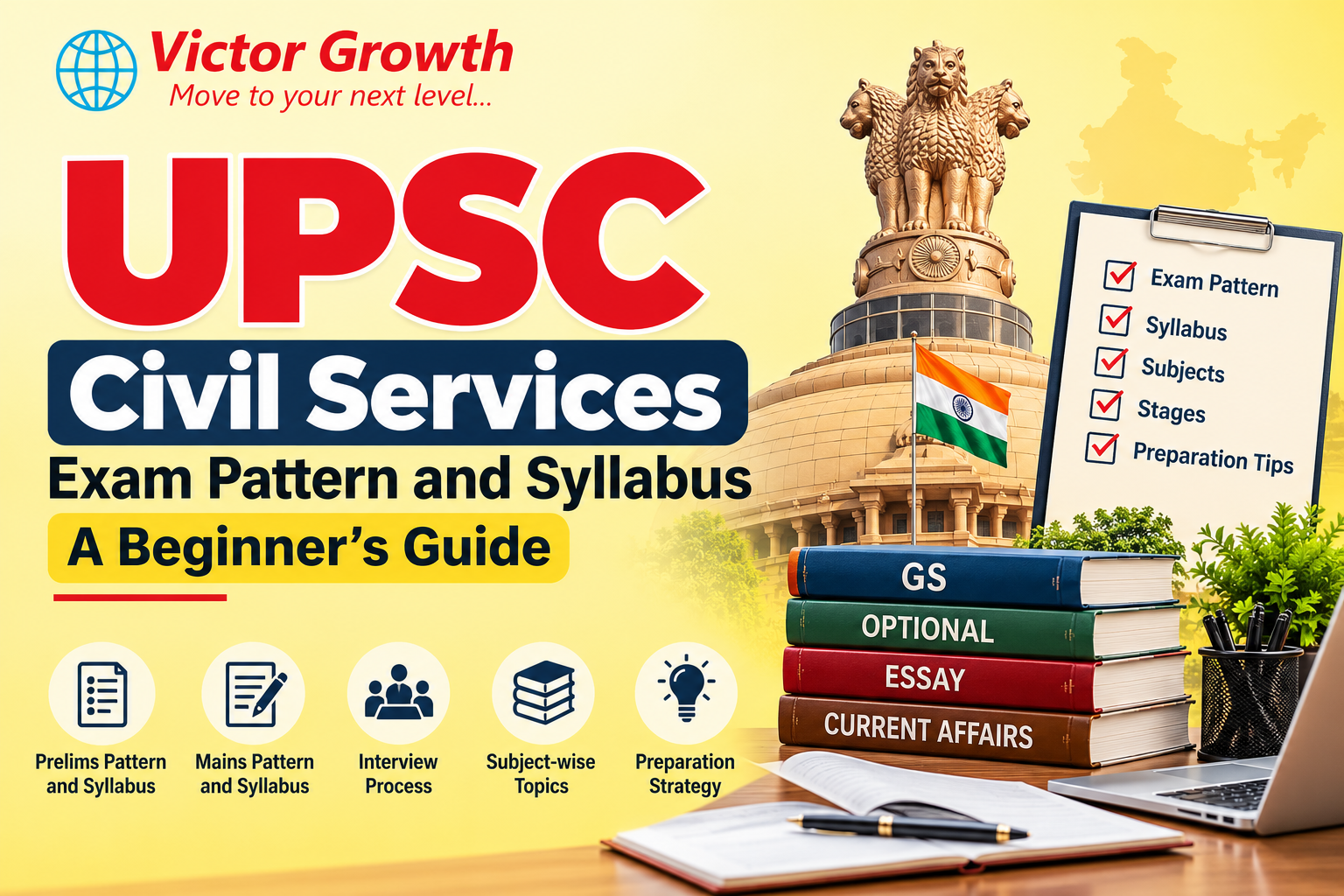
The UPSC Civil Services Examination (CSE) is conducted by the Union Public Service Commission to select candidates for various prestigious civil services in India. For beginners, understanding the UPSC exam pattern and syllabus is the first step towards building an effective preparation strategy.
For aspirants looking for the Best IAS Coaching in Kerala, a clear understanding of the examination structure can help in choosing the right study plan, resources, test series and mentorship program.
UPSC Civil Services Examination Structure
The UPSC Civil Services Examination is conducted in three stages:
Preliminary Examination
Main Examination
Personality Test/Interview
Candidates must qualify at each stage to progress to the next.
1. UPSC Preliminary Examination
The Preliminary Examination is the first stage of the Civil Services Examination.
It consists of two objective-type papers:
General Studies Paper I
This paper covers:
Current events of national and international importance
History of India and Indian National Movement
Indian and World Geography
Indian Polity and Governance
Economic and Social Development
Environmental Ecology, Biodiversity and Climate Change
General Science
The paper carries 200 marks.
General Studies Paper II – CSAT
CSAT is a qualifying paper and covers:
Comprehension
Interpersonal and communication skills
Logical reasoning
Analytical ability
Decision-making and problem-solving
General mental ability
Basic numeracy
Data interpretation
The paper carries 200 marks, with the qualifying requirement prescribed by UPSC.
Important Point
Marks obtained in the Prelims are used for shortlisting candidates for the Mains examination. Prelims marks are not added to the final ranking.
2. UPSC Civil Services Main Examination
Candidates who qualify for the Preliminary Examination can appear for the Mains Examination.
The Mains consists of written papers followed by the Personality Test.
The written examination includes:
Qualifying Papers
Paper A: Indian Language – 300 marks
Paper B: English – 300 marks
These papers are qualifying in nature.
Papers Counted for Merit
Essay – 250 marks
General Studies I – 250 marks
General Studies II – 250 marks
General Studies III – 250 marks
General Studies IV – 250 marks
Optional Subject Paper I – 250 marks
Optional Subject Paper II – 250 marks
The written Mains examination carries 1750 marks for merit.
3. UPSC Personality Test
Candidates who qualify in the written Mains examination are called for the Personality Test, commonly known as the UPSC Interview.
The Personality Test carries 275 marks.
It assesses aspects such as:
General awareness
Suitability for public service
Intellectual qualities
Social awareness
Interest in current affairs
Personality and communication
The final ranking is based on the marks obtained in the Mains examination and Personality Test, subject to the applicable rules.
Understanding the UPSC Syllabus
The UPSC syllabus is extensive, but it provides a clear framework for preparation.
General Studies I
Focuses primarily on:
Indian Heritage & Culture, History, Geography and Society
Important areas include Indian culture, modern Indian history, freedom struggle, world history, Indian society and physical and human geography.
General Studies II
Covers:
Governance, Constitution, Polity, Social Justice and International Relations
Topics include the Constitution, Parliament, judiciary, governance, welfare schemes, constitutional bodies, social issues and India’s international relations.
General Studies III
Focuses on:
Technology, Economic Development, Biodiversity, Environment, Security and Disaster Management
Important areas include the Indian economy, agriculture, science and technology, environment, infrastructure, internal security and disaster management.
General Studies IV
This paper deals with:
Ethics, Integrity and Aptitude
It includes ethical principles, emotional intelligence, values, integrity, public-service ethics and case studies.
Essay
Candidates are required to write essays on given topics. The paper tests the ability to present ideas in a structured, coherent and analytical manner.
Optional Subject
Candidates choose one optional subject, with two papers.
The optional should be selected after considering factors such as interest, syllabus, availability of resources and previous-year questions.
How Beginners Should Start UPSC Preparation
A beginner should avoid immediately collecting large numbers of books and study materials.
Start with:
Step 1: Understand the UPSC exam pattern
Step 2: Read the complete syllabus
Step 3: Analyse previous-year questions
Step 4: Build basic concepts using NCERTs
Step 5: Move to standard reference books
Step 6: Develop a current-affairs habit
Step 7: Begin Prelims MCQ and Mains answer-writing practice
Step 8: Revise regularly and take mock tests
A structured UPSC coaching program in Kerala can help beginners follow this process systematically.
Why Choose the Best IAS Coaching in Kerala?
For beginners, coaching can provide a structured learning environment and reduce confusion about resources and preparation strategy.
When selecting the Best IAS Coaching in Kerala, consider:
Experienced faculty
Comprehensive study materials
Prelims and Mains test series
Current-affairs guidance
Answer-writing evaluation
Personal mentorship
Online and offline learning options
Regular performance analysis
Victor Growth – UPSC Coaching in Kerala
Victor Growth, Kochi provides UPSC Civil Services preparation through online and offline learning options, with structured study materials, test practice, mentorship and guidance for the different stages of the examination.
The focus is on helping beginners understand the syllabus and gradually develop the knowledge, analytical ability and examination skills required for UPSC.
Frequently Asked Questions
1. What are the three stages of the UPSC Civil Services Examination?
The three stages are Preliminary Examination, Main Examination and Personality Test.
2. Is CSAT qualifying in UPSC Prelims?
Yes. CSAT is a qualifying paper, and candidates must meet the prescribed qualifying requirement.
3. How many papers are there in UPSC Mains?
The Mains written examination consists of nine papers, including two qualifying language papers, Essay, four General Studies papers and two Optional papers.
4. How many marks are considered for the final UPSC ranking?
The Mains merit papers carry 1750 marks, while the Personality Test carries 275 marks, making the total 2025 marks for the final merit consideration.
5. When should beginners start answer writing?
Beginners can start gradually after developing basic conceptual understanding. Early practice helps develop structure, clarity and time management.
6. Is UPSC coaching necessary for beginners?
Coaching is not compulsory. However, a structured program can provide guidance, study materials, mock tests, mentorship and a defined preparation strategy.
7. How can I find the best IAS coaching in Kerala?
Compare faculty, study materials, test series, mentorship, current-affairs support, answer-writing evaluation and learning flexibility before selecting an institute.
Conclusion
Understanding the UPSC Civil Services exam pattern and syllabus is the foundation of effective preparation. Beginners should first understand what UPSC expects, then build their preparation around the syllabus, previous-year questions, standard resources, current affairs, revision and regular testing.
For aspirants searching for the Best IAS Coaching in Kerala, the right institute should provide structured guidance across Prelims, Mains and the Personality Test, while helping students develop an effective and sustainable preparation strategy.