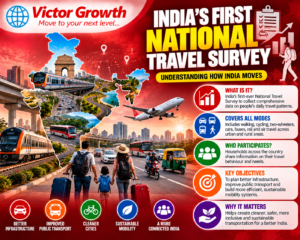
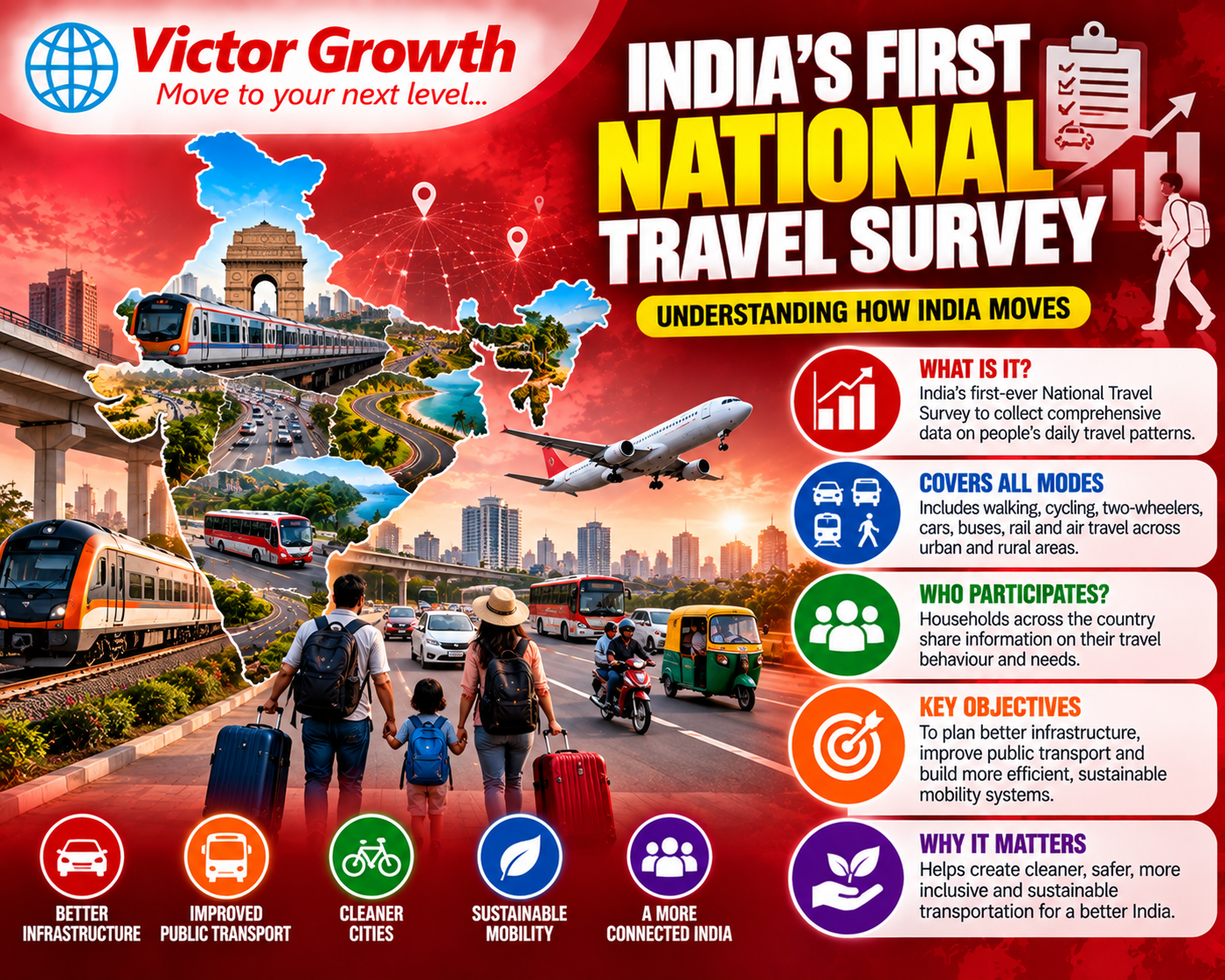
The National Statistics Office (NSO) under the Ministry of Statistics and Programme Implementation (MoSPI) has released the findings of India’s first-ever all-India National Household Travel Survey (NHTS).
The survey was conducted from July 2025 to June 2026 to understand how, why and by what modes Indians travel. It covered both rural and urban areas across the country.
What is the National Household Travel Survey?
The NHTS is a nationwide survey designed to generate reliable data on household travel patterns. It focuses on:
Purpose of travel – employment, education, tourism, social, cultural and religious activities, etc.
Mode of transport used
Travel frequency
Distance and duration of journeys
Expenditure on regular travel
Public transport usage and accessibility
For the survey, a trip covering more than 1 km was considered as travel.
The survey was conducted by the NSO based on requirements of the Ministry of Railways and is expected to provide an important evidence base for transport planning and infrastructure development.
Major Findings of the NHTS
1. Two-wheelers dominate workplace commuting
Two-wheelers are the most common mode of transport for commuting to fixed workplaces, accounting for 42.6% of workers.
This highlights India’s continued dependence on private motorised transport for daily mobility.
2. Buses and railways dominate overnight journeys
Buses account for 55.8% and railways for 17.7% of household overnight journeys.
Together, buses and railways account for 73.5% of overnight travel, demonstrating the importance of public transport in India’s mobility system.
3. Most students and workers have short commutes
Around 87.6% of students reach their educational institutions within 30 minutes.
Similarly, 83.4% of workers commute to their fixed workplaces in less than 30 minutes.
4. Urban commuting is more expensive
The average monthly expenditure on commuting to a fixed workplace is ₹785 per worker.
However, the average is considerably higher in urban areas at ₹1,044, compared with ₹612 in rural areas.
Why is the Survey Important?
The NHTS provides India with a comprehensive benchmark on household mobility. Earlier, transport-related information was available through different datasets, but the NHTS provides a dedicated nationwide picture of household travel behaviour.
Its findings can help governments:
Identify gaps in public transportation
Improve bus and railway services
Optimise routes and schedules
Plan transport infrastructure
Improve accessibility in underserved regions
Support sustainable and affordable mobility
Develop evidence-based urban and regional transport policies
The data can also contribute to better planning of multimodal transportation systems.
NHTS and Sustainable Development
India’s rapidly growing urban population has increased demand for efficient mobility. Greater dependence on private vehicles can contribute to congestion, air pollution and greenhouse-gas emissions.
The survey can therefore support policies promoting:
Public transportation
Electric mobility
Walking and cycling infrastructure
Multimodal transport
Transit-oriented development
Sustainable urban planning
This connects the survey with SDG 11: Sustainable Cities and Communities.
UPSC Relevance
Prelims
Remember:
Survey: National Household Travel Survey (NHTS)
First nationwide dedicated household travel survey in India
Conducted by: National Statistics Office (NSO)
Ministry: Ministry of Statistics and Programme Implementation (MoSPI)
Survey period: July 2025 – June 2026
Coverage: Rural and urban India
Travel considered: Trips exceeding 1 km
Largest mode for workplace commuting: Two-wheelers
Major modes for overnight journeys: Buses and railways
Mains – GS Paper III
The topic is relevant to:
Infrastructure and transportation
Urbanisation
Sustainable development
Public transport
Electric mobility
Air pollution
Evidence-based policymaking
Regional planning
Possible UPSC Mains Question
“India’s first National Household Travel Survey provides an important evidence base for transforming India’s transport and mobility systems. Discuss its significance for sustainable and inclusive transportation planning.”
Conclusion
The first National Household Travel Survey marks an important improvement in India’s transport data ecosystem. By providing nationwide evidence on how, why and by what means Indians travel, it can help policymakers design more accessible, efficient, affordable and sustainable transportation systems.
For UPSC aspirants, the survey is particularly relevant to the themes of urbanisation, infrastructure, sustainable development and evidence-based governance.