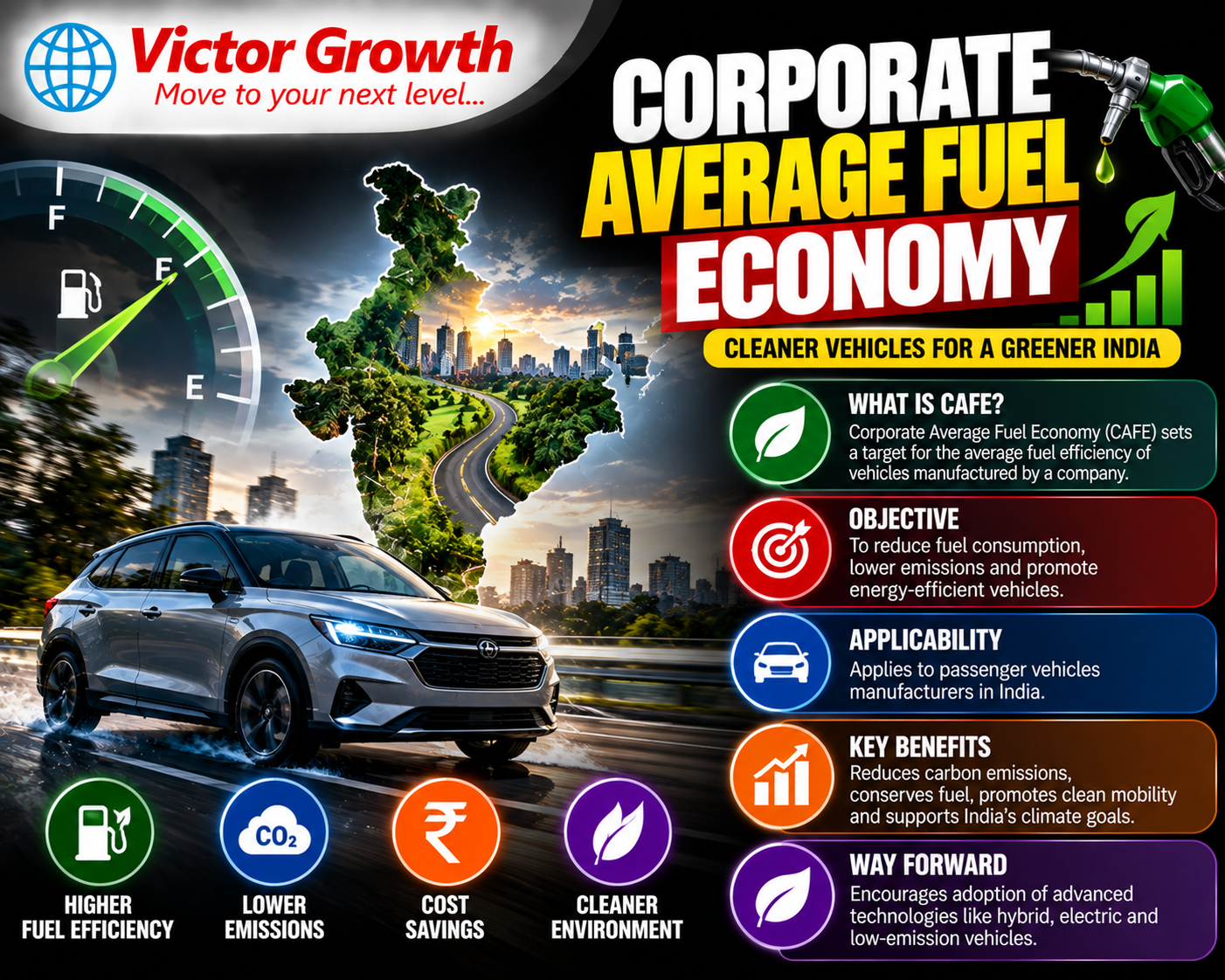
The Ministry of Power has notified the new Corporate Average Fuel Economy (CAFE) norms for passenger vehicles. The CAFE-III norms will come into effect from 1 April 2027 and remain applicable until 31 March 2032.
The new framework aims to improve vehicle fuel efficiency, reduce fuel consumption and encourage the adoption of electric vehicles, hybrids, alternative fuels and energy-efficient technologies.
The norms target an improvement of about 16.7% in fuel efficiency over the five-year period.
What are CAFE Norms?
Corporate Average Fuel Economy (CAFE) norms regulate the average fuel consumption of a manufacturer’s passenger-vehicle fleet, rather than imposing the same fuel-efficiency requirement on every individual vehicle.
In simple terms, the fuel consumption of all eligible vehicles sold by a manufacturer is considered together to calculate its corporate fleet average.
India introduced CAFE norms in 2017 under the Energy Conservation Act, 2001 to reduce fuel consumption, oil dependence and CO₂ emissions.
What is New in CAFE-III?
The new norms will apply to M1-category passenger vehicles manufactured or imported for sale in India.
Progressive Fuel-Efficiency Targets
The benchmark for a fleet with the reference weight of 1,229 kg becomes progressively stricter:
| Financial Year | Benchmark Fuel Consumption |
|---|---|
| 2027–28 | 3.996 litres/100 km |
| 2028–29 | 3.860 litres/100 km |
| 2029–30 | 3.7585 litres/100 km |
| 2030–31 | 3.5313 litres/100 km |
| 2031–32 | 3.3273 litres/100 km |
This represents an improvement of approximately 16.7% between 2027–28 and 2031–32.
Key Features of CAFE-III
1. Incentive for Electric Vehicles
CAFE-III provides super credits for cleaner vehicle technologies.
Battery Electric Vehicles (BEVs) and Range-Extended Electric Vehicles (REEVs) receive a volume derogation factor of 3, meaning their contribution to the fleet calculation is weighted more heavily.
Plug-in hybrids, strong hybrids and flex-fuel vehicles also receive preferential treatment.
2. Alternative Fuels
The framework recognises the contribution of ethanol-blended petrol, biofuels and compressed biogas (CBG) through a Carbon Neutrality Factor (CNF).
This provides manufacturers with multiple pathways to meet their fuel-efficiency obligations.
3. Fuel-Saving Technologies
The number of recognised fuel-conservation technologies has been expanded from four to twelve.
Eligible technologies can receive concessions in the calculation, subject to an overall limit. Examples include technologies that improve vehicle efficiency, air-conditioning performance and other energy-saving features.
4. Credit Trading
Manufacturers that perform better than their prescribed targets can generate CAFE credits.
These credits can be carried forward under specified compliance blocks, traded with other manufacturers or otherwise used under the prescribed compliance mechanism.
This creates a market-based element within the regulatory framework.
5. Transition to Global Testing Standards
CAFE-III will involve reporting under both the Modified Indian Driving Cycle (MIDC) and the Worldwide Harmonized Light Vehicles Test Procedure (WLTP).
This is intended to facilitate India’s gradual transition towards globally harmonised vehicle-testing practices.
Why are CAFE Norms Important?
Energy Security
India imports a substantial share of its crude oil requirements. Improving vehicle fuel efficiency can reduce petroleum consumption and strengthen energy security.
Climate Change
Lower fuel consumption means lower CO₂ emissions, contributing to India’s climate and decarbonisation objectives.
Cleaner Mobility
The norms encourage manufacturers to invest in:
Electric vehicles
Hybrid vehicles
Flex-fuel vehicles
Alternative fuels
Energy-efficient technologies
Technological Innovation
CAFE-III creates incentives for automobile manufacturers to develop more efficient vehicles and adopt advanced technologies.
CAFE vs Bharat Stage Norms
UPSC aspirants should distinguish between the two:
CAFE norms primarily address fuel efficiency and fleet-average fuel consumption.
Bharat Stage emission standards regulate pollutants emitted by individual vehicles, such as NOx, particulate matter and hydrocarbons.
Thus, both contribute to cleaner mobility but address different aspects of vehicle environmental performance.
Challenges
Implementation of CAFE-III may involve challenges such as:
Higher technology costs
Need for greater EV and charging infrastructure
Cost of advanced hybrid technologies
Measurement and compliance complexities
Balancing affordability with environmental objectives
Dependence on batteries and critical minerals
The policy therefore needs to be supported by charging infrastructure, clean electricity, public transport and sustainable urban mobility.
UPSC Relevance
Prelims
Remember:
CAFE: Corporate Average Fuel Economy
India introduced CAFE norms in 2017
Legal basis: Energy Conservation Act, 2001
CAFE-III: 2027–28 to 2031–32
Effective from: 1 April 2027
Target improvement: about 16.7%
EVs receive super credits
Reporting uses MIDC and WLTP
Mains – GS Paper III
The topic can be linked with:
Energy security
Electric mobility
Climate change
Air pollution
Sustainable transport
Alternative fuels
Automobile-sector technology
India’s energy transition
Possible UPSC Mains Question
“Corporate Average Fuel Economy norms can simultaneously address India’s energy-security and climate objectives. Discuss the significance and challenges of CAFE-III norms.”
Conclusion
The CAFE-III norms represent an important step towards improving the energy efficiency of India’s passenger-vehicle sector. By combining stricter fleet-average targets with EV and hybrid incentives, alternative fuels, technology incentives and credit mechanisms, India is encouraging a gradual transition towards cleaner mobility.
For UPSC aspirants, CAFE-III is an important case study linking energy security, climate change, automobile technology, sustainable transportation and environmental governance.