The 2026 Nobel Prize announcements are being held from 5 to 12 October 2026 across six categories. The Nobel Prizes recognise outstanding contributions to science, literature and peace. The Sveriges Riksbank Prize in Economic Sciences in Memory of Alfred Nobel is also announced during Nobel Week.
As of 7 October 2026, the prizes in Physiology or Medicine, Physics and Chemistry have been announced.
Nobel Prize 2026: Winners Announced So Far
1. Nobel Prize in Physiology or Medicine
The 2026 Nobel Prize in Physiology or Medicine was awarded jointly to:
Karl Deisseroth
Peter Hegemann
Georg Nagel
They were recognised for their discoveries concerning light-gated ion channels and optogenetics. Optogenetics uses light-sensitive proteins to control the activity of specific cells, particularly neurons, and has become an important tool in neuroscience.
2. Nobel Prize in Physics
Francis Halzen received the 2026 Nobel Prize in Physics for decisive contributions to the IceCube Neutrino Observatory and the discovery of high-energy neutrinos of astrophysical origin.
The IceCube Observatory uses sensors embedded deep in the Antarctic ice to detect neutrinos. These elusive particles provide information about extreme cosmic environments and expand our understanding of the Universe.
3. Nobel Prize in Chemistry
The 2026 Nobel Prize in Chemistry was awarded jointly to:
Henri B. Kagan
Kenso Soai
They were recognised for the discovery of non-linear effects and autocatalysis in asymmetric organic synthesis. Their work is important for understanding how chemical reactions can amplify molecular asymmetry and has implications for modern synthetic chemistry.
The remaining 2026 prizes in Literature, Peace and Economic Sciences are scheduled to be announced later during Nobel Week.
What is the Nobel Prize?
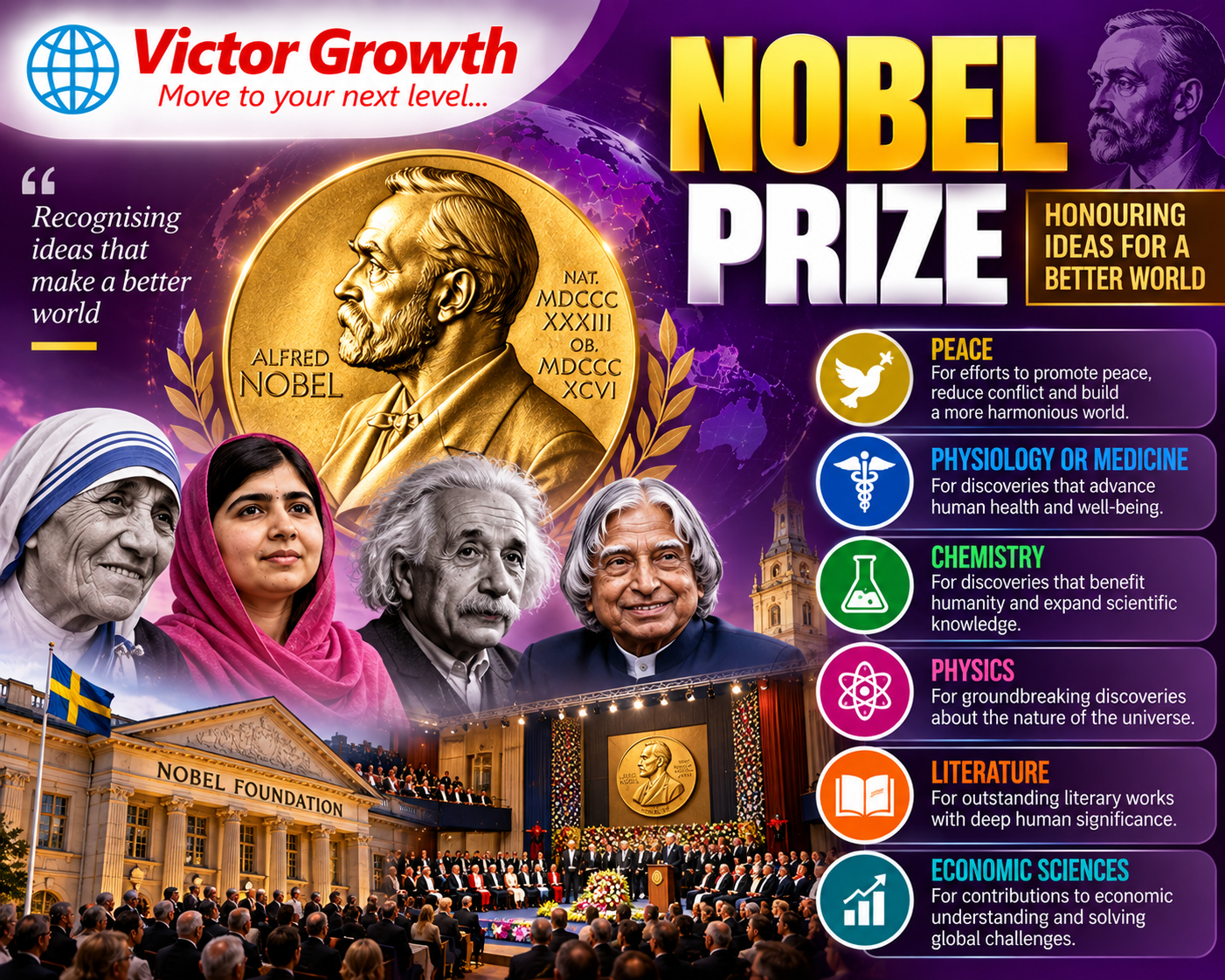
The Nobel Prize was established according to the will of Alfred Nobel, the Swedish inventor and entrepreneur.
The original five categories were:
Physics
Chemistry
Physiology or Medicine
Literature
Peace
The Prize in Economic Sciences in Memory of Alfred Nobel was established by Sweden’s central bank in 1968, with the first award given in 1969.
The first Nobel Prizes were awarded in 1901.
Where Are the Nobel Prizes Awarded?
Most Nobel Prizes are presented in Stockholm, Sweden.
The Nobel Peace Prize is awarded in Oslo, Norway.
This distinction is important for UPSC Prelims.
The formal award ceremonies are held annually on 10 December, the anniversary of Alfred Nobel’s death.
Nobel Prize and India
The Nobel Prize is particularly relevant to India because several Indians and persons of Indian origin have made major contributions.
Rabindranath Tagore
Rabindranath Tagore became the first Asian Nobel laureate when he received the Nobel Prize in Literature in 1913 for Gitanjali.
C. V. Raman
C. V. Raman received the Nobel Prize in Physics in 1930 for his work on the scattering of light, popularly known as the Raman Effect.
Mother Teresa
Mother Teresa received the Nobel Peace Prize in 1979 for her humanitarian work.
Amartya Sen
Amartya Sen received the Nobel Memorial Prize in Economic Sciences in 1998 for contributions to welfare economics.
Kailash Satyarthi
Kailash Satyarthi shared the Nobel Peace Prize in 2014 with Malala Yousafzai for their struggle against the suppression of children and for the right of children to education.
Why is the Nobel Prize Important for UPSC?
The Nobel Prize is not merely a list of award winners. It provides important links with science, technology, international relations, literature, ethics and global affairs.
For example:
Medicine: Biotechnology and neuroscience
Physics: Particle physics and astrophysics
Chemistry: Molecular science and chemical synthesis
Peace: International relations and human rights
Economics: Development and economic policy
Literature: Culture and society
UPSC Prelims: Quick Facts
| Topic | Key Fact |
|---|---|
| First Nobel Prizes | 1901 |
| Original categories | 5 |
| Economics Prize | Established in 1968 |
| Peace Prize | Awarded in Oslo |
| Other Nobel Prizes | Awarded in Stockholm |
| Nobel Day | 10 December |
| Founder | Alfred Nobel |
| 2026 Medicine | Deisseroth, Hegemann & Nagel |
| 2026 Physics | Francis Halzen |
| 2026 Chemistry | Henri B. Kagan & Kenso Soai |
Possible UPSC Mains Question
“The Nobel Prizes reflect the growing importance of scientific innovation and international cooperation in addressing global challenges. Discuss their significance in promoting human progress.”
Conclusion
The Nobel Prize 2026 highlights advances across neuroscience, astrophysics and chemistry. For UPSC aspirants, Nobel-related current affairs should be studied beyond memorising names: understanding the scientific concepts, institutions and wider social implications can make the topic useful across Prelims, GS Papers and Essay preparation.