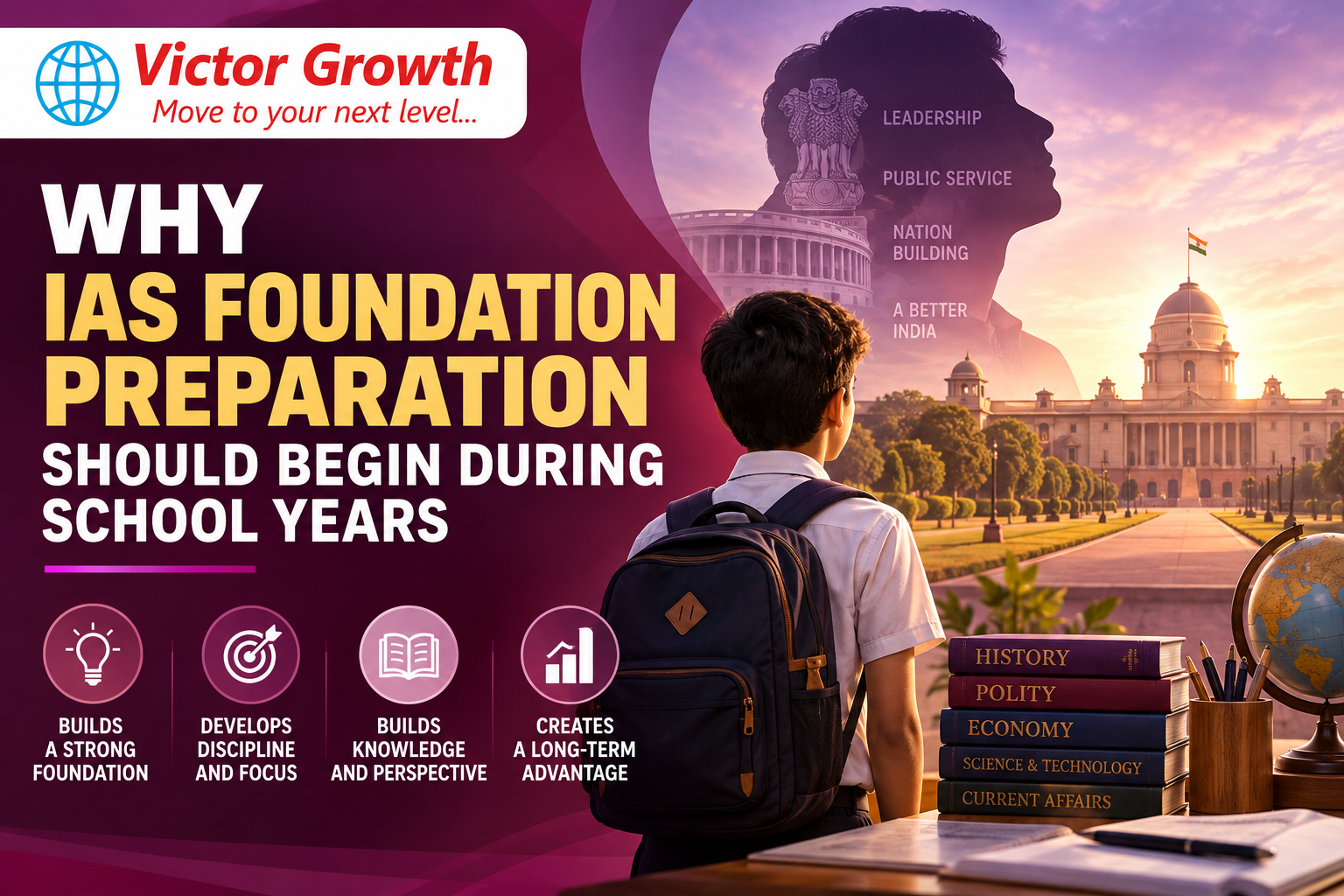
The UPSC Civil Services Examination demands strong conceptual knowledge, analytical thinking, effective communication, awareness of current affairs and consistent preparation. While dedicated UPSC preparation usually begins during college or after graduation, the foundation for these skills can be developed much earlier.
IAS Foundation Preparation during school years is not about asking children to study the complete UPSC syllabus. It is about developing the right habits, knowledge and thinking abilities gradually.
For parents searching for the Best IAS Coaching in Kerala, a well-designed foundation programme can help school students develop these capabilities while continuing to focus on their regular academics.
What Does IAS Foundation Preparation Mean?
IAS Foundation Preparation refers to early exposure to the skills and subjects that can support future Civil Services preparation.
A school-level foundation programme may introduce students to:
Indian history and geography
Indian Constitution and governance
Basic economics
Science and technology
Environment
Current affairs
General knowledge
Reading and comprehension
Logical and analytical thinking
Writing and communication
Public speaking and discussions
The emphasis should be on understanding and curiosity rather than intensive examination preparation.
Why Should IAS Foundation Preparation Begin During School?
1. Strong Habits Take Time to Develop
UPSC preparation requires consistent reading, revision and learning. These habits cannot be developed overnight.
Starting during school gives students several years to gradually build:
Regular reading habits
Note-making skills
Time-management habits
Writing practice
General awareness
Independent learning
When serious UPSC preparation begins later, these habits can provide a strong advantage.
2. School Subjects Build the Foundation
Many areas studied in school are connected to concepts that students encounter later during UPSC preparation.
History, geography, science, economics and civics provide important conceptual foundations.
Students who understand these subjects instead of simply memorising them can develop stronger academic fundamentals.
3. Early Reading Builds Better Comprehension
UPSC involves reading large amounts of information and understanding complex issues.
A student who starts reading regularly during school can gradually improve:
Vocabulary
Reading speed
Comprehension
Concentration
Ability to identify important information
Even 20–30 minutes of meaningful reading each day can help establish a strong long-term habit.
4. Develops Awareness Beyond Textbooks
School education provides essential academic knowledge, but students also benefit from understanding the world around them.
Foundation learning can introduce students to topics such as:
Indian democracy
Government policies
Environmental challenges
Economic developments
International affairs
Scientific developments
Social issues
This encourages students to connect textbook concepts with real-life events.
5. Encourages Analytical Thinking
UPSC is not simply a test of memory. Aspirants need to understand issues and analyse them from different perspectives.
School-level foundation programmes can encourage students to ask:
What happened?
Why did it happen?
What are its effects?
What can be done about it?
This habit of questioning and analysing can become valuable during future UPSC preparation.
6. Improves Communication Skills
Civil Services requires effective communication in both written and spoken formats.
School is an ideal stage to develop these skills through:
Debates
Presentations
Essay writing
Group discussions
Public speaking
Reading and summarising
These skills can also benefit students in academics, college admissions and future careers.
7. Gives Students More Time to Explore
Starting foundation learning early does not mean deciding a child’s entire career.
Instead, it gives students an opportunity to explore subjects such as governance, history, economics, science, international relations and social issues.
Over time, students can understand their interests and decide whether Civil Services is the right career path for them.
What Should School Students Focus On?
A practical foundation approach can include:
Classes 6–8
Focus on:
Reading habits
General knowledge
Basic geography and history
Curiosity and questioning
Communication skills
Classes 9–10
Focus on:
Strong school-level concepts
Current affairs
Constitution and governance basics
Analytical thinking
Writing practice
Classes 11–12
Focus on:
Deeper conceptual understanding
Current affairs analysis
Essay and comprehension skills
Communication
General Studies awareness
College
This is when students can gradually transition towards structured UPSC preparation, including detailed syllabus coverage, standard books, answer writing, mock tests and optional-subject preparation.
IAS Foundation Coaching vs Intensive UPSC Preparation
Parents should understand that these are different stages.
IAS Foundation Coaching:
Builds knowledge, habits, awareness, analytical ability and communication skills.
Intensive UPSC Preparation:
Focuses on completing the UPSC syllabus, Prelims practice, Mains answer writing, optional subjects, test series and interview preparation.
Trying to conduct intensive UPSC preparation during school may create unnecessary pressure. Foundation learning should instead prepare students for the next stage.
How Parents Can Support Early Preparation
Parents can contribute significantly by creating a positive learning environment.
They can:
Encourage daily reading
Discuss important news at home
Encourage children to ask questions
Support participation in quizzes and debates
Provide quality books
Encourage writing and public speaking
Avoid excessive pressure
Allow sufficient time for sports and hobbies
The goal should be to develop a curious and confident learner, not simply a future examination candidate.
Choosing the Best IAS Coaching in Kerala for Foundation Preparation
Parents searching for the Best IAS Coaching in Kerala should carefully evaluate the foundation programme before enrolling their child.
Important factors include:
Age-appropriate curriculum
Experienced faculty
Personal mentorship
Interactive teaching methods
Current affairs exposure
Quality study materials
Regular assessments
Communication development
Flexible schedules
Balance with school education
A good foundation programme should make students more interested in learning, not overwhelmed by the UPSC syllabus.
IAS Foundation Programme at Victor Growth
Victor Growth, Kadavanthra, Kochi, offers foundation-oriented learning for school students interested in developing an early understanding of Civil Services and competitive examinations.
The programme can focus on general awareness, current affairs, conceptual learning, reading, writing, analytical thinking, quizzes, communication skills, assessments and mentorship.
For parents looking for the Best IAS Coaching in Kerala, the focus should be on choosing a programme that provides structured guidance while keeping learning age-appropriate and enjoyable.
Frequently Asked Questions
1. Why should IAS Foundation Preparation begin during school?
Starting during school allows students to gradually develop reading habits, general awareness, analytical thinking, communication skills and strong academic fundamentals.
2. Does starting IAS preparation early mean studying the UPSC syllabus?
No. School students should focus primarily on building fundamentals and developing useful learning habits rather than completing the entire UPSC syllabus.
3. What is the best age to start IAS Foundation Preparation?
There is no single ideal age. The programme should be appropriate to the student’s class, maturity and academic level.
4. Can IAS Foundation coaching improve school performance?
A well-designed programme can strengthen conceptual understanding, reading, comprehension, writing and analytical skills, which can support overall academic development.
5. How much time should school students spend on IAS preparation?
Foundation learning does not require several hours every day. A limited and consistent schedule is generally more appropriate while school studies, sleep, sports and hobbies remain priorities.
6. How should parents choose the Best IAS Coaching in Kerala?
Parents should evaluate the curriculum, faculty, mentorship, teaching methodology, study materials, assessments and whether the programme maintains a healthy balance with school education.
7. Does early preparation guarantee success in UPSC?
No. Early preparation can provide a strong foundation, but UPSC success ultimately depends on sustained effort, conceptual clarity, disciplined preparation and performance in the examination.
Conclusion
IAS Foundation Preparation should begin during school years not because children need to become UPSC aspirants immediately, but because strong habits and fundamental skills take time to develop.
Reading regularly, understanding school subjects, following important events, asking questions, analysing problems and communicating ideas can create a powerful foundation for future Civil Services preparation.
For parents searching for the Best IAS Coaching in Kerala, the right foundation programme should focus on long-term development, curiosity and confidence rather than examination pressure.
Start with the foundation today. Build the capabilities that can support tomorrow’s aspirations.