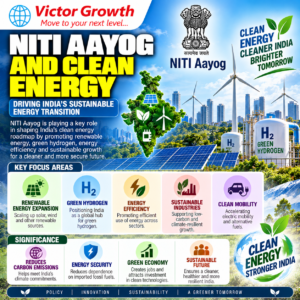
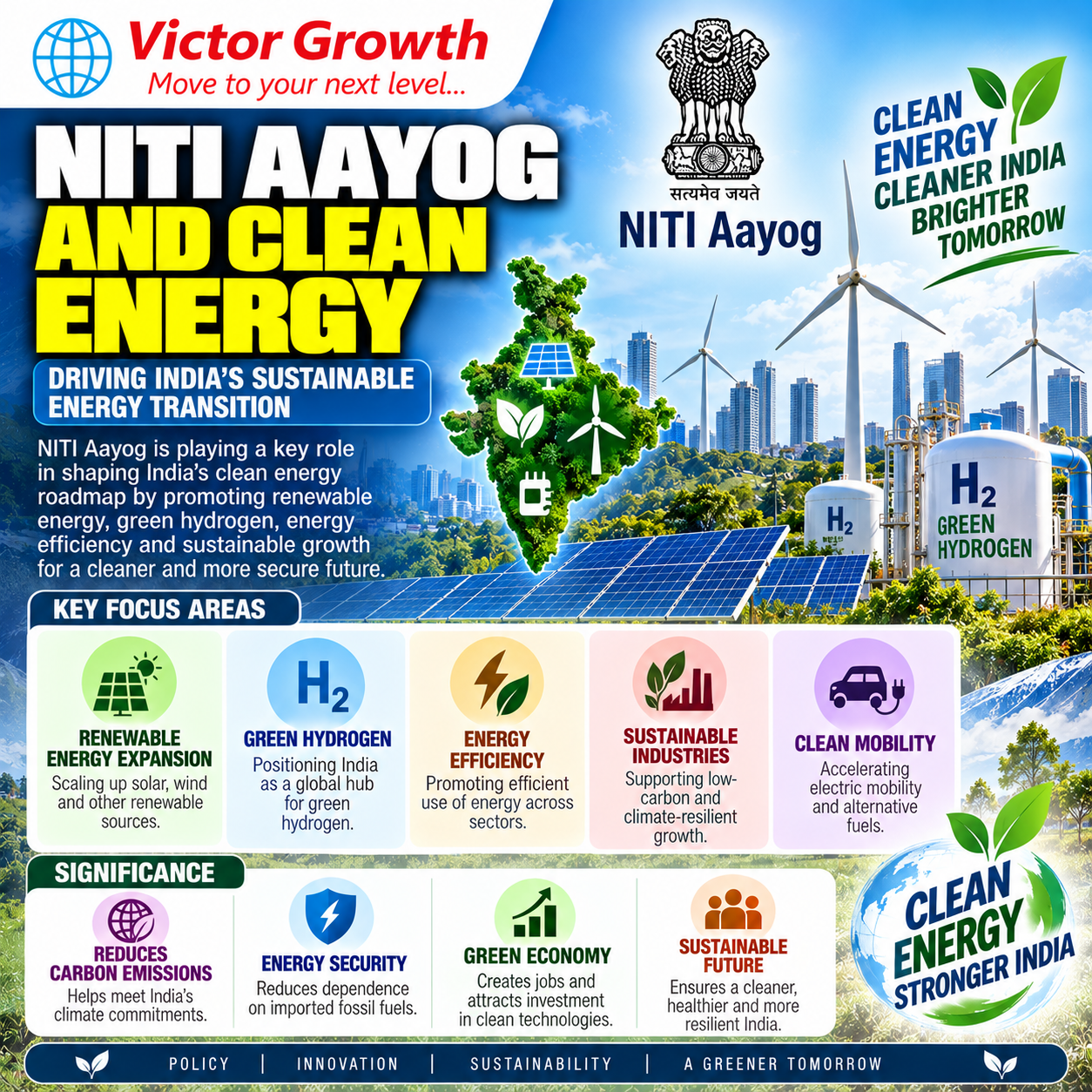
NITI Aayog plays an important role in shaping India’s clean-energy transition through policy research, long-term planning and coordination among government departments. Its Energy Division works on renewable energy, decarbonisation, energy storage, green hydrogen and pathways towards India’s net-zero emissions target.
In 2026, NITI Aayog continued publishing sectoral insights on India’s energy transition and the pathway towards Viksit Bharat and Net Zero. Its work highlights the need to balance economic growth, energy security and environmental sustainability. <Cite refs={[“turn684634search0″,”turn684634search5”]}/>
What Is NITI Aayog?
The National Institution for Transforming India (NITI Aayog) was established on 1 January 2015, replacing the Planning Commission. It serves as the Government of India’s policy think tank and promotes cooperative federalism, evidence-based policymaking and long-term development strategies.
In clean energy, it supports policy formulation, technological assessment and coordination across sectors.
Key Areas of NITI Aayog’s Clean-Energy Work
1. Renewable Energy Expansion
NITI Aayog supports policy approaches that accelerate solar, wind and other non-fossil energy sources. India aims to expand clean electricity capacity while meeting the energy needs of a growing economy.
2. Green Hydrogen
The National Green Hydrogen Mission seeks to establish India as a global hub for green hydrogen production, use and export. Green hydrogen can help decarbonise hard-to-abate sectors such as steel, fertilisers and heavy industry.
3. Energy Storage and Grid Stability
Solar and wind power depend on weather conditions. Battery energy storage systems and pumped-storage hydropower can help balance electricity supply and demand, making renewable energy more reliable.
4. Decarbonisation and Net Zero
NITI Aayog studies pathways to reduce emissions across industry, transport and the energy sector. India has announced a target of achieving net-zero emissions by 2070.
5. Energy Data and Policy Planning
Tools such as the India Climate Energy Dashboard support access to energy-related information and help policymakers analyse trends, monitor progress and improve planning. <Cite refs={[“turn684634search0″,”turn684634search3″,”turn684634search2”]}/>
Why Is This Important for India?
Energy security: Greater use of domestic renewable resources can reduce dependence on imported fossil fuels.
Climate action: Clean energy can help reduce greenhouse gas emissions and air pollution.
Economic growth: Renewable energy and green technologies can attract investment and create employment.
Technological innovation: Research and domestic manufacturing can strengthen India’s clean-energy supply chains.
Cooperative federalism: Coordination between the Centre and states is essential for land availability, grid infrastructure and renewable-energy projects.
Major Challenges
India faces challenges related to the intermittency of renewable energy, inadequate storage capacity, high initial investment, land acquisition and dependence on imported components. Rising electricity demand also requires reliable power sources and stronger transmission infrastructure.
A successful transition must therefore combine renewable energy with storage, grid modernisation, energy efficiency and carefully planned low-carbon technologies.
Way Forward
India should expand energy storage, strengthen domestic manufacturing, improve transmission networks and encourage private investment in clean technologies. NITI Aayog can further support evidence-based policymaking, state-level coordination and measurable progress towards climate and energy goals.
UPSC Exam Relevance
Prelims: NITI Aayog, National Green Hydrogen Mission, renewable energy and energy storage.
Mains GS Paper II: Government institutions, policy coordination and cooperative federalism.
Mains GS Paper III: Energy security, environmental sustainability, climate change and technological development.
Possible UPSC Mains Question: “India’s clean-energy transition requires an integrated approach to energy security, economic growth and environmental sustainability.” Discuss the role of NITI Aayog.
Conclusion
NITI Aayog contributes to India’s clean-energy transition through policy analysis, strategic planning and intergovernmental coordination. By supporting renewable energy, green hydrogen, storage technologies and decarbonisation, it can help India pursue sustainable economic growth while progressing towards its long-term climate commitments.
SEO Title: NITI Aayog and Clean Energy: Role and Initiatives | UPSC
Meta Description: Understand NITI Aayog’s role in India’s clean-energy transition, including renewable energy, green hydrogen, energy storage, net zero and UPSC exam relevance.
URL Slug: niti-aayog-clean-energy-upsc-current-affairs