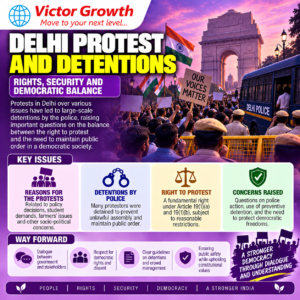
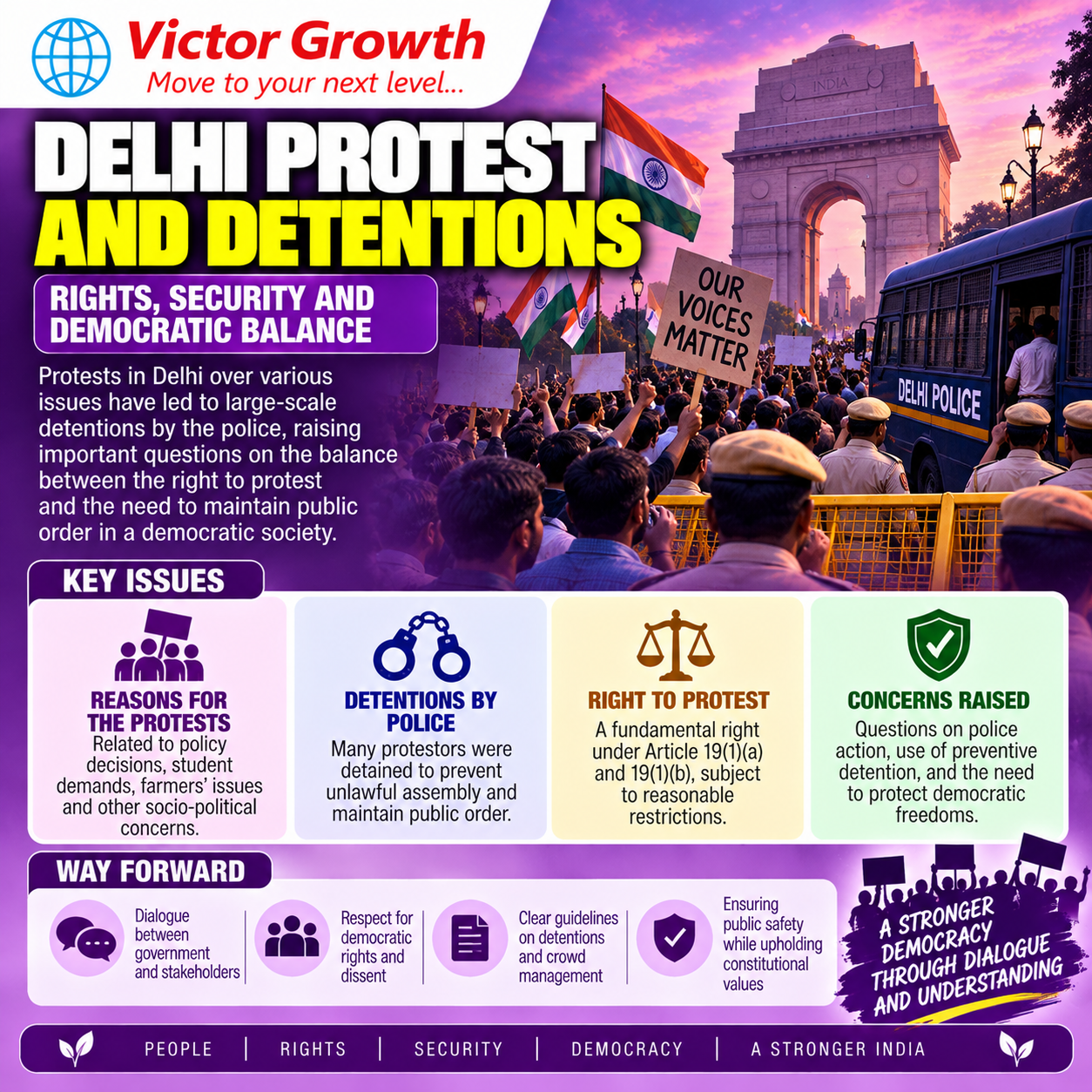
In October 2026, Delhi witnessed protests and large-scale detentions as the Cockroach Janta Party (CJP) and other groups demanded the resignation of Chief Election Commissioner Gyanesh Kumar over alleged irregularities in electoral-roll revision. Police detained protesters and political activists, citing security and public-order concerns. The Election Commission has denied allegations of political bias in the revision process. <Cite refs={[“turn472009news16″,”turn472009search0”]}/>
The incident has renewed debate over the constitutional right to peaceful protest, preventive detention and the independence of electoral institutions.
Background of the Protest
The protests centred on the Special Intensive Revision (SIR) of electoral rolls, a process intended to verify and update voter lists. Critics raised concerns about the deletion of eligible voters, while the Election Commission maintained that the exercise sought to remove duplicate, deceased and otherwise ineligible entries.
The authorities imposed security restrictions around central Delhi, and Jantar Mantar—the traditional protest venue—was declared unavailable for demonstrations. Subsequent attempts by CJP members to enter the site resulted in further detentions. <Cite refs={[“turn472009search0″,”turn472009search11”]}/>
Constitutional Provisions Involved
Article 19(1)(a): Guarantees freedom of speech and expression.
Article 19(1)(b): Protects the right to assemble peacefully and without arms.
Article 19(2) and Article 19(3): Permit reasonable restrictions on speech and peaceful assembly on specified constitutional grounds.
Article 21: Protects life and personal liberty.
Article 22: Provides safeguards relating to arrest and detention.
The right to protest is fundamental to democracy but is not absolute. Restrictions must have a lawful basis and comply with constitutional requirements.
Why Is This Issue Important?
1. Democratic Accountability
Peaceful protests allow citizens to question government decisions, raise grievances and demand institutional accountability.
2. Electoral Integrity
Accurate and inclusive electoral rolls are essential for free and fair elections. Transparent verification and effective grievance-redress mechanisms help protect eligible voters.
3. Police Powers and Civil Liberties
Police must maintain public order, but preventive action and detention should be lawful, necessary and proportionate. Access to legal assistance and judicial remedies remains important.
4. Independence of Constitutional Institutions
The Election Commission of India plays a crucial role in administering elections. Public confidence depends on transparency, impartiality and effective resolution of complaints.
Challenges and the Way Forward
The incident highlights the difficulty of balancing public order with civil liberties. Restrictions on protest sites, mass preventive detentions and concerns over electoral-roll deletions can weaken public trust if not handled transparently.
Authorities should publish clear rules for demonstrations, facilitate peaceful assembly at suitable locations and ensure that detention procedures follow the law. The Election Commission should provide accessible mechanisms for voters to verify their status, challenge incorrect deletions and obtain timely remedies.
UPSC Exam Relevance
Prelims: Fundamental Rights, Articles 19, 21 and 22; Election Commission of India; electoral-roll revision.
Mains GS Paper II: Constitutional bodies, electoral reforms, democratic governance and civil liberties.
Essay: Democracy, dissent and the balance between liberty and public order.
Possible UPSC Mains Question: “The right to peaceful protest is essential for democratic accountability, but must be balanced with public order.” Discuss in the context of constitutional safeguards and electoral governance.
Conclusion
The Delhi protest and detention episode highlights the importance of protecting peaceful dissent while maintaining public order. A healthy democracy requires lawful policing, transparent electoral processes and accessible remedies for citizens. Respect for constitutional freedoms and public confidence in electoral institutions must remain central to democratic governance.
SEO Title: Delhi Protest and Detentions: UPSC Current Affairs
Meta Description: Understand the October 2026 Delhi protests, CJP detentions, constitutional rights, electoral-roll revision and democratic accountability for UPSC preparation.
URL Slug: delhi-protest-detentions-upsc-current-affairs