The UPSC Civil Services Examination requires a combination of conceptual knowledge, analytical thinking, reading ability, communication skills and awareness of current affairs. However, school students do not need to start studying the complete UPSC syllabus at an early age.
IAS Foundation Preparation for school students should focus on building strong fundamentals and developing habits that will be useful when they begin serious UPSC preparation later.
For parents searching for the Best IAS Coaching in Kerala, the right foundation programme should be age-appropriate, engaging and designed to complement regular school education.
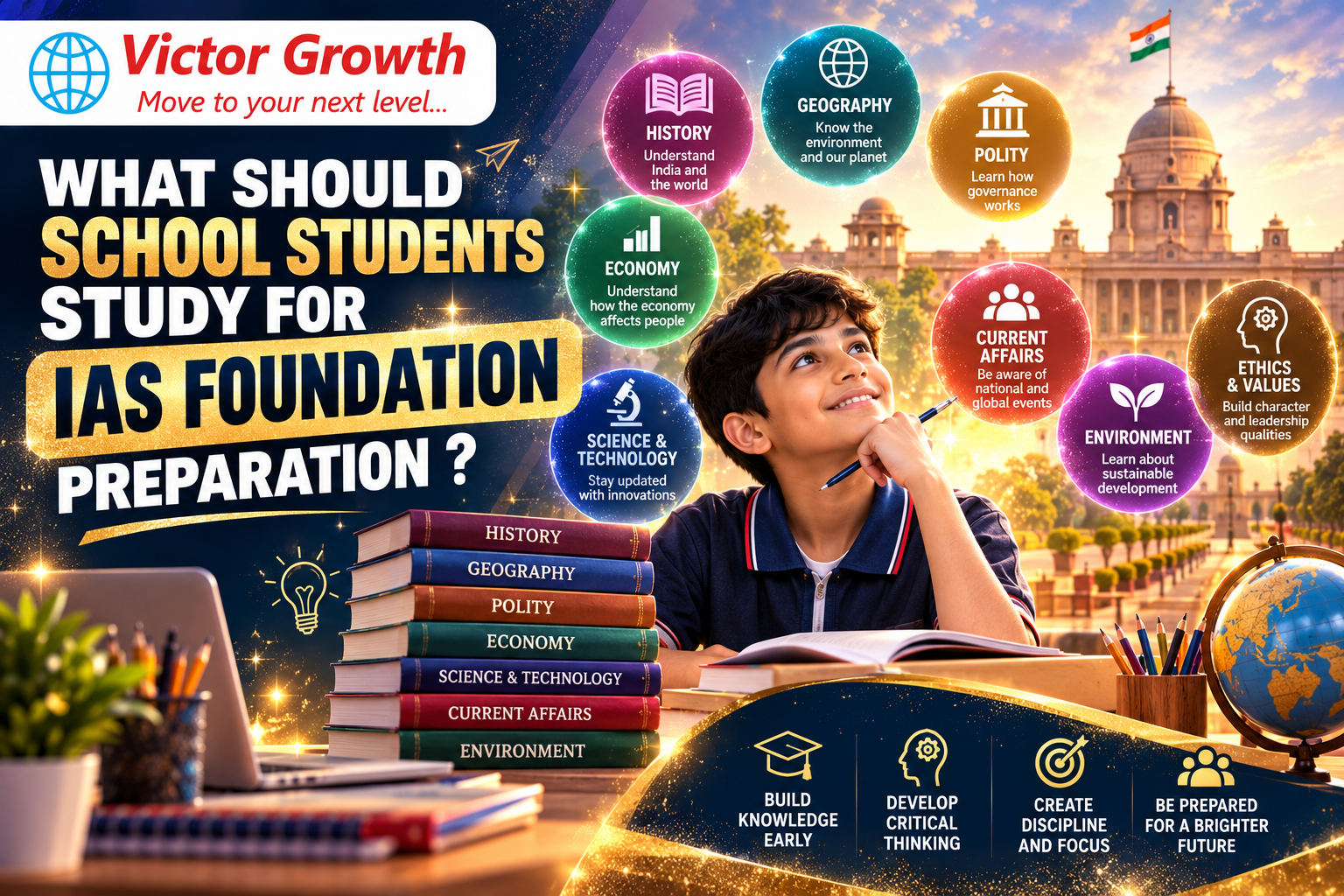
What Should School Students Study for IAS Foundation?
1. School Subjects and Basic Concepts
The first priority should always be strong school-level academics.
Students should develop a clear understanding of:
History
Geography
Civics
Basic Economics
Science
Mathematics
English
School textbooks can provide an excellent starting point because they help students understand fundamental concepts without unnecessary complexity.
The focus should be on understanding rather than memorising.
2. Indian History
Students can gradually develop an interest in India’s past by learning about:
Ancient Indian civilisation
Medieval India
Modern Indian history
Freedom movement
Important personalities
India’s cultural heritage
At the foundation stage, students do not need to memorise extensive dates and facts. Understanding important events, causes and consequences is more valuable.
3. Geography
Geography is another important area for developing a strong foundation.
Students can learn about:
Continents and oceans
India and its physical features
Rivers and mountains
Climate
Monsoon
Agriculture
Natural resources
Population
Maps and locations
Map-based learning can make geography more interesting and improve spatial understanding.
4. Indian Constitution and Civics
Students can gradually learn how India’s democratic system works.
Basic topics can include:
Constitution
Fundamental Rights and Duties
Parliament
President and Prime Minister
State Government
Judiciary
Elections
Local self-government
Role of citizens
These topics can be connected with what students learn in their school Social Science or Civics curriculum.
5. Basic Economics
School students do not need advanced economic theory. They can begin with simple concepts such as:
Money
Banking
Inflation
Budget
Taxes
Employment
Agriculture
Poverty
Economic development
Understanding how the economy affects ordinary people can make these topics easier and more interesting.
6. Science and Technology
Science is an important part of modern society and future competitive examinations.
Students can develop awareness of:
Space technology
Artificial intelligence
Biotechnology
Renewable energy
Information technology
Basic scientific discoveries
Health and science
India’s scientific institutions
The focus should be on understanding how science and technology affect everyday life.
7. Environment and Climate Change
Environmental awareness is increasingly important.
Students can learn basic concepts related to:
Climate change
Global warming
Pollution
Biodiversity
Forests
Wildlife
Conservation
Renewable energy
Sustainable development
Activities, documentaries and real-life examples can make environmental learning more engaging.
8. Current Affairs
Current affairs should form an important part of IAS Foundation Preparation.
Students can gradually follow important developments related to:
India
World affairs
Government initiatives
Science and technology
Environment
Economy
Sports
Important national events
However, students do not need to memorise every daily news item.
The objective is to develop the habit of understanding what is happening and why it matters.
9. Reading and Comprehension
Reading is one of the most valuable skills for a future UPSC aspirant.
Students should gradually develop the habit of reading:
Newspapers
Books
Magazines
Age-appropriate current affairs material
Educational articles
After reading, students can practise answering:
What did I read?
What is the main idea?
Why is it important?
This improves comprehension and analytical ability.
10. Writing Skills
Students should also learn to express their thoughts clearly.
Foundation-level writing activities can include:
Short essays
Paragraph writing
Summaries
Book reviews
Current-affairs notes
Opinion-based writing
The objective is not UPSC-style answer writing at this stage. It is to develop clear and structured expression.
11. General Knowledge and Logical Thinking
Quizzes and reasoning activities can help students develop curiosity and problem-solving abilities.
Useful areas include:
Indian states and capitals
World geography
Important organisations
Historical events
Basic science
Important personalities
Logical reasoning
Problem-solving
Interactive learning can make these topics much more enjoyable than rote memorisation.
What Should Students NOT Do?
IAS Foundation Preparation should not become an intensive UPSC programme during school.
Students generally do not need to:
Complete the entire UPSC syllabus
Read multiple advanced reference books
Memorise large volumes of facts
Spend several hours daily on UPSC material
Follow every current-affairs source available
Sacrifice sports, hobbies or sleep
The purpose of foundation learning is to build capability, not create pressure.
A Simple Study Structure for School Students
A balanced approach could include:
Daily:
20–30 minutes of reading or current affairs.
Weekly:
Foundation class, quiz, discussion or writing activity.
Monthly:
Revision of important concepts and current affairs.
Throughout the year:
Strong focus on regular school academics.
This approach allows students to develop useful habits without compromising their school education.
Choosing the Best IAS Coaching in Kerala for Foundation Preparation
Parents searching for the Best IAS Coaching in Kerala should check whether the institute offers an age-appropriate foundation curriculum.
Important factors include:
Experienced faculty
Concept-based teaching
Current affairs guidance
Quality study materials
Interactive classes
Quizzes and assessments
Communication development
Personal mentorship
Flexible schedules
Balance with school academics
A good foundation programme should encourage students to become better readers, thinkers and learners, rather than simply giving them more books to study.
IAS Foundation at Victor Growth
Victor Growth, Kadavanthra, Kochi, provides foundation-oriented learning for school students interested in developing an early understanding of Civil Services and competitive examinations.
The programme can include general awareness, current affairs, conceptual learning, reading and writing activities, analytical thinking, quizzes, communication development, assessments and mentorship.
For parents looking for the Best IAS Coaching in Kerala, the focus should be on choosing a programme that provides structured guidance while keeping learning age-appropriate and enjoyable.
Frequently Asked Questions
1. What should school students study for IAS Foundation Preparation?
Students should focus on school subjects, history, geography, basic polity, economics, science, environment, current affairs, general knowledge, reading, writing and analytical thinking.
2. Should school students study the complete UPSC syllabus?
No. The complete UPSC syllabus is not necessary at the foundation stage. Students should build strong fundamentals and useful learning habits.
3. Is current affairs important for school students?
Yes. Students can gradually develop awareness of important national and international events through age-appropriate news and current-affairs resources.
4. Which books should school students read for IAS Foundation?
School textbooks and age-appropriate general knowledge, history, geography and current-affairs books are a good starting point. Students do not need a large collection of advanced UPSC books.
5. How much time should students spend on IAS Foundation Preparation?
There is no fixed number of hours. A short, consistent schedule is preferable, while school studies, sleep, sports and hobbies remain priorities.
6. How can parents choose the Best IAS Coaching in Kerala?
Parents should look for experienced faculty, an age-appropriate curriculum, personal mentorship, interactive teaching, quality study materials and a healthy balance with school education.
7. Does IAS Foundation coaching guarantee UPSC success?
No. Foundation coaching can help develop useful knowledge and skills, but future UPSC success depends on sustained preparation, discipline, conceptual understanding and examination performance.
Conclusion
IAS Foundation Preparation for school students should be about building the right foundation, not rushing into the UPSC examination.
Strong academic concepts, reading habits, current-affairs awareness, basic knowledge of history, geography, polity, economics, science and environment, along with communication and analytical skills, can prepare students for more advanced learning in the future.
For parents searching for the Best IAS Coaching in Kerala, the ideal foundation programme should make students curious, confident and capable learners while allowing them to enjoy their school years.