Your Ultimate Guide to Becoming an Officer in the Indian Air Force
Joining the Indian Air Force as a commissioned officer is a dream shared by thousands of young men and women across India. The Air Force Common Admission Test (AFCAT) serves as one of the primary gateways to this prestigious career. However, the journey from filling out the AFCAT application form to finally receiving a commission as an Air Force officer requires careful planning, dedication, and proper guidance.
Many successful candidates attribute their achievements to systematic preparation and expert mentorship received from the best AFCAT coaching in Kerala. With a structured roadmap, aspirants can navigate every stage of the AFCAT selection process confidently and efficiently.
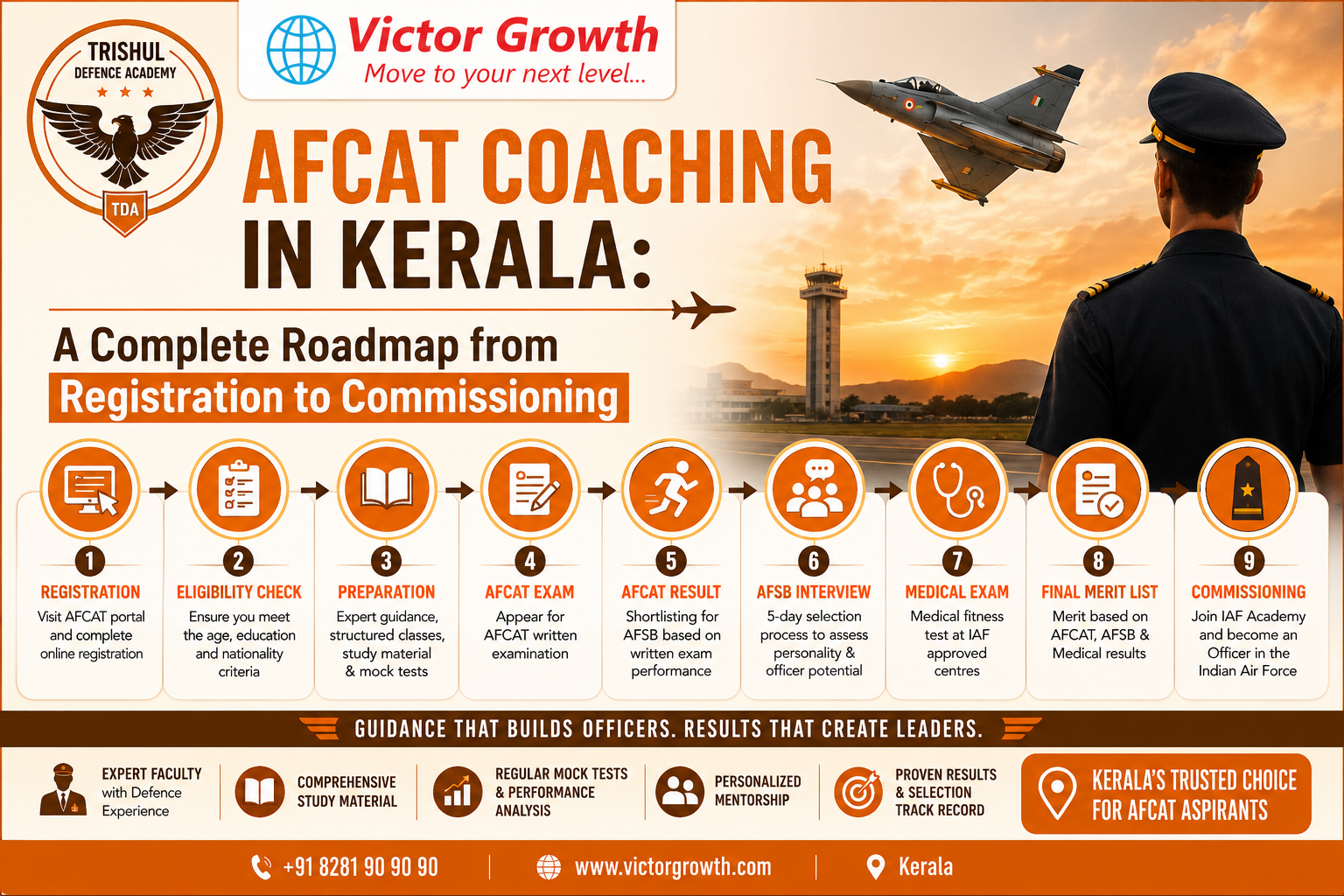
This comprehensive guide explains the complete AFCAT journey—from registration to commissioning—covering eligibility, preparation strategies, written examination, AFSB interview, medical examination, training, and commissioning.
Understanding AFCAT
The Air Force Common Admission Test (AFCAT) is conducted by the Indian Air Force to recruit officers for:
Flying Branch
Responsible for operating fighter aircraft, transport aircraft, and helicopters.
Ground Duty (Technical) Branch
Responsible for maintenance and management of aircraft systems and equipment.
Ground Duty (Non-Technical) Branch
Responsible for administration, logistics, accounts, education, meteorology, and other support functions.
The AFCAT examination is conducted twice every year, usually as:
- AFCAT 1
- AFCAT 2
Stage 1: Understanding Eligibility Criteria
Before beginning preparation, candidates must verify their eligibility.
Nationality
Applicants must be Indian citizens.
Educational Qualification
Flying Branch
- Graduation with minimum required percentage.
- Mathematics and Physics at 10+2 level.
Ground Duty Technical
- Engineering degree in relevant disciplines.
Ground Duty Non-Technical
- Graduation or post-graduation as specified in the notification.
Age Limit
The age criteria vary depending on the branch applied for.
Candidates should always refer to the latest official AFCAT notification for updated eligibility details.
Stage 2: AFCAT Registration Process
The first formal step toward becoming an Air Force officer is registration.
How to Register
Step 1
Visit the official AFCAT recruitment portal.
Step 2
Create a candidate account.
Step 3
Fill in personal details.
Step 4
Upload:
- Photograph
- Signature
- Required documents
Step 5
Select examination centre.
Step 6
Submit application form and pay applicable fees.
Step 7
Download confirmation page for future reference.
Students preparing through the best AFCAT coaching in Kerala often receive guidance on completing the registration process correctly.
Stage 3: Understanding the AFCAT Syllabus
A proper understanding of the syllabus is critical.
The AFCAT written examination consists of:
General Awareness
- Current Affairs
- History
- Geography
- Polity
- Science
- Defence Knowledge
Verbal Ability in English
- Vocabulary
- Grammar
- Comprehension
- Error Detection
Numerical Ability
- Arithmetic
- Percentage
- Profit and Loss
- Time and Work
- Algebra
Reasoning and Military Aptitude
- Logical Reasoning
- Analytical Ability
- Spatial Reasoning
Understanding the syllabus helps candidates create an effective study plan.
Stage 4: Joining AFCAT Coaching
Many aspirants struggle with self-study due to lack of direction and proper resources.
Enrolling in the best AFCAT coaching in Kerala offers several advantages:
Structured Study Plan
Systematic coverage of the entire syllabus.
Expert Faculty
Guidance from experienced defence educators.
Study Materials
Updated notes and question banks.
Mock Tests
Regular assessments and performance analysis.
AFSB Preparation
Integrated interview training.
Professional coaching significantly improves preparation quality.
Stage 5: Building a Preparation Strategy
Daily Study Schedule
A balanced schedule should include:
- English Preparation
- General Awareness
- Quantitative Aptitude
- Reasoning
- Current Affairs
Weekly Goals
- Complete specific topics.
- Attempt mock tests.
- Revise completed portions.
Monthly Goals
- Full syllabus review.
- Performance analysis.
- Improvement planning.
Consistency is the key to AFCAT success.
Stage 6: Preparing for General Awareness
General Awareness is one of the highest-scoring sections.
Important Topics
- Current Affairs
- Defence News
- Indian History
- Geography
- Polity
- Science
Recommended Sources
- Newspapers
- Current Affairs Magazines
- Defence Updates
- Coaching Materials
Daily reading habits play a crucial role.
Stage 7: Preparing for English
The English section can significantly improve overall scores.
Focus Areas
- Vocabulary
- Grammar
- Reading Comprehension
- Error Detection
Improvement Tips
- Read newspapers daily.
- Learn new words regularly.
- Practice comprehension passages.
- Solve previous year questions.
Stage 8: Preparing for Numerical Ability
Many candidates fear mathematics, but consistent practice can improve performance.
Important Topics
- Percentages
- Ratio and Proportion
- Time and Work
- Profit and Loss
- Average
- Algebra
Preparation Strategy
- Strengthen basics.
- Practice daily.
- Learn shortcut techniques.
Stage 9: Preparing for Reasoning and Military Aptitude
Reasoning is one of the most scoring sections.
Topics
- Verbal Reasoning
- Non-Verbal Reasoning
- Spatial Ability
- Analytical Thinking
Practice is essential for improving speed and accuracy.
Stage 10: Mock Tests and Performance Analysis
Mock tests are a crucial component of AFCAT preparation.
Benefits
- Improve speed
- Enhance confidence
- Build exam temperament
- Identify weak areas
Experts recommend attempting at least one full-length mock test every week.
The best AFCAT coaching in Kerala typically provides a comprehensive mock test series.
Stage 11: AFCAT Written Examination
On exam day:
Before the Exam
- Reach the centre early.
- Carry required documents.
- Stay calm and confident.
During the Exam
- Manage time effectively.
- Attempt easy questions first.
- Avoid unnecessary guesswork.
- Monitor negative marking.
A balanced strategy improves performance.
Stage 12: Result Declaration
Candidates who clear the written examination become eligible for the next stage:
Air Force Selection Board (AFSB)
This stage evaluates officer-like qualities and leadership potential.
Stage 13: AFSB Interview Process
The AFSB interview is one of the most important stages.
It generally consists of:
Stage I
Officer Intelligence Rating (OIR)
Tests reasoning and intelligence.
Picture Perception and Discussion Test (PPDT)
Evaluates observation and communication skills.
Stage II
Psychological Tests
- TAT
- WAT
- SRT
- Self Description
Group Testing Officer (GTO) Tasks
- Group Discussion
- Group Planning Exercise
- Outdoor Tasks
- Leadership Tasks
Personal Interview
Assessment of personality, communication, confidence, and awareness.
Candidates receiving AFSB training from the best AFCAT coaching in Kerala often gain a significant advantage.
Stage 14: Medical Examination
Candidates recommended by the AFSB undergo detailed medical examinations.
Medical evaluation includes:
- Vision standards
- Hearing standards
- Physical fitness
- Overall health assessment
Maintaining fitness throughout preparation is highly recommended.
Stage 15: Merit List
The final merit list is prepared based on:
- AFCAT performance
- AFSB performance
- Medical fitness
- Availability of vacancies
Only candidates meeting all requirements are selected.
Stage 16: Joining Air Force Academy Training
Selected candidates undergo training at the prestigious:
Air Force Academy
Training focuses on:
- Military discipline
- Leadership development
- Physical conditioning
- Academic instruction
- Professional military skills
The training period varies depending on the branch.
Stage 17: Commissioning as an Indian Air Force Officer
After successful completion of training, candidates receive their commission and officially become officers in the Indian Air Force.
At this stage, they begin serving in:
Flying Branch
Pilots and aviation officers.
Technical Branch
Engineering and maintenance roles.
Non-Technical Branch
Administration, logistics, education, accounts, and other vital functions.
This marks the successful completion of the AFCAT journey.
Why the Best AFCAT Coaching in Kerala Can Accelerate Your Success
Professional coaching provides:
Expert Guidance
Learn from experienced mentors.
Structured Preparation
Complete syllabus coverage.
Quality Study Materials
Exam-oriented resources.
Mock Test Series
Regular assessments and performance tracking.
AFSB Training
Comprehensive interview preparation.
Personalized Mentorship
Focused improvement plans.
These advantages help candidates stay ahead of the competition.
Common Mistakes to Avoid
- Ignoring the syllabus
- Neglecting current affairs
- Avoiding mock tests
- Poor time management
- Lack of revision
- Delaying AFSB preparation
- Ignoring physical fitness
Avoiding these mistakes can significantly improve selection chances.
Conclusion
The journey from AFCAT registration to commissioning as an Indian Air Force officer is challenging but immensely rewarding. Success requires proper planning, disciplined preparation, consistent effort, and expert guidance.
By following a structured roadmap and preparing under the mentorship of the best AFCAT coaching in Kerala, aspirants can confidently navigate every stage of the selection process—from registration and written examination to AFSB interview, medical examination, training, and commissioning.
With determination, perseverance, and the right strategy, your dream of wearing the Indian Air Force uniform can become a reality.
Frequently Asked Questions (FAQs)
1. What is AFCAT?
AFCAT (Air Force Common Admission Test) is an entrance examination conducted by the Indian Air Force for recruiting commissioned officers in Flying, Technical, and Ground Duty branches.
2. How many times is AFCAT conducted every year?
AFCAT is generally conducted twice a year as AFCAT 1 and AFCAT 2.
3. Can final-year students apply for AFCAT?
Yes, final-year students can apply for certain entries if they meet the eligibility criteria mentioned in the official notification.
4. What subjects are included in the AFCAT written exam?
The exam includes General Awareness, English, Numerical Ability, and Reasoning & Military Aptitude.
5. Is coaching necessary for AFCAT preparation?
Coaching is not mandatory, but professional guidance can improve preparation efficiency and success rates.
6. What happens after clearing the AFCAT written examination?
Candidates are called for the Air Force Selection Board (AFSB) interview.
7. How important is the AFSB interview?
The AFSB interview is a critical stage that evaluates leadership qualities, personality traits, intelligence, and officer-like qualities.
8. Is there a medical examination after AFSB?
Yes. Candidates recommended by the AFSB must clear detailed medical examinations.
9. Where do selected candidates undergo training?
Selected candidates undergo training at the Air Force Academy before commissioning.
10. Why should I join the best AFCAT coaching in Kerala?
The best AFCAT coaching in Kerala offers structured preparation, expert faculty, quality study materials, mock tests, current affairs support, and comprehensive AFSB training, helping candidates maximize their chances of becoming officers in the Indian Air Force.