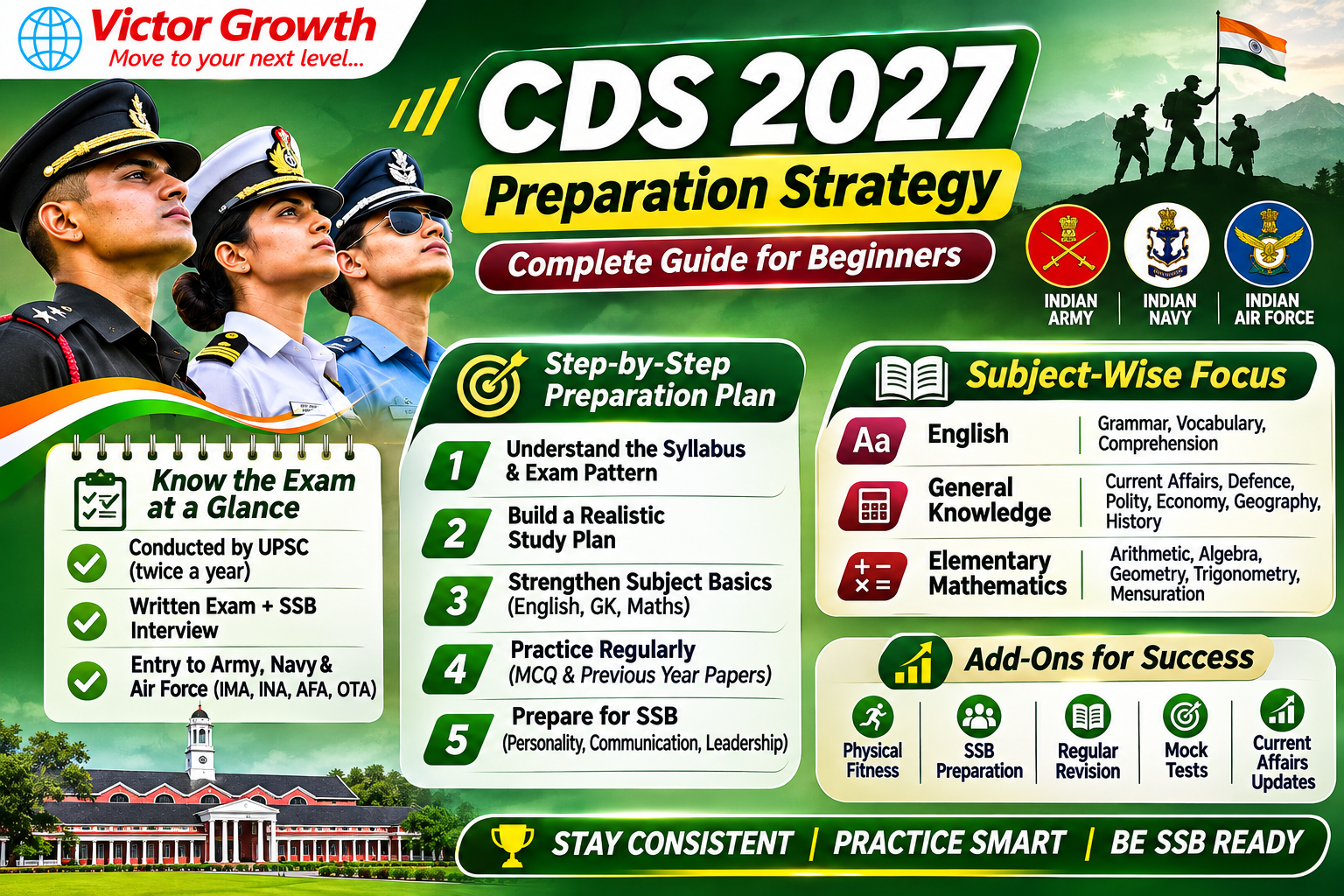
The Combined Defence Services (CDS) Examination is one of the most popular opportunities for graduates who dream of becoming officers in the Indian Armed Forces. Conducted by the Union Public Service Commission (UPSC), the CDS examination provides entry into prestigious training academies, including the Indian Military Academy (IMA), Indian Naval Academy (INA), Air Force Academy (AFA) and Officers Training Academy (OTA).
For beginners, preparing for CDS 2027 may seem challenging because the examination covers multiple subjects and requires strong academic knowledge, time management and consistent practice. However, with the right preparation strategy, proper study materials and regular revision, candidates can improve their chances of success.
This guide explains how beginners can start their CDS 2027 preparation, understand the syllabus, manage their study schedule and prepare effectively for the written examination and SSB interview.
1. Understand the CDS 2027 Exam Pattern
Before starting preparation, candidates should understand the examination pattern. The CDS written examination consists of objective-type questions.
The subjects and marks differ depending on the academy.
Subject | IMA, INA and AFA | OTA |
|---|---|---|
English | 100 marks | 100 marks |
General Knowledge | 100 marks | 100 marks |
Elementary Mathematics | 100 marks | Not applicable |
Total | 300 marks | 200 marks |
Duration: 2 hours for each paper.
All papers contain objective-type questions.
There is negative marking for incorrect answers.
Mathematics is compulsory for IMA, INA and AFA candidates but not required for OTA.
Understanding the examination pattern helps beginners plan their preparation according to their chosen academy.
2. Know the Complete CDS 2027 Syllabus
A clear understanding of the syllabus is essential for effective preparation.
English
English evaluates candidates’ understanding of grammar, vocabulary and language skills.
Important topics include:
Synonyms and Antonyms
Spotting Errors
Sentence Improvement
Fill in the Blanks
Reading Comprehension
Ordering of Sentences
Idioms and Phrases
General Knowledge
This section tests candidates’ awareness of national and international events and general subjects.
Important topics include:
Indian History
Geography
Indian Polity
Economics
General Science
Defence Awareness
Current Affairs
Elementary Mathematics
Mathematics is an important section for IMA, INA and AFA aspirants.
Important topics include:
Arithmetic
Number System
Percentage and Profit and Loss
Ratio and Proportion
Time and Work
Algebra
Geometry
Trigonometry
Mensuration
Statistics
Beginners should first strengthen their basic concepts before attempting difficult questions.
3. Create a Realistic Daily Study Timetable
A proper timetable helps candidates cover the syllabus systematically without unnecessary stress.
Beginners can start with 4–5 hours of focused study daily, depending on their available time.
Subject | Daily Study Time |
|---|---|
English | 1 hour |
General Knowledge | 1 hour |
Mathematics | 1.5 hours |
Current Affairs | 30 minutes |
Revision and Practice | 1 hour |
Candidates preparing for OTA can use the Mathematics study time for additional English and General Knowledge practice.
Consistency is more important than studying for long hours occasionally.
4. Subject-Wise Preparation Strategy for CDS 2027
A. English Preparation Strategy
English can become a scoring subject with regular practice.
Read English newspapers and articles daily.
Learn 10–15 new vocabulary words regularly.
Practise grammar and sentence correction.
Solve previous-year question papers.
Attempt comprehension exercises to improve reading speed.
Focus on understanding grammar rules instead of memorising answers.
B. General Knowledge Preparation Strategy
General Knowledge requires continuous learning and revision.
Study Indian History, Geography and Polity systematically.
Strengthen basic concepts in Physics, Chemistry and Biology.
Follow important national and international current affairs.
Revise defence exercises, awards, appointments and government schemes.
Practise previous-year GK questions.
Beginners should avoid collecting too many study materials. A limited number of reliable resources with regular revision is more effective.
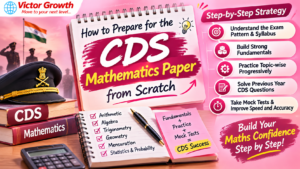
C. Mathematics Preparation Strategy
Mathematics can be challenging for candidates who have weak fundamentals.
Start with basic arithmetic topics such as percentages, averages, ratios, profit and loss, and time and work.
Then gradually move towards algebra, geometry, trigonometry and mensuration.
Understand the basic formulas.
Practise calculations every day.
Solve questions topic by topic.
Maintain a separate formula notebook.
Attempt timed practice tests.
Regular practice and conceptual clarity are essential for improving mathematical accuracy.
5. Importance of Previous-Year Question Papers and Mock Tests
Previous-year question papers are among the most useful resources for CDS preparation.
They help candidates understand:
Frequently asked topics.
Question difficulty levels.
Important chapters.
Examination patterns.
Time management requirements.
Beginners should first solve topic-wise questions after completing each chapter. Once they gain confidence, they should attempt full-length mock tests under examination conditions.
After every mock test, identify mistakes and revise the topics where performance is weak.
6. How to Prepare for the CDS SSB Interview?
Clearing the written examination is only one stage of the CDS selection process. Candidates who qualify must attend the Services Selection Board (SSB) interview.
The SSB process generally includes:
Officer Intelligence Rating (OIR) Test: Evaluates reasoning and intelligence abilities.
Picture Perception and Discussion Test (PPDT): Tests observation, story formation and communication.
Psychological Tests: Includes TAT, WAT, SRT and Self Description.
Group Testing Officer Tasks: Evaluates teamwork, leadership and problem-solving abilities.
Personal Interview: Assesses personality, motivation and awareness.
Conference: The final assessment stage before the recommendation decision.
Candidates should develop communication skills, confidence, leadership qualities and general awareness from the beginning of their preparation.
7. Common Mistakes Beginners Should Avoid
Many candidates struggle with CDS preparation because of poor planning and inconsistent study habits.
Avoid these common mistakes:
Studying without understanding the official syllabus.
Ignoring previous-year question papers.
Collecting too many books and study materials.
Avoiding Mathematics practice.
Neglecting English grammar and vocabulary.
Ignoring current affairs.
Not revising previously studied topics.
Starting SSB preparation only after clearing the written examination.
A disciplined approach and regular self-assessment can help candidates avoid these problems.
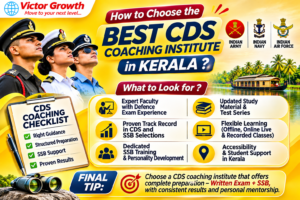
8. Why Choose the Best CDS Coaching in Kerala?
Preparing for CDS requires proper academic guidance, regular practice and a structured study plan. Choosing the best CDS coaching in Kerala can help beginners understand the examination pattern and prepare systematically.
A good CDS coaching institute should provide:
Experienced faculty for all major subjects.
Complete syllabus coverage.
Regular mock examinations.
Previous-year question paper discussions.
Current affairs and General Knowledge sessions.
Mathematics and English practice.
SSB interview guidance.
Individual attention and performance evaluation.
At Victor Growth, Kochi, defence aspirants can receive structured guidance for competitive defence examinations. With proper academic support, regular practice and consistent preparation, candidates can work towards achieving their goal of becoming officers in the Indian Armed Forces.
9. Final Preparation Tips for CDS 2027
Follow these important tips to make your preparation more effective:
Start preparation early and follow a realistic timetable.
Understand the syllabus and examination pattern.
Give equal importance to conceptual learning and practice.
Solve previous-year question papers regularly.
Revise important topics every week.
Improve speed and accuracy through mock tests.
Read current affairs daily.
Maintain physical fitness and develop communication skills.
Prepare for the SSB interview alongside written examination preparation.
Remember, regular effort and the right preparation strategy are more important than studying everything at once.
10. Frequently Asked Questions (FAQs)
1. Can beginners crack the CDS 2027 examination?
Yes. Beginners can clear CDS with proper planning, consistent study, regular practice and a clear understanding of the syllabus.
2. How many hours should I study daily for CDS 2027?
Beginners can start with 4–5 hours of focused study daily. Study time can be increased depending on individual preparation levels and examination requirements.
3. Is Mathematics compulsory for CDS?
Mathematics is compulsory for IMA, INA and AFA entries. OTA candidates are not required to write the Mathematics paper.
4. Which subject should beginners study first?
Beginners should start with basic English grammar, fundamental Mathematics concepts and important General Knowledge topics. All subjects should receive regular attention.
5. Are NCERT books enough for CDS preparation?
NCERT books are useful for building basic concepts, especially in History, Geography and Science. However, candidates should also practise previous-year questions and use additional preparation materials.
6. Is coaching necessary for CDS 2027?
Coaching is not compulsory, but structured guidance can help candidates understand difficult topics, follow a timetable and evaluate their preparation through regular tests.
7. When should I start preparing for the CDS SSB interview?
Candidates should begin developing communication skills, confidence, leadership qualities and general awareness during their written examination preparation itself.
8. Can final-year students apply for CDS 2027?
Yes. Final-year degree students can apply, subject to the educational qualification conditions and deadlines specified in the official UPSC notification.
Conclusion
CDS 2027 is an excellent opportunity for graduates who aspire to serve the nation as commissioned officers in the Indian Army, Navy or Air Force. For beginners, success starts with understanding the syllabus, developing strong fundamentals and following a consistent preparation strategy.
Regular practice, mock examinations, previous-year question papers and early SSB preparation can make a significant difference in performance.
With dedication, discipline and proper guidance from the best CDS coaching in Kerala, aspiring candidates can move closer to achieving their dream of joining the Indian Armed Forces.