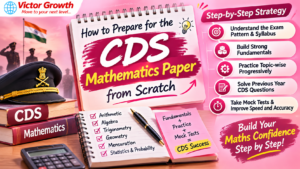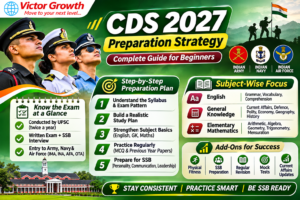
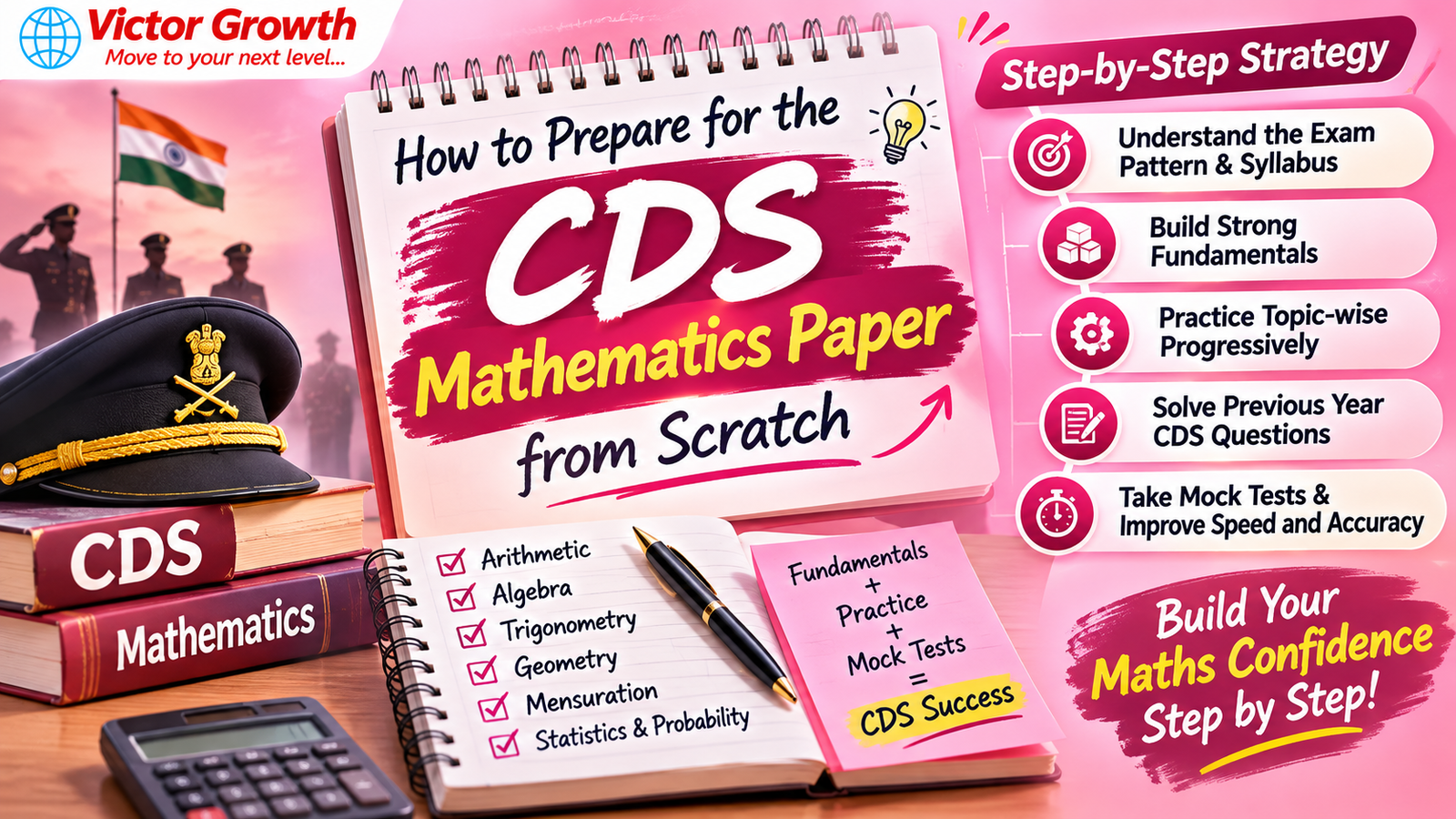
Preparing for the CDS Mathematics paper from scratch may seem difficult, especially for candidates who are not confident in mathematics. However, with a clear study plan, regular practice and proper guidance, you can gradually improve your problem-solving skills and score well in the examination.
The CDS (Combined Defence Services) examination, conducted by UPSC, includes an Elementary Mathematics paper for candidates applying to IMA, INA and Air Force Academy. Candidates applying for OTA do not have to write this paper.
If you are a beginner, this guide will help you understand the syllabus, identify important topics and develop an effective preparation strategy. Joining the best CDS coaching in Kerala can also help you prepare with structured lessons, regular practice and mock tests.
1. Understand the CDS Mathematics Exam Pattern
Before starting your preparation, understand the examination pattern.
Total marks: 100
Duration: 2 hours
Question type: Objective (multiple-choice questions)
Negative marking: One-third of the marks assigned to a question are deducted for every incorrect answer.
The paper tests basic mathematical concepts up to the level prescribed in the CDS syllabus. Speed and accuracy are equally important.
2. Know the Important Topics in the CDS Mathematics Syllabus
The CDS Mathematics syllabus covers several topics. Beginners should first focus on understanding the basic concepts before attempting difficult questions.
Important topics include:
Arithmetic: Number system, HCF and LCM, percentage, profit and loss, ratio and proportion, time and work, time and distance, simple and compound interest.
Algebra: Basic algebraic identities, polynomials, quadratic equations, indices and logarithms.
Trigonometry: Trigonometric ratios, standard angles, identities, heights and distances.
Geometry: Lines and angles, triangles, circles, quadrilaterals and properties of geometric figures.
Mensuration: Area, perimeter, surface area and volume of two-dimensional and three-dimensional figures.
Statistics: Collection and classification of data, graphs, measures of central tendency and basic statistical concepts.
3. Start with Basic Mathematics
If you are starting from zero, do not immediately solve CDS-level questions. First, revise fundamental concepts such as:
Addition, subtraction, multiplication and division
Fractions and decimals
Squares, square roots and cubes
Basic percentage calculations
Simple equations
Basic formulas
Spend enough time understanding these concepts. A strong foundation will make advanced topics easier to learn.
4. Follow a Topic-Wise Preparation Strategy
Avoid studying all topics randomly. Complete one topic at a time.
A practical order for beginners is:
Number System
HCF and LCM
Percentage
Ratio and Proportion
Profit and Loss
Time and Work
Time, Speed and Distance
Algebra
Geometry
Mensuration
Trigonometry
Statistics
Start with easier arithmetic topics to build confidence. Gradually move towards geometry, trigonometry and other topics.
5. Practise Previous Year Question Papers
Previous year question papers are essential for CDS Mathematics preparation. They help you:
Understand the question pattern.
Identify frequently tested topics.
Improve calculation speed.
Understand the difficulty level.
Recognise your weak areas.
After completing each topic, solve questions from previous CDS examinations. Do not simply check the answers. Understand the method used to solve each problem.
6. Make Formula Revision a Daily Habit
Mathematics requires regular formula revision. Maintain a separate notebook for important formulas related to algebra, geometry, trigonometry and mensuration.
Spend at least 10–15 minutes every day revising formulas. This will help you remember them during the examination and reduce calculation time.
7. Take Regular Mock Tests
Mock tests help you understand how to manage the two-hour examination.
Initially, practise topic-wise tests. Once you complete the syllabus, start attempting full-length mock tests.
After every test, analyse your mistakes and identify whether they occurred because of:
Lack of conceptual understanding.
Incorrect formula application.
Calculation errors.
Poor time management.
Avoid guessing answers randomly because negative marking can reduce your score.
8. Follow a Simple Daily Study Timetable
Consistency is more important than studying for long hours occasionally. Beginners can follow this simple routine:
Study activity | Time |
|---|---|
Learn a new concept | 30 minutes |
Practise solved examples | 30 minutes |
Solve CDS-level questions | 30 minutes |
Revise formulas | 15 minutes |
Review mistakes | 15 minutes |
Try to practise mathematics every day. Even a small number of questions solved consistently can improve your confidence.
9. Choose the Right CDS Coaching in Kerala
Preparing independently can be challenging for beginners, particularly when they struggle with mathematical concepts. A good coaching institute can provide structured classes, concept-based teaching, practice sessions and regular assessments.
When choosing the best CDS coaching in Kerala, look for:
Experienced faculty who can explain basic concepts clearly.
Topic-wise classes covering the complete syllabus.
Regular practice using previous year questions.
Mock examinations and performance analysis.
Individual support to improve weak areas.
Victor Growth provides guidance for defence competitive examination preparation, helping aspirants work towards their CDS goals with a structured approach.
Conclusion
Preparing for the CDS Mathematics paper from scratch requires patience, consistency and the right learning strategy. Start with basic concepts, focus on important topics, practise previous year questions and revise formulas regularly. Do not get discouraged by difficult questions in the beginning.
With disciplined preparation and proper guidance from the best CDS coaching in Kerala, even candidates with weak mathematical foundations can gradually develop the confidence and skills needed to perform well in the CDS examination.
Frequently Asked Questions (FAQs)
1. Can I prepare for CDS Mathematics from scratch?
Yes. You can prepare from scratch by learning basic mathematical concepts first and gradually moving towards CDS-level questions.
2. Is CDS Mathematics difficult for beginners?
It can be challenging initially, but regular practice and a clear understanding of basic concepts make it manageable.
3. How many hours should I study Mathematics daily for CDS?
Beginners can start with 1–2 hours daily. Focus on understanding concepts and solving questions consistently.
4. Which topics should I study first for CDS Mathematics?
Start with number systems, HCF and LCM, percentages, ratio and proportion, profit and loss, and time and work.
5. Is Mathematics compulsory for all CDS candidates?
No. Mathematics is compulsory for candidates applying to IMA, INA and Air Force Academy. Candidates applying for OTA have only English and General Knowledge papers in the written examination.
6. Are previous year question papers important for CDS Mathematics?
Yes. They help you understand the examination pattern, practise frequently tested concepts and improve speed and accuracy.