Joining the Indian Armed Forces is a dream for many young graduates who wish to serve the nation and build a respected career in defence. Two popular entry examinations for graduates are the Combined Defence Services (CDS) Examination and the Air Force Common Admission Test (AFCAT).
Both examinations offer opportunities to become commissioned officers, but they differ in terms of the services offered, eligibility criteria, examination patterns, training and career opportunities.
For candidates planning to enter the defence forces, choosing between CDS and AFCAT can be confusing. Understanding their differences will help you select the examination that matches your educational qualifications, interests and career goals.
In this article, we compare CDS vs AFCAT to help aspirants make the right decision and understand how to prepare effectively.
1. What Is the CDS Examination?
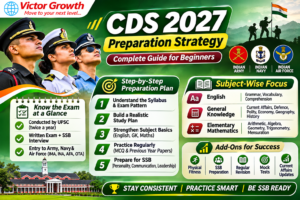
The Combined Defence Services (CDS) Examination is conducted by the Union Public Service Commission (UPSC). It provides graduates with an opportunity to join the Indian Army, Indian Navy and Indian Air Force as commissioned officers.
Through CDS, candidates can apply for admission to four major training academies:
Indian Military Academy (IMA): For candidates aspiring to become officers in the Indian Army.
Indian Naval Academy (INA): For candidates interested in becoming officers in the Indian Navy.
Air Force Academy (AFA): For candidates aspiring to become officers in the Indian Air Force.
Officers Training Academy (OTA): Offers Short Service Commission entry into the Indian Army for eligible men and women.
CDS is suitable for graduates who want to explore officer-level career opportunities across different branches of the Indian Armed Forces.
2. What Is the AFCAT Examination?
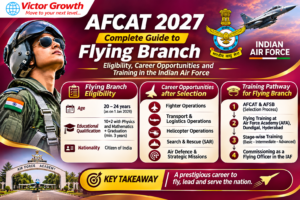
The Air Force Common Admission Test (AFCAT) is conducted by the Indian Air Force to recruit officers for its Flying and Ground Duty branches.
AFCAT provides opportunities in the following areas:
Flying Branch
Fighter Pilot
Transport Pilot
Helicopter Pilot
Ground Duty Technical Branch
Aeronautical Engineering (Electronics)
Aeronautical Engineering (Mechanical)
Ground Duty Non-Technical Branch
Administration
Logistics
Accounts
Education
Meteorology
Weapon Systems
AFCAT is particularly suitable for graduates who want to build their careers as officers in the Indian Air Force.
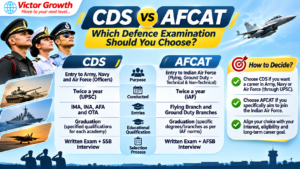
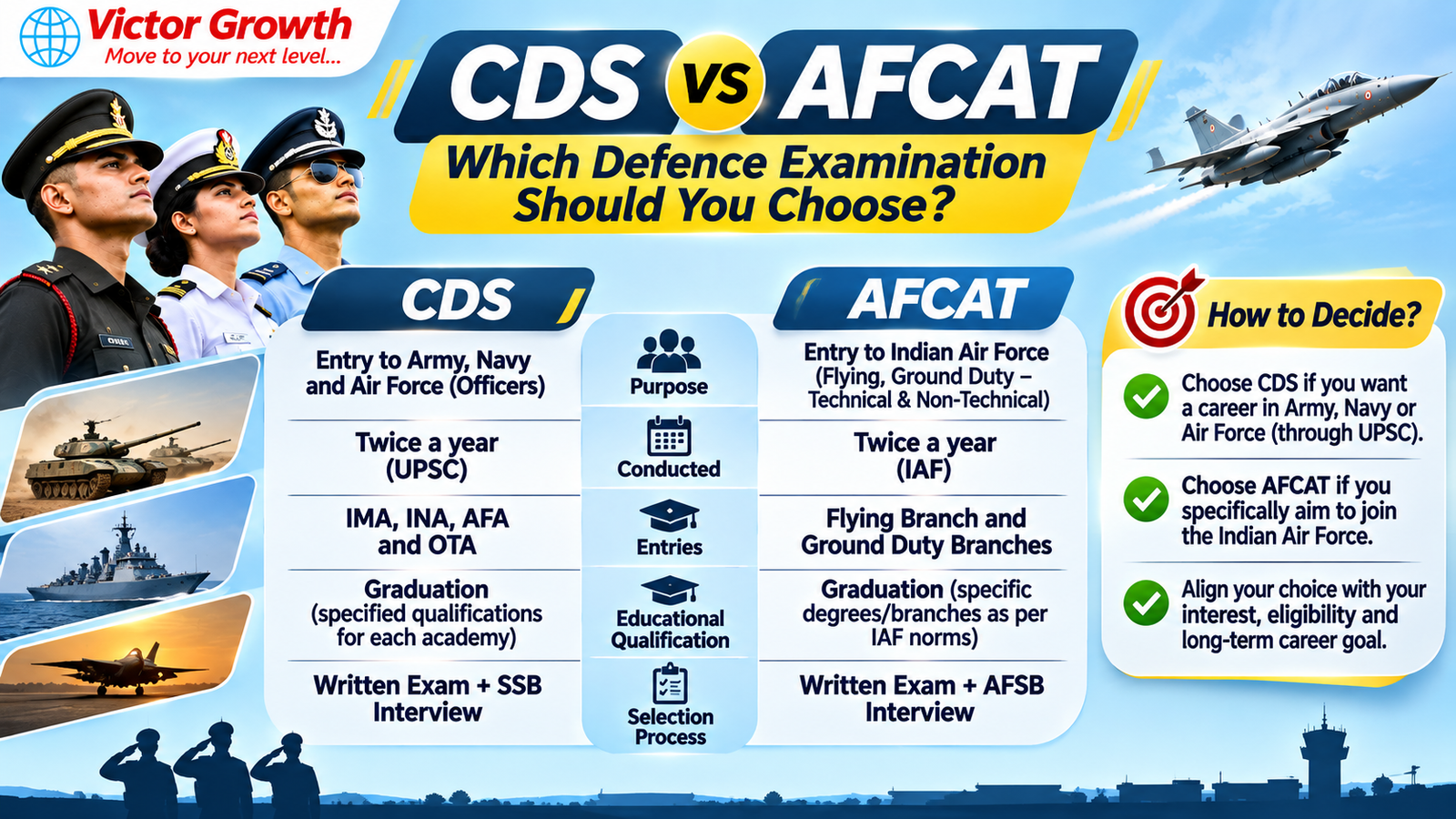
3. CDS vs AFCAT: Major Differences
Understanding the major differences between these examinations can help candidates select the right career path.
Factors | CDS | AFCAT |
|---|---|---|
Conducting Authority | UPSC | Indian Air Force |
Services | Army, Navy and Air Force | Indian Air Force |
Educational Qualification | Graduation; varies by academy | Graduation or specialised qualifications depending on branch |
Age Limit | Generally 19–25 years, depending on academy | 20–26 years, depending on branch |
Exam Mode | Offline | Online |
Subjects | English, GK and Mathematics (except OTA) | English, General Awareness, Numerical Ability and Reasoning |
Exam Duration | 2 hours per paper | 2 hours |
Total Marks | 300 for IMA, INA and AFA; 200 for OTA | 300 |
Selection Process | Written Exam, SSB and Medical | Written Exam, AFSB and Medical |
Career Opportunities | Army, Navy and Air Force | Air Force |
Age limits and eligibility vary according to the entry and course. Candidates must check the respective official notifications.
4. CDS vs AFCAT: Eligibility Criteria
Eligibility is one of the most important factors when choosing between CDS and AFCAT.
CDS Eligibility
Candidates must possess a recognised bachelor’s degree for IMA and OTA.
INA generally requires an engineering degree.
AFA requires graduation with Physics and Mathematics at the 10+2 level or a BE/BTech degree.
Age limits vary according to the academy.
Women candidates can apply for the prescribed OTA entry.
AFCAT Eligibility
Flying Branch: Graduation with at least 60% marks or BE/BTech, along with Physics and Mathematics at the 10+2 level.
Ground Duty Technical: Relevant engineering or technology qualifications.
Ground Duty Non-Technical: Graduation or specialised qualifications depending on the branch.
Flying Branch age limit: 20–24 years, with applicable relaxation up to 26 years for eligible CPL holders.
Ground Duty age limit: 20–26 years.
Both examinations have additional physical, medical and nationality requirements.
5. CDS vs AFCAT: Exam Pattern and Syllabus
The examination pattern is another important difference between CDS and AFCAT.
CDS Exam Pattern
For IMA, INA and AFA:
Subject | Marks | Duration |
|---|---|---|
English | 100 | 2 Hours |
General Knowledge | 100 | 2 Hours |
Elementary Mathematics | 100 | 2 Hours |
Total | 300 | 6 Hours |
For OTA, candidates write only English and General Knowledge, carrying 200 marks in total.
AFCAT Exam Pattern
Subject | Topics |
|---|---|
General Awareness | History, Geography, Science, Defence and Current Affairs |
English | Grammar, Vocabulary and Comprehension |
Numerical Ability | Arithmetic and Basic Mathematics |
Reasoning and Military Aptitude | Verbal and Non-Verbal Reasoning |
Total Questions: 100
Total Marks: 300
Duration: 2 Hours
Correct Answer: +3 marks
Incorrect Answer: -1 mark
CDS has separate subject papers, while AFCAT combines four subject areas into one online examination.
6. CDS vs AFCAT: Career Opportunities and Salary
Both examinations offer excellent career opportunities, but the service conditions and professional responsibilities differ.
Career Through CDS
Candidates selected through CDS can become officers in the Army, Navy or Air Force, depending on their academy and entry.
Career opportunities include:
Army Officer
Naval Officer
Air Force Officer
The service commission depends on the selected academy. IMA and INA offer Permanent Commission, while the OTA entry offers Short Service Commission. AFA commission conditions depend on the applicable entry.
Career Through AFCAT
AFCAT candidates can join the Indian Air Force as Flying or Ground Duty officers.
Career opportunities include:
Fighter, Transport and Helicopter Pilot
Aeronautical Engineer
Administration Officer
Logistics Officer
Accounts Officer
Other specialised Air Force roles
Salary Comparison
Both examinations offer attractive officer-level salaries.
Basic Pay: ₹56,100 per month at the applicable entry-level officer rank.
Military Service Pay: ₹15,500 per month, where applicable.
Additional allowances depend on the service, branch, duties and posting.
AFCAT Flying Branch officers may receive Flying Allowance, while eligible Ground Duty Technical officers may receive Technical Allowance.
7. CDS vs AFCAT: Which Is Easier to Crack?
There is no universally easier examination. The difficulty depends on the candidate’s subject knowledge, preparation level and strengths.
CDS may be suitable if:
You have strong English and General Knowledge skills.
You are comfortable with Mathematics.
You want to explore Army, Navy and Air Force career opportunities.
You prefer a traditional offline examination.
AFCAT may be suitable if:
You are interested specifically in the Indian Air Force.
You have good reasoning and numerical aptitude.
You are comfortable with computer-based examinations.
You want to explore Flying or Ground Duty career opportunities.
Candidates should compare the syllabus and eligibility requirements rather than choosing an examination based only on its perceived difficulty.
8. Can You Prepare for Both CDS and AFCAT Together?
Yes. Candidates can prepare for CDS and AFCAT simultaneously because several subjects overlap.
Common preparation areas include:
English Grammar and Vocabulary
General Awareness
History and Geography
Basic Mathematics
Current Affairs
Reasoning and Aptitude
However, candidates should also prepare for examination-specific topics. CDS requires dedicated preparation for Elementary Mathematics for IMA, INA and AFA, while AFCAT includes a separate Reasoning and Military Aptitude section.
Solving previous-year question papers and taking separate mock tests for both examinations can help candidates manage their preparation effectively.
9. How to Choose the Right Defence Coaching Institute?
Choosing the right coaching institute can help candidates follow a structured preparation strategy.
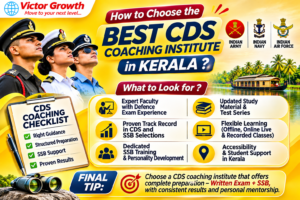
Students searching for the best CDS coaching in Kerala should look for institutes that offer:
Experienced faculty for English, Mathematics and General Knowledge.
Complete CDS and AFCAT syllabus coverage.
Regular mock examinations.
Previous-year question paper discussions.
Current Affairs preparation.
Individual doubt-clearing sessions.
SSB and AFSB interview guidance.
Personality development and communication training.
At Victor Growth, Kochi, defence aspirants can receive guidance for competitive defence examinations through structured academic preparation and examination-oriented learning.
Selecting an institute that understands the requirements of both CDS and AFCAT can help students prepare confidently for their preferred defence career.
10. Frequently Asked Questions (FAQs)
1. Which is better, CDS or AFCAT?
CDS is better for candidates who want opportunities in the Army, Navy or Air Force. AFCAT is suitable for candidates who specifically want to join the Indian Air Force.
2. Can I apply for both CDS and AFCAT?
Yes. Eligible candidates can apply for both examinations separately, provided they satisfy the respective age, educational and other eligibility conditions.
3. Which examination is easier, CDS or AFCAT?
Neither examination is universally easier. CDS includes separate English, General Knowledge and Mathematics papers for most academy entries, while AFCAT tests four subject areas in a single online examination.
4. Is Mathematics compulsory for both CDS and AFCAT?
CDS Mathematics is compulsory for IMA, INA and AFA but not OTA. AFCAT includes Numerical Ability for all candidates appearing through the AFCAT written examination.
5. Can women apply for CDS and AFCAT?
Yes. Women can apply for the prescribed OTA entry through CDS and eligible Flying and Ground Duty vacancies through AFCAT.
6. Which examination offers better career opportunities?
Both offer excellent career opportunities. CDS provides access to multiple armed services, while AFCAT focuses on different officer roles within the Indian Air Force.
7. Can BCom graduates apply for CDS and AFCAT?
Yes. BCom graduates can apply for eligible CDS entries such as IMA and OTA. They may also apply for AFCAT Ground Duty Non-Technical branches if they meet the specific educational requirements. Flying Branch requires Physics and Mathematics at the 10+2 level.
8. Is coaching necessary for CDS and AFCAT preparation?
Coaching is not compulsory, but professional guidance, regular mock tests and structured preparation can help candidates improve their performance.
9. Which is the best CDS coaching in Kerala?
Candidates should choose an institute that offers experienced faculty, comprehensive syllabus coverage, regular tests, individual guidance and SSB preparation. Victor Growth in Kochi is an option for aspirants seeking defence examination coaching.
Conclusion
Choosing between CDS and AFCAT depends on your career ambitions, educational qualifications and personal interests. CDS offers opportunities to join the Indian Army, Navy and Air Force through different academies, whereas AFCAT provides specialised career opportunities within the Indian Air Force.
Before selecting an examination, carefully understand the eligibility criteria, syllabus, selection process and career opportunities.
Candidates can also prepare for both examinations together by focusing on common subjects and practising examination-specific questions.
With consistent preparation, proper guidance and support from the best CDS coaching in Kerala, defence aspirants can move closer to achieving their dream of becoming commissioned officers in the Indian Armed Forces.