Preparing for the UPSC Civil Services Examination is one of the most demanding academic journeys in India. Every year, lakhs of aspirants begin their preparation, but only a small percentage qualify for the final merit list. One of the most common mistakes made by beginners is collecting too many books and study materials instead of mastering a limited set of reliable resources.
The UPSC examination does not reward the number of books you read—it rewards conceptual clarity, repeated revision, analytical thinking, and smart preparation.
Choosing the right books is therefore one of the first and most important decisions an aspirant makes. Standard books provide authentic information, comprehensive coverage of the syllabus, and the conceptual depth required for both UPSC Prelims and UPSC Mains.
At Victor Growth, recognized as one of the Best IAS Coaching in Kerala, students are guided to follow a limited yet comprehensive set of standard books that have consistently helped successful candidates build a strong foundation.
Why Choosing the Right Books Matters
The UPSC syllabus is extensive, covering subjects such as History, Geography, Polity, Economy, Environment, Science & Technology, Ethics, Essay, Current Affairs, and an Optional Subject.
Without proper guidance, aspirants often:
- Buy too many books
- Follow multiple coaching notes
- Waste time comparing resources
- Revise inadequately
- Experience information overload
Selecting a few trusted books and revising them multiple times is far more effective than constantly switching between different sources.
Start with NCERT Books
Before moving to advanced reference books, every aspirant should develop a strong conceptual foundation through NCERT textbooks.
Recommended NCERT Subjects
- History (Class VI–XII)
- Geography (Class VI–XII)
- Political Science (Class IX–XII)
- Economics (Class IX–XII)
- Science (Class VI–X)
- Sociology (Selective)
- Art & Culture (Selective)
Why NCERTs?
- Simple language
- Conceptual clarity
- Reliable information
- Frequently reflected in UPSC questions
- Excellent for beginners
Reading NCERTs first makes advanced books easier to understand.
Essential Books for Indian Polity
Indian Polity is one of the highest-scoring and most predictable subjects in UPSC.
Recommended Books
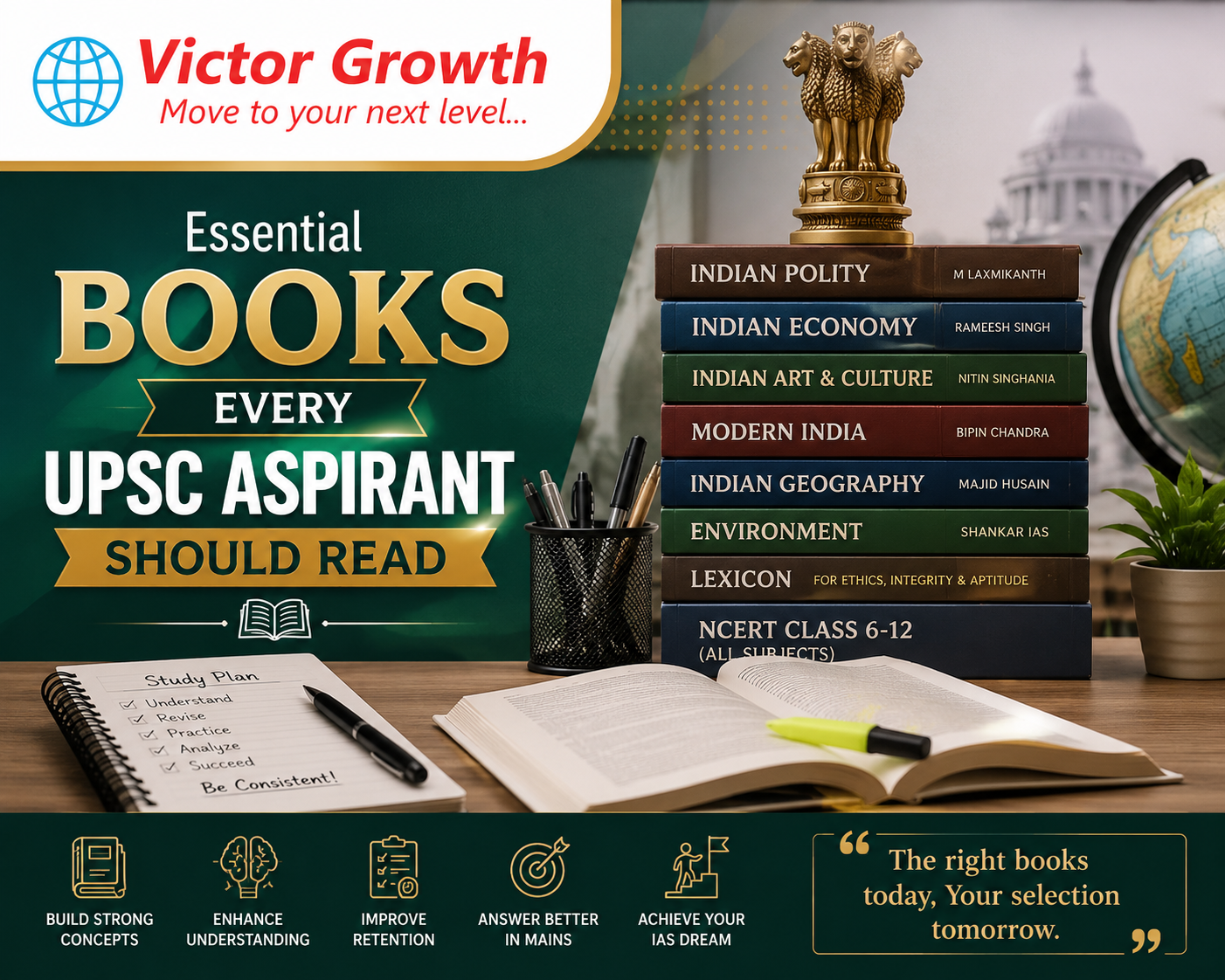
1. Indian Polity – M. Laxmikanth
This book is widely regarded as the “Bible” for UPSC Polity.
Topics covered include:
- Constitution
- Fundamental Rights
- DPSPs
- Parliament
- President
- Judiciary
- Federalism
- Constitutional Bodies
- Local Government
- Amendments
Why It Is Essential
- Comprehensive coverage
- Easy-to-understand language
- Frequently updated editions
- Highly relevant for both Prelims and Mains
Essential Books for Modern Indian History
1. Spectrum – A Brief History of Modern India
This is the most recommended book for Modern History.
Topics include:
- European Arrival
- Revolt of 1857
- Social Reform Movements
- Freedom Struggle
- Congress Sessions
- Partition
- Independence
Why It Is Important
- Concise presentation
- Chronological arrangement
- Excellent revision resource
- Highly relevant for UPSC Prelims
Ancient and Medieval History
Recommended Resources
- Old NCERT History Books
- New NCERT History Textbooks
Focus on:
- Indus Valley Civilization
- Vedic Age
- Mauryan Empire
- Gupta Empire
- Delhi Sultanate
- Mughal Empire
- Bhakti and Sufi Movements
Essential Books for Geography
1. NCERT Geography (Class XI & XII)
Must be completed first.
2. Certificate Physical and Human Geography – G.C. Leong
Topics covered:
- Geomorphology
- Climate
- Oceanography
- Vegetation
- Human Geography
Additional Resources
- Atlas (Oxford or Orient BlackSwan)
Map practice is essential for both Prelims and Mains.
Essential Books for Indian Economy
Recommended Resources
- NCERT Economics
- Indian Economy by Ramesh Singh (Selective Reading)
Focus on:
- GDP
- Inflation
- Banking
- Fiscal Policy
- Monetary Policy
- Budget
- Economic Survey
- External Sector
Supplement with current affairs for better understanding.
Environment and Ecology
Recommended Book
Shankar IAS Environment
Topics include:
- Biodiversity
- Climate Change
- Ecosystems
- National Parks
- Environmental Acts
- International Conventions
Environment questions have become increasingly important in recent UPSC examinations.
Art and Culture
Recommended Book
Indian Art and Culture by Nitin Singhania
Important topics:
- Architecture
- Dance Forms
- Music
- Paintings
- Literature
- UNESCO Heritage Sites
This book is valuable for both Prelims and Mains.
Science and Technology
UPSC focuses more on applications than theoretical science.
Recommended approach:
- NCERT Science
- Newspapers
- Government reports
- PIB updates
- Current Affairs compilations
Focus on:
- Artificial Intelligence
- Biotechnology
- Space Technology
- Defence Technology
- Semiconductor Technology
- Quantum Computing
Ethics (GS Paper IV)
Recommended Books
- Lexicon for Ethics
- Ethics, Integrity & Aptitude by Subba Rao & P.N. Roy Chowdhury (Optional Reference)
Practice:
- Case Studies
- Value-based questions
- Real-life examples
Essay Preparation
Essay writing cannot rely on one book alone.
Recommended approach:
- Read quality editorials
- Study previous year essay topics
- Practice regularly
- Build multidimensional thinking
Useful references include:
- Yojana Magazine
- Kurukshetra Magazine
- Economic Survey
- NITI Aayog Reports
Current Affairs Resources
Current affairs are essential throughout the UPSC journey.
Recommended sources:
- The Hindu
- The Indian Express
- PIB
- PRS India
- Yojana
- Kurukshetra
- Press Information Bureau releases
- Budget
- Economic Survey
Limit your sources and revise consistently.
Government Reports Worth Reading
For Mains enrichment:
- Economic Survey
- Union Budget
- NITI Aayog Reports
- SDG Reports
- National Education Policy
- India State of Forest Report
- RBI Annual Report
These reports provide authentic data and examples.
Previous Year Question Papers (PYQs)
Previous Year Questions are among the most valuable preparation resources.
Benefits include:
- Understanding UPSC trends
- Identifying recurring themes
- Learning question framing
- Improving analytical ability
Solve at least 10 years of Prelims and Mains PYQs.
Recommended Newspapers
Choose one newspaper consistently.
Best options:
- The Hindu
- The Indian Express
Focus on:
- Editorials
- Economy
- International Relations
- Science
- Environment
- Government policies
Avoid reading multiple newspapers daily.
Magazines for UPSC Preparation
Useful magazines include:
- Yojana
- Kurukshetra
- Down To Earth (Selective)
- Civil Services Chronicle (Selective)
Read selectively rather than cover-to-cover.
Digital Resources
Modern UPSC preparation benefits from digital learning.
Useful resources include:
- Government websites
- PIB
- PRS India
- ISRO
- RBI
- NITI Aayog
- Ministry websites
Always rely on authentic sources.
Books for CSAT
Recommended resources:
- Previous Year CSAT Papers
- Quantitative Aptitude Practice Books
- Logical Reasoning Practice
- Reading Comprehension Exercises
Regular practice is more important than collecting multiple books.
How Many Books Should You Read?
One of the biggest misconceptions is that reading more books leads to better results.
A better strategy is:
- Read fewer books.
- Revise multiple times.
- Solve MCQs.
- Practise answer writing.
- Analyse mistakes.
Repeated revision of standard books yields better outcomes than constantly changing resources.
Common Mistakes While Selecting Books
Avoid these mistakes:
- Buying every recommended book
- Following multiple coaching materials
- Ignoring NCERTs
- Changing resources frequently
- Reading without revision
- Ignoring Previous Year Questions
- Depending only on notes
- Collecting books instead of studying them
A disciplined approach to resource selection saves time and improves retention.
How Mentorship Helps in Choosing the Right Resources
Experienced mentors help aspirants:
- Select reliable books
- Avoid unnecessary materials
- Prioritize subjects
- Create revision schedules
- Integrate current affairs with static topics
- Use books effectively rather than extensively
Proper guidance minimizes confusion and streamlines preparation.
Why Victor Growth is Considered One of the Best IAS Coaching in Kerala
Victor Growth emphasizes resource optimization by guiding students toward a focused set of high-quality books and structured study plans.
Key Features
- Over 20 years of UPSC mentoring experience
- Carefully curated booklists for every subject
- Comprehensive Foundation, Prelims, and Mains programs
- Daily current affairs discussions
- Regular Prelims and Mains test series
- Dedicated answer-writing practice
- Personalized mentorship and book guidance
- Comprehensive printed and digital study materials
- Offline, Online Live, and Recorded learning options
- Continuous revision support and academic monitoring
By helping students avoid information overload and focus on the right resources, Victor Growth enables aspirants to prepare more effectively and efficiently.
Final Thoughts
Success in the UPSC Civil Services Examination does not depend on reading the greatest number of books. It depends on selecting the right books, understanding concepts thoroughly, revising consistently, and applying knowledge through mock tests and answer writing.
Build a strong foundation with NCERTs, master standard reference books, integrate current affairs with static subjects, and practise regularly. A focused and disciplined approach to resource selection can significantly improve your preparation.
If you are searching for the Best IAS Coaching in Kerala, choose an institute that provides expert guidance on book selection, structured study plans, comprehensive mentorship, and continuous evaluation to help you make the most of every resource.
Frequently Asked Questions (FAQs)
1. Which books should I read first for UPSC preparation?
Begin with NCERT textbooks for History, Geography, Polity, Economics, and Science to build conceptual clarity before moving to advanced reference books.
2. Is M. Laxmikanth enough for Indian Polity?
M. Laxmikanth is the primary reference for Polity and covers most topics required for UPSC Prelims and Mains. Supplement it with current constitutional developments from newspapers.
3. How many books are enough for UPSC?
There is no fixed number, but most successful aspirants rely on a limited set of standard books and revise them multiple times instead of reading numerous resources.
4. Are NCERT books important for UPSC?
Yes. NCERTs provide the conceptual foundation necessary for understanding advanced topics and are particularly valuable for beginners.
5. Should I read multiple newspapers?
No. Reading one quality newspaper consistently, along with monthly current affairs compilations, is usually sufficient for UPSC preparation.
6. How important are Previous Year Questions?
Previous Year Questions are extremely important because they help aspirants understand UPSC trends, identify recurring themes, and improve question-solving skills.
7. Can coaching notes replace standard books?
Coaching notes are useful for revision but should complement—not replace—standard books and authentic government resources.
8. Why is Victor Growth considered among the Best IAS Coaching in Kerala?
Victor Growth provides carefully curated booklists, experienced faculty, personalized mentorship, structured Foundation, Prelims and Mains programs, comprehensive study materials, current affairs support, answer-writing practice, and regular test series, helping aspirants prepare systematically without information overload.