
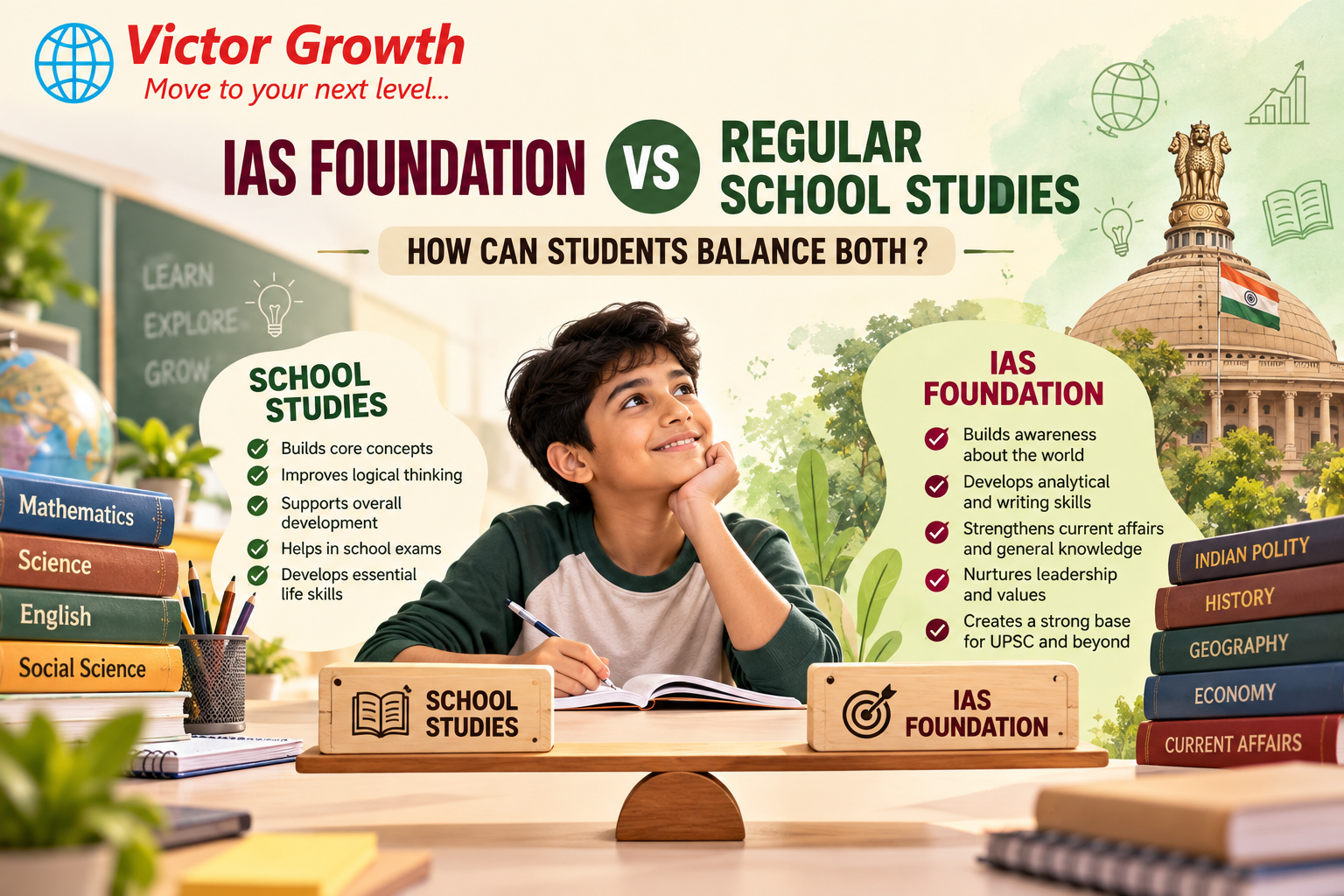
School years are an important stage for building academic knowledge, reading habits, communication skills and general awareness. For students interested in a future career in Civil Services, an IAS Foundation programme can provide early exposure to subjects and skills that are useful for UPSC preparation.
However, many parents have an important concern:
Can students balance IAS Foundation preparation with regular school studies?
The answer is yes—provided the foundation programme is properly structured and students follow a realistic study routine.
For families searching for the Best IAS Coaching in Kerala, the ideal approach is not to replace school education with UPSC preparation, but to make foundation learning complement regular academics.
What Is the Difference Between IAS Foundation and School Studies?
Regular school education provides the core academic foundation required for a student’s overall development. It covers subjects according to the school curriculum and prepares students for school examinations and higher education.
IAS Foundation programmes have a different objective. They gradually introduce students to:
General Knowledge
Current Affairs
Indian History and Geography
Constitution and Governance
Basic Economics
Science and Environment
Reading and Comprehension
Analytical Thinking
Writing and Communication
Quizzes and Discussions
Therefore, the two should not be viewed as competing forms of education.
School studies build academic fundamentals, while IAS Foundation learning develops broader awareness and additional skills.
Why Should School Studies Remain the Priority?
Students should not neglect their regular academics while attending an IAS Foundation programme.
Strong school-level knowledge is important because subjects such as history, geography, science, mathematics, economics and social science contribute to a student’s overall conceptual development.
School education also helps students develop:
Discipline
Basic knowledge
Examination skills
Writing ability
Time management
Academic confidence
A good IAS Foundation programme should strengthen these abilities rather than interfere with them.
How Can Students Balance Both?
1. Create a Realistic Weekly Schedule
Students do not need to spend several hours every day studying UPSC-related material.
A practical schedule can include:
School: Regular academic studies
Foundation: A few structured sessions each week
Daily: 20–30 minutes of reading or current affairs
Weekend: Revision, quizzes and additional activities
The exact schedule should depend on the student’s class and academic workload.
2. Connect Foundation Learning With School Subjects
One of the easiest ways to save time is to connect the two learning systems.
For example:
School Geography + Foundation Geography
A student learning about Indian rivers in school can also explore their economic, environmental and geographical importance.
Similarly:
School Civics + Indian Polity Foundation
Learning about government in school can be expanded through simple discussions about Parliament, elections, Fundamental Rights and the Constitution.
This approach avoids unnecessary duplication.
3. Develop a Daily Reading Habit
Reading is one activity that can support both school education and future UPSC preparation.
Students can spend 20–30 minutes reading:
Newspapers or age-appropriate news
Books
Educational articles
General knowledge material
Current affairs summaries
The objective is to understand information rather than memorise everything.
4. Use Weekends Effectively
Weekends can be used for foundation classes, revision and activities without disturbing the regular school schedule.
Students can use weekend time for:
Foundation classes
Current affairs revision
Quizzes
Writing practice
Reading
Discussions
However, sufficient time should also be reserved for rest, hobbies and sports.
5. Avoid Too Many Study Materials
One common mistake is collecting too many books, PDFs and online resources.
School students do not need an extensive UPSC library.
A small number of reliable resources, combined with good classroom guidance, is generally more effective than trying to study everything available online.
6. Focus on Understanding Rather Than Memorisation
Foundation learning should not become another examination burden.
Instead of memorising hundreds of facts, students should learn to understand:
What happened?
Why did it happen?
What are its effects?
How does it affect people?
What could be possible solutions?
This approach develops analytical thinking while making learning more interesting.
A Sample Daily Routine for School Students
A simple routine could look like:
Morning: School preparation
School hours: Regular academics
After school: Rest and recreation
Evening: Homework and school revision
20–30 minutes: Reading/current affairs
Foundation classes: According to the weekly schedule
Night: Light revision and adequate sleep
The exact routine should be adjusted according to the student’s class, school timings and individual learning capacity.
What About Students in Classes 10, 11 and 12?
As students move into higher classes, academic responsibilities increase.
During Classes 10–12, students should give particular attention to school examinations and board-level concepts.
Foundation learning can continue through:
Current affairs
Reading
General awareness
Essay writing
Communication
Analytical exercises
Basic understanding of General Studies subjects
Intensive UPSC preparation can be undertaken later, when the student is academically and mentally ready.
Role of Parents in Maintaining Balance
Parents play an important role in ensuring that foundation preparation remains healthy.
They should:
Avoid excessive pressure
Monitor the student’s workload
Encourage regular sleep
Support sports and hobbies
Discuss current affairs at home
Encourage reading
Focus on learning rather than marks alone
Allow children to develop their own interests
Parents should remember that foundation coaching is a long-term investment, not an immediate examination race.
Choosing the Best IAS Coaching in Kerala for School Students
Parents searching for the Best IAS Coaching in Kerala should check whether the foundation programme is designed specifically for school students.
Important factors include:
Age-appropriate curriculum
Flexible class schedules
Experienced faculty
Personal mentorship
Limited and relevant study materials
Interactive learning
Current affairs exposure
Regular assessments
Communication development
Compatibility with school academics
A good institute should help students balance both rather than increase their workload unnecessarily.
IAS Foundation at Victor Growth
Victor Growth, Kadavanthra, Kochi, provides foundation-oriented learning for school students interested in developing an early understanding of Civil Services and competitive examinations.
The programme can include general awareness, current affairs, conceptual learning, quizzes, reading and writing activities, analytical thinking, communication skills, assessments and mentorship.
For parents looking for the Best IAS Coaching in Kerala, the emphasis should be on a structured approach that supports school education while gradually developing skills useful for future UPSC preparation.
Frequently Asked Questions
1. Can students do IAS Foundation coaching while attending school?
Yes. A properly designed foundation programme can be balanced with regular school studies through a limited and structured schedule.
2. Should IAS Foundation studies get more importance than school studies?
No. School education should remain a priority. Foundation learning should complement regular academics.
3. How many hours should a school student spend on IAS Foundation preparation?
There is no fixed requirement. A few structured sessions per week and a short daily reading habit can be sufficient for foundation-level learning.
4. Can school subjects help with future UPSC preparation?
Yes. History, geography, science, economics, civics and other school subjects provide valuable conceptual foundations for future competitive-examination preparation.
5. Is newspaper reading necessary for school students?
Reading age-appropriate news or current affairs summaries can be useful. Students do not need to read and analyse every news article.
6. How can parents choose the Best IAS Coaching in Kerala?
Look for an age-appropriate curriculum, experienced faculty, mentorship, flexible scheduling, quality study materials and a programme that does not compromise regular school education.
7. Can IAS Foundation coaching create stress for students?
It can if the programme is too intensive or poorly structured. The right programme should encourage curiosity and learning while providing adequate time for school, sleep, recreation and hobbies.
Conclusion
IAS Foundation and regular school studies do not have to compete with each other. With proper planning, students can use foundation learning to complement their academic education and gradually develop skills useful for future UPSC preparation.
The key is balance—not excessive preparation.
For parents searching for the Best IAS Coaching in Kerala, the ideal foundation programme should help students become better readers, thinkers, communicators and learners while allowing them to succeed in school and enjoy their childhood.
Strong school fundamentals + meaningful foundation learning + healthy routines = a better long-term preparation journey.