
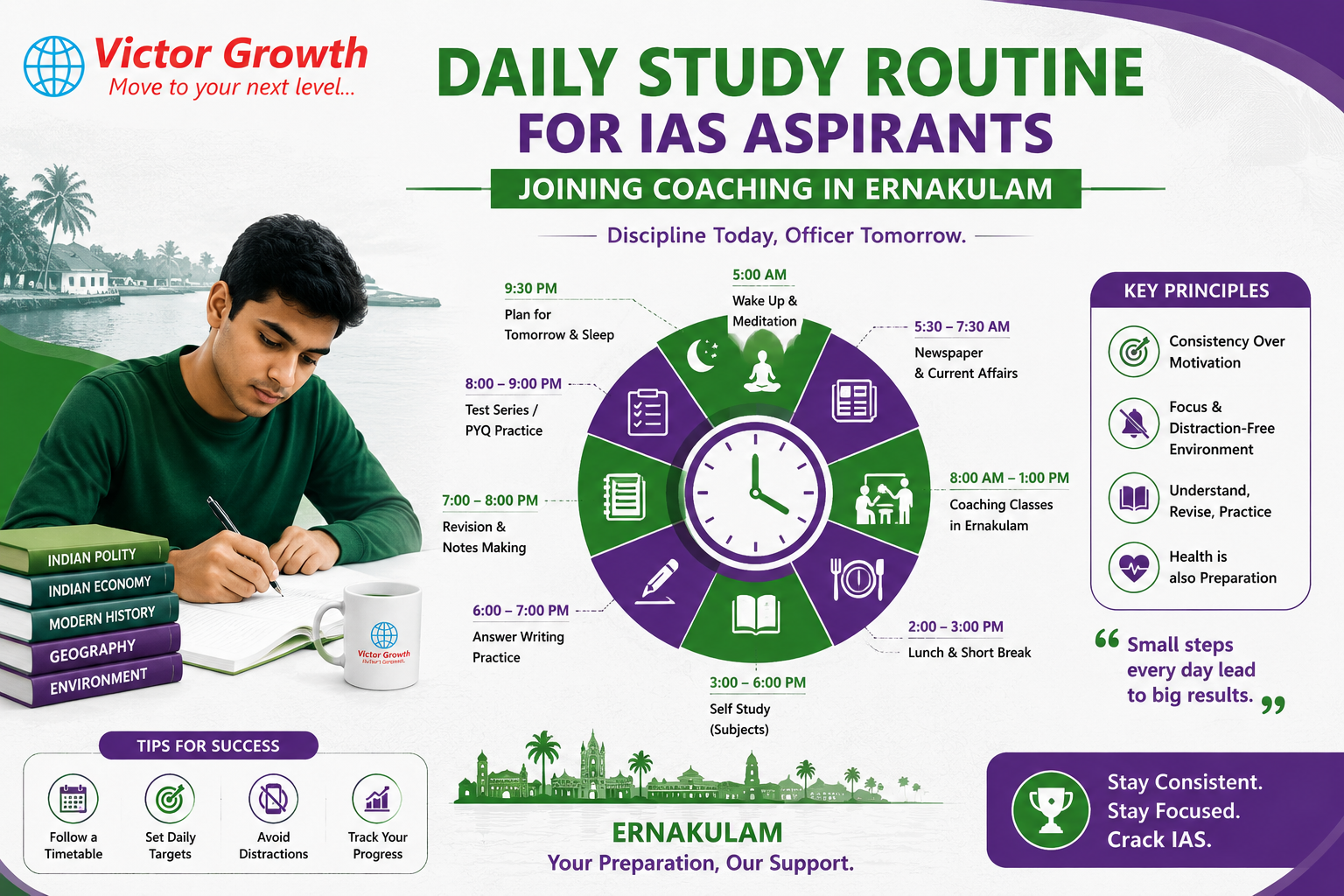
Preparing for the UPSC Civil Services Examination is one of the most demanding academic journeys in India. Every year, thousands of students join coaching institutes in Ernakulam with dreams of becoming IAS, IPS, IFS, and IRS officers. However, joining a coaching institute alone is not enough. Success in UPSC depends heavily on maintaining a disciplined and smart daily study routine.
Students searching for the best IAS coaching in Kerala often ask:
“How should I plan my daily schedule after joining IAS coaching?”
A proper study routine helps aspirants:
- Complete the syllabus systematically
- Revise consistently
- Improve answer writing
- Stay updated with current affairs
- Avoid burnout
- Maintain motivation for long-term preparation
This detailed guide explains the ideal daily study routine for IAS aspirants joining coaching in Ernakulam, including time management strategies, revision techniques, newspaper reading schedules, answer writing plans, and productivity tips.
Why a Daily Study Routine Is Important for UPSC Preparation
UPSC preparation is not about studying for one or two months intensely. It is a long-term process that demands:
- Consistency
- Discipline
- Time management
- Revision
- Practice
Even students studying at the best IAS coaching in Kerala may struggle if they do not follow a proper daily routine.
A structured routine helps aspirants:
- Reduce stress
- Track progress
- Improve concentration
- Balance coaching and self-study
- Cover the vast syllabus efficiently
Ideal Daily Study Hours for IAS Aspirants
The number of study hours depends on the aspirant’s stage of preparation.
| Aspirant Type | Recommended Study Hours |
|---|---|
| Beginners | 6–8 hours |
| Full-Time Aspirants | 8–10 hours |
| Working Professionals | 4–6 hours |
| College Students | 4–7 hours |
| Advanced Aspirants | 10–12 hours during revision phase |
Quality matters more than simply counting hours.
Focused study with proper revision is far more effective than long distracted study sessions.
Ideal Daily Study Routine for IAS Aspirants in Ernakulam
Morning Routine (5:30 AM – 8:00 AM)
1. Wake Up Early
Most successful UPSC aspirants prefer early morning study because:
- The mind remains fresh
- Fewer distractions
- Better concentration
- Improved retention
Starting the day early creates a disciplined lifestyle essential for UPSC preparation.
2. Newspaper Reading (1 to 1.5 Hours)
Current affairs are extremely important for:
- Prelims
- Mains
- Essay
- Interview
Spend time reading:
- National news
- International relations
- Economy
- Environment
- Government schemes
- Editorials
Focus Areas
- Government policies
- Supreme Court judgments
- International developments
- Science and technology
- Social issues
Avoid wasting time on:
- Political gossip
- Celebrity news
- Sports details irrelevant to UPSC
3. Make Short Notes
Prepare concise current affairs notes daily.
This helps during:
- Monthly revision
- Prelims revision
- Mains answer writing
- Essay preparation
Coaching Hours (Usually 9:00 AM – 1:00 PM)
Many students attending the best IAS coaching in Kerala spend their mornings in classroom sessions.
During coaching:
- Listen actively
- Avoid passive note-taking
- Mark important concepts
- Clarify doubts immediately
- Focus on conceptual understanding
Afternoon Routine (2:00 PM – 5:00 PM)
1. Revise Coaching Notes
This is one of the biggest mistakes aspirants make.
Many students attend classes but fail to revise the same day.
Daily revision helps:
- Improve retention
- Prevent backlog accumulation
- Strengthen concepts
Suggested Method
- Revise within 24 hours
- Highlight important points
- Create micro-notes
- Add current affairs connections
2. Standard Book Reading
Dedicate time daily for standard UPSC books.
Important subjects include:
- Polity
- History
- Geography
- Economy
- Environment
- Ethics
Consistency is more important than speed.
Evening Routine (5:30 PM – 8:00 PM)
1. Answer Writing Practice
UPSC Mains requires descriptive writing skills.
Daily answer writing helps improve:
- Speed
- Structure
- Analysis
- Presentation
- Time management
Beginners Can Start With
- 2 answers daily
Advanced Aspirants
- 5–10 answers daily
2. MCQ Practice for Prelims
Prelims preparation should start from Day 1.
Daily MCQ practice improves:
- Accuracy
- Elimination techniques
- Conceptual clarity
- Exam temperament
Aim for:
- 20–50 MCQs daily
Night Routine (8:30 PM – 10:30 PM)
1. Revision Session
Night revision strengthens memory retention.
Revise:
- Current affairs
- Important facts
- Class notes
- Optional subject topics
2. Plan the Next Day
Before sleeping:
- Write the next day’s targets
- Set realistic goals
- Prioritize important topics
Planning reduces confusion and improves productivity.
Weekly Study Strategy for IAS Aspirants
Sunday Revision Plan
Every Sunday should include:
- Weekly revision
- Mock tests
- Current affairs compilation
- Optional subject revision
Weekly Mock Tests
Students joining the best IAS coaching in Kerala should regularly attempt:
- Prelims tests
- Mains answer writing tests
- Essay practice
Testing helps identify:
- Weak areas
- Time management issues
- Conceptual gaps
Daily Routine for Working Professionals Preparing for IAS
Working aspirants require a different strategy.
Suggested Routine
Morning (5:00 AM – 7:30 AM)
- Newspaper reading
- Static subject study
Evening (7:00 PM – 10:30 PM)
- Revision
- MCQs
- Answer writing
Weekends
- Long study sessions
- Mock tests
- Optional subject preparation
Consistency matters more than long study hours.
Daily Routine for College Students Preparing for IAS
College students in Ernakulam can gain a major advantage by starting early.
Suggested Strategy
- 2–3 hours daily during weekdays
- 6–8 hours during weekends
- Focus on NCERTs and basics
- Build newspaper reading habit
- Improve writing skills early
Foundation preparation creates a strong long-term advantage.
Importance of Optional Subject Preparation in Daily Routine
Optional subjects carry 500 marks in UPSC Mains.
Daily optional subject study is essential.
Suggested Time Allocation
- 1.5 to 2 hours daily
Popular optional subjects in Kerala include:
- Public Administration
- Geography
- Sociology
- PSIR
- History
Students joining the best IAS coaching in Kerala often receive separate mentorship for optional subjects.
Common Mistakes IAS Aspirants Must Avoid
1. Studying Without a Timetable
Random preparation leads to confusion and backlog.
2. Ignoring Revision
Revision is the key to retention.
Without revision, most information is forgotten quickly.
3. Overdependence on Coaching
Coaching provides guidance.
Self-study creates success.
4. Reading Too Many Books
Stick to limited standard resources.
Repeated revision is more important than collecting materials.
5. Ignoring Answer Writing
Many aspirants fail in Mains because they start answer writing too late.
6. Burnout and Lack of Balance
Include:
- Short breaks
- Exercise
- Proper sleep
- Healthy food
Mental health is extremely important during UPSC preparation.
Productivity Tips for IAS Aspirants
Use the Pomodoro Technique
Study:
- 50 minutes focused
- 10 minutes break
Avoid Mobile Distractions
Limit unnecessary social media usage.
Maintain Short Notes
Short notes improve revision efficiency.
Track Daily Targets
Daily target tracking improves discipline and consistency.
Role of Coaching Institutes in Building Study Discipline
The best IAS coaching in Kerala helps students by providing:
- Structured classes
- Timetables
- Test series
- Mentorship
- Daily targets
- Revision plans
- Current affairs guidance
However, students must combine coaching with disciplined self-study for success.
Conclusion
A disciplined daily study routine is one of the most important factors in UPSC success. Aspirants joining coaching institutes in Ernakulam should focus on consistency, revision, answer writing, current affairs preparation, and regular testing.
The UPSC Civil Services Examination is not a sprint — it is a marathon requiring patience, strategy, and daily discipline.
Students preparing with the best IAS coaching in Kerala can significantly improve their chances of success when they combine proper coaching guidance with a smart and sustainable study routine.
Remember:
Small daily improvements create extraordinary long-term results in UPSC preparation.
Frequently Asked Questions (FAQ)
How many hours should an IAS aspirant study daily?
Most full-time aspirants study between 8 to 10 hours daily, while beginners may start with 6 to 8 focused hours.
Is coaching enough for UPSC preparation?
No. Coaching provides guidance, but self-study, revision, and answer writing are equally important.
When should I start answer writing practice?
Ideally within the first few months of preparation. Early answer writing improves analytical thinking and presentation skills.
How important is newspaper reading for UPSC?
Very important. Newspapers help in current affairs, essay writing, ethics, interview preparation, and General Studies papers.
Should I study optional subjects daily?
Yes. Daily optional subject preparation helps maintain continuity and improves retention.
Is 6 hours of study enough for UPSC?
Yes, if the study is focused and consistent. Quality matters more than simply counting hours.
Which is the best time to study for UPSC?
Morning hours are generally considered highly productive because the mind remains fresh and distractions are minimal.
How many mock tests should IAS aspirants attempt?
Aspirants should regularly attempt Prelims and Mains mock tests throughout preparation for performance improvement.
Can working professionals crack UPSC?
Yes. Many successful candidates have cleared UPSC while working full-time through disciplined and smart preparation.
How does the best IAS coaching in Kerala help aspirants?
Good coaching institutes provide structured preparation, mentorship, test series, current affairs support, answer writing practice, and strategic guidance for UPSC success.