
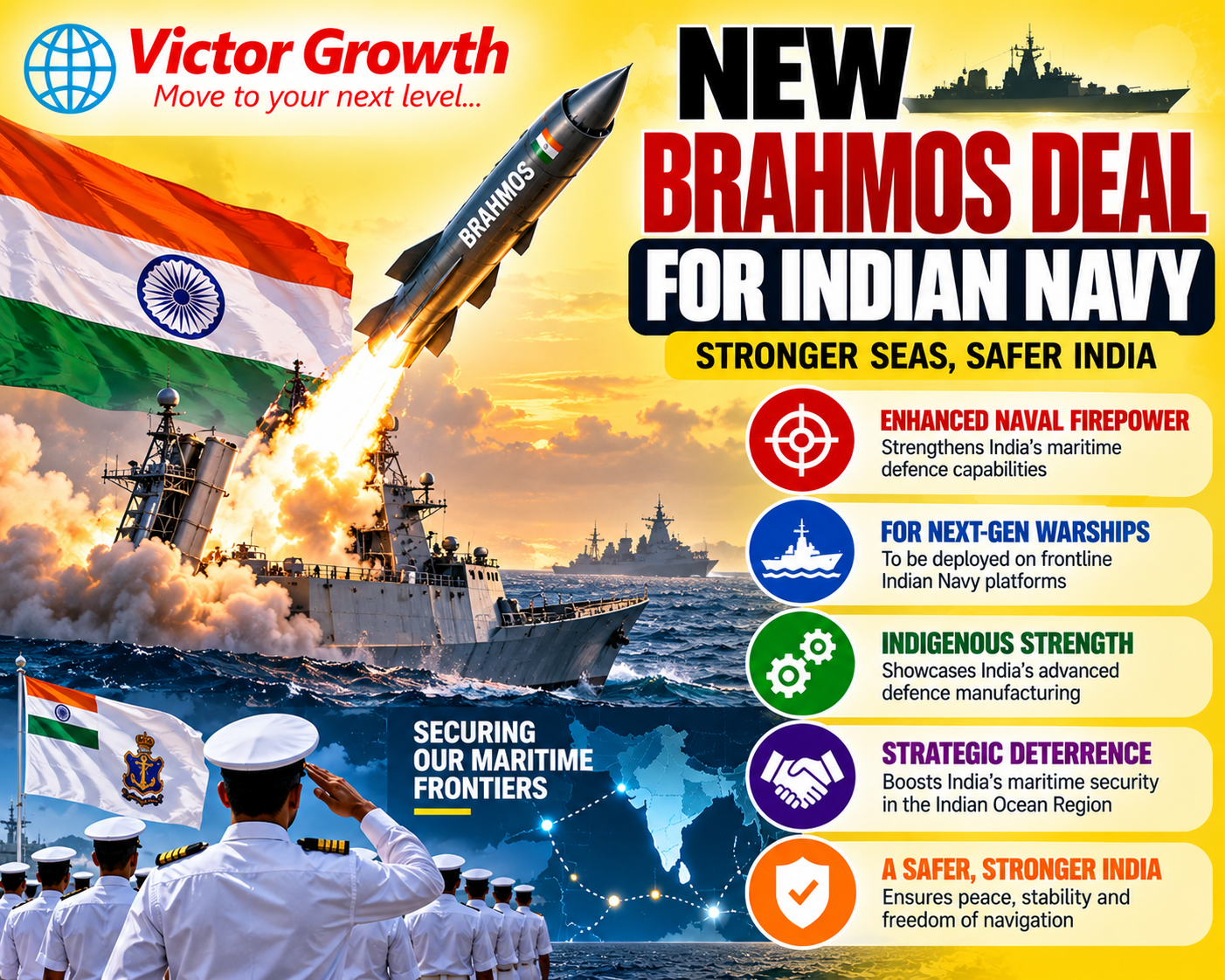
The Ministry of Defence (MoD) has signed a ₹661.50 crore contract with BrahMos Aerospace Private Limited for the procurement of BrahMos Fire Control Systems and launchers for Indian Navy ships.
The contract was signed on 6 October 2026 under the Buy (Indian-IDDM) category, with a minimum 68% indigenous content. The project is expected to strengthen India’s maritime security and promote domestic defence manufacturing, including participation by Indian MSMEs.
What is BrahMos?
BrahMos is a supersonic cruise missile developed through a joint venture between India’s DRDO and Russia’s NPO Mashinostroyenia.
The name BrahMos is derived from the Brahmaputra and Moskva rivers.
The missile is known for:
Supersonic speed
High precision
Low-altitude flight capability
Land-attack and anti-ship roles
Deployment from land, ships, aircraft and other platforms
For the Indian Navy, the ship-based BrahMos system is a major component of its maritime strike capability.
What Does the New Deal Include?
The ₹661.50 crore contract covers:
1. Fire Control Systems
Fire control systems help a warship detect, track, identify and engage targets by integrating information from sensors with the weapon system.
2. Missile Launchers
The contract also provides launchers required to deploy BrahMos missiles from compatible naval platforms.
Together, these systems will enhance the operational capability of frontline Indian Navy ships.
Why is the Deal Important?
1. Strengthening Maritime Security
BrahMos provides Indian warships with a powerful long-range surface-strike capability, strengthening India’s ability to respond to maritime threats.
This is particularly significant for a country with a long coastline and vital sea lanes of communication.
2. Strengthening the Indian Navy
The new systems will support the Navy’s ongoing effort to equip more frontline warships with advanced missile capabilities. The Navy has been moving towards wider BrahMos integration across its fleet.
3. Boost to Aatmanirbhar Bharat
The contract falls under the Buy (Indian-IDDM) category and requires at least 68% indigenous content.
This supports India’s objective of reducing dependence on imported defence equipment and strengthening domestic defence manufacturing.
4. MSME Participation
The project is expected to encourage participation by Indian Micro, Small and Medium Enterprises (MSMEs) and generate employment over the next three years.
BrahMos and India’s Defence Industrialisation
BrahMos has increasingly become an important example of India’s transition from defence importer to defence manufacturer and exporter.
The BrahMos Integration and Testing Facility in Lucknow, established under the Uttar Pradesh Defence Industrial Corridor, has already begun manufacturing missiles.
India has also entered the international market for BrahMos systems, demonstrating the growing export potential of Indian defence products.
Strategic Significance
The deal has significance beyond the missile itself.
India’s maritime security increasingly depends on:
Modern warships
Long-range precision weapons
Maritime domain awareness
Indigenous defence technology
Secure supply chains
Network-centric warfare
The integration of advanced missile systems with indigenous naval platforms contributes to India’s broader objective of developing a credible blue-water navy and strengthening its position in the Indian Ocean Region.
UPSC Relevance
Prelims
Important facts to remember:
BrahMos: Supersonic cruise missile
Developed by India and Russia
Indian partner: DRDO
Russian partner: NPO Mashinostroyenia
New Navy contract: ₹661.50 crore
Contract date: 6 October 2026
Indigenous content: Minimum 68%
Procurement category: Buy (Indian-IDDM)
Mains – GS Paper III
The topic can be linked with:
Defence indigenisation
Aatmanirbhar Bharat
Defence exports
Maritime security
Indian Ocean Region
Defence technology
Make in India
MSME participation in defence manufacturing
Possible UPSC Mains Question
“Defence indigenisation is essential for India’s strategic autonomy. Discuss how systems such as BrahMos can contribute to India’s maritime security and defence manufacturing ecosystem.”
Conclusion
The new ₹661.50 crore BrahMos contract for the Indian Navy represents more than an acquisition of missile launchers and fire-control systems. It reflects India’s broader push towards maritime capability, defence indigenisation, advanced technology and strategic autonomy.
For UPSC aspirants, BrahMos should be studied as a case study connecting defence technology, India-Russia cooperation, Aatmanirbhar Bharat, defence exports and India’s maritime security interests.