India has achieved a major milestone in digital healthcare, with eSanjeevani, the country’s national telemedicine service, crossing 50 crore (500 million) teleconsultations.
The platform crossed the milestone on 15 September 2026, recording more than 50.09 crore consultations across all 36 States and Union Territories. This makes eSanjeevani one of the world’s largest telemedicine implementations in primary healthcare.
The achievement highlights India’s use of Digital Public Infrastructure (DPI) to expand healthcare access, particularly for people living in rural, remote and underserved areas.
What is eSanjeevani?
eSanjeevani is India’s government-backed national telemedicine platform, developed by the Centre for Development of Advanced Computing (C-DAC) under the guidance of the Ministry of Health and Family Welfare.
Launched in 2019, it enables patients to consult healthcare professionals remotely, reducing the need for travel to hospitals and helping connect primary healthcare facilities with doctors and specialists.
The platform currently supports:
More than 1.42 lakh Ayushman Arogya Mandir spokes
19,473 medical hubs
901 online OPDs
Over 2.41 lakh registered healthcare providers
Services in 15 languages
Around 2.5–3 lakh consultations per day
Why is the 50-Crore Milestone Important?
1. Improving Rural Healthcare
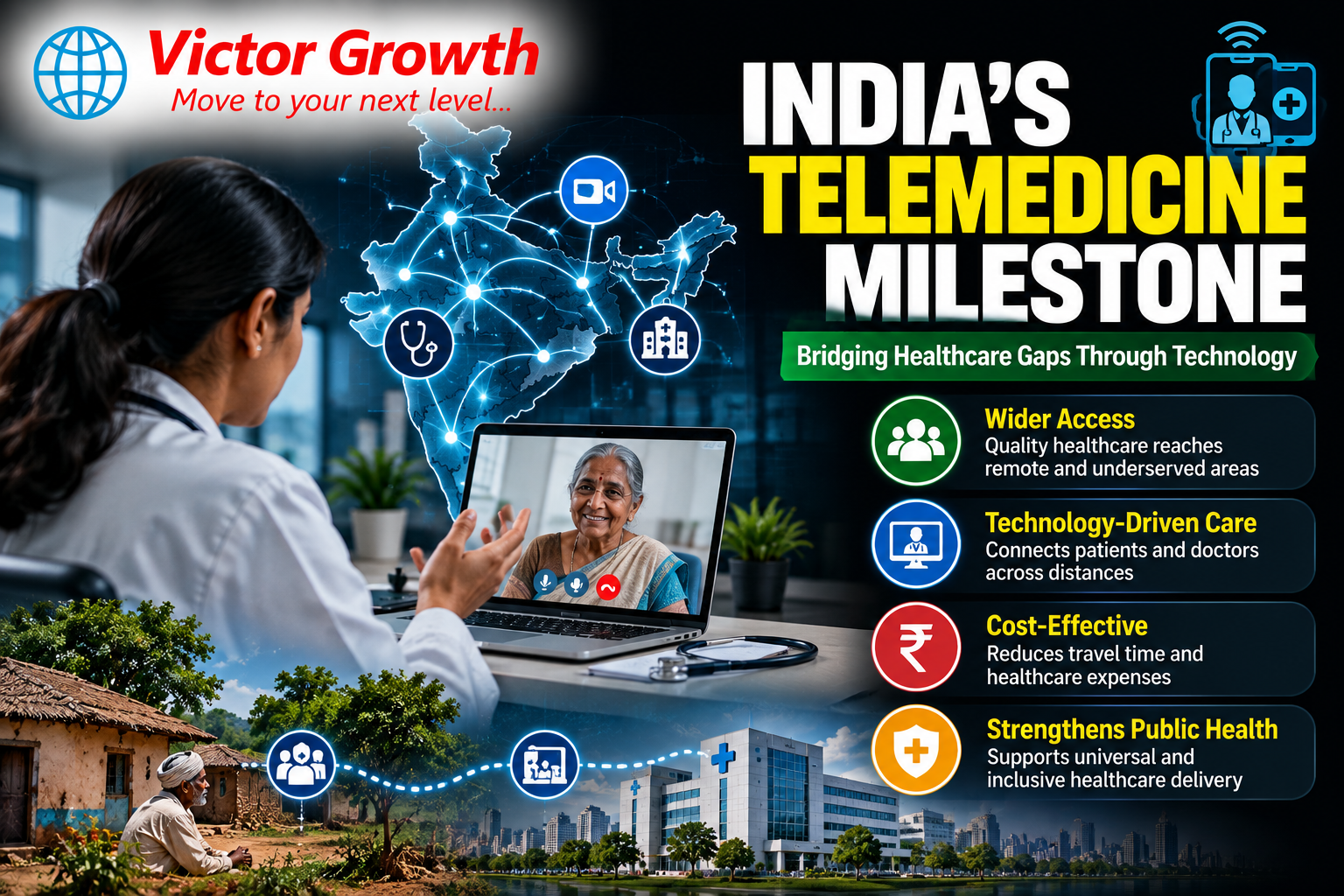
Telemedicine can connect patients in remote areas with qualified medical professionals without requiring long-distance travel.
This is particularly important in India, where specialists and advanced healthcare facilities are concentrated in urban centres.
2. Reducing Cost and Travel
Patients can save travel expenses, time and waiting periods, making healthcare more accessible and affordable.
3. Supporting Universal Health Coverage
eSanjeevani contributes to India’s objective of Universal Health Coverage (UHC) by extending healthcare services beyond conventional physical facilities.
4. Greater Inclusion
Women account for 57.14% of eSanjeevani utilisation, while people aged 46 years and above account for more than 40% of consultations. This demonstrates the platform’s growing relevance among populations that may face greater barriers to physical healthcare access.
AI and the Future of Telemedicine
eSanjeevani is evolving beyond simple video consultations.
The platform has integrated an AI-powered Clinical Decision Support System (AI-CDSS) that assists healthcare providers during consultations and supports more consistent clinical decision-making.
The AI-enabled system has received the Gold Award under the National Awards for e-Governance 2026.
The integration of AI with telemedicine illustrates how emerging technologies can help address India’s shortage of healthcare specialists while improving the efficiency of public healthcare delivery.
From Primary Care to Specialist Care
Another important development is the expansion of eSanjeevani into specialist OPD consultations.
Teleconsultation services for selected specialties have been introduced through institutions including:
AIIMS Jodhpur
AIIMS Jammu
AIIMS Patna
The model is expected to progressively expand to other premier institutions, allowing patients to access specialist expertise without necessarily travelling to major cities.
Telemedicine and India’s Digital Health Ecosystem
eSanjeevani forms part of India’s broader digital health ecosystem, including the Ayushman Bharat Digital Mission (ABDM).
ABDM seeks to create an interoperable digital health ecosystem through components such as:
ABHA (Ayushman Bharat Health Account)
Healthcare Professionals Registry
Health Facility Registry
Digital health records
Unified Health Interface (UHI)
In June 2026, the government launched UHI as an open and interoperable network intended to allow citizens and healthcare providers to connect across different digital platforms.
Challenges of Telemedicine
Despite its potential, telemedicine faces several challenges:
Digital divide and poor internet connectivity
Lack of digital literacy
Privacy and cybersecurity concerns
Difficulty in conducting physical examinations remotely
Language and accessibility barriers
Need for reliable digital health records
Ensuring quality and accountability
Therefore, telemedicine should complement rather than completely replace physical healthcare infrastructure.
UPSC Relevance
Prelims
Important facts:
eSanjeevani: India’s national telemedicine service
Launched in 2019
Developed by C-DAC
50 crore+ consultations: September 2026
AI-powered Clinical Decision Support System integrated into the platform
Linked with Ayushman Bharat Digital Mission
Mains – GS Paper II
The topic can be linked to:
Universal Health Coverage
Digital governance
Public healthcare
Health infrastructure
Digital divide
Technology for inclusive development
GS Paper III
Relevant themes include:
Artificial Intelligence
Digital Public Infrastructure
Emerging technologies
Cybersecurity
Technology-enabled healthcare
Possible UPSC Mains Question
“Digital technologies such as telemedicine can help bridge India’s geographical and specialist healthcare gaps, but their effectiveness depends on digital inclusion and physical healthcare infrastructure. Discuss.”
Conclusion
India’s 50-crore eSanjeevani milestone demonstrates the potential of technology to transform public healthcare delivery at population scale. The integration of AI, specialist consultations and digital health infrastructure can further strengthen India’s healthcare system.
For UPSC aspirants, eSanjeevani should be studied as a case study linking Digital Public Infrastructure, Universal Health Coverage, AI, healthcare accessibility and inclusive governance.