
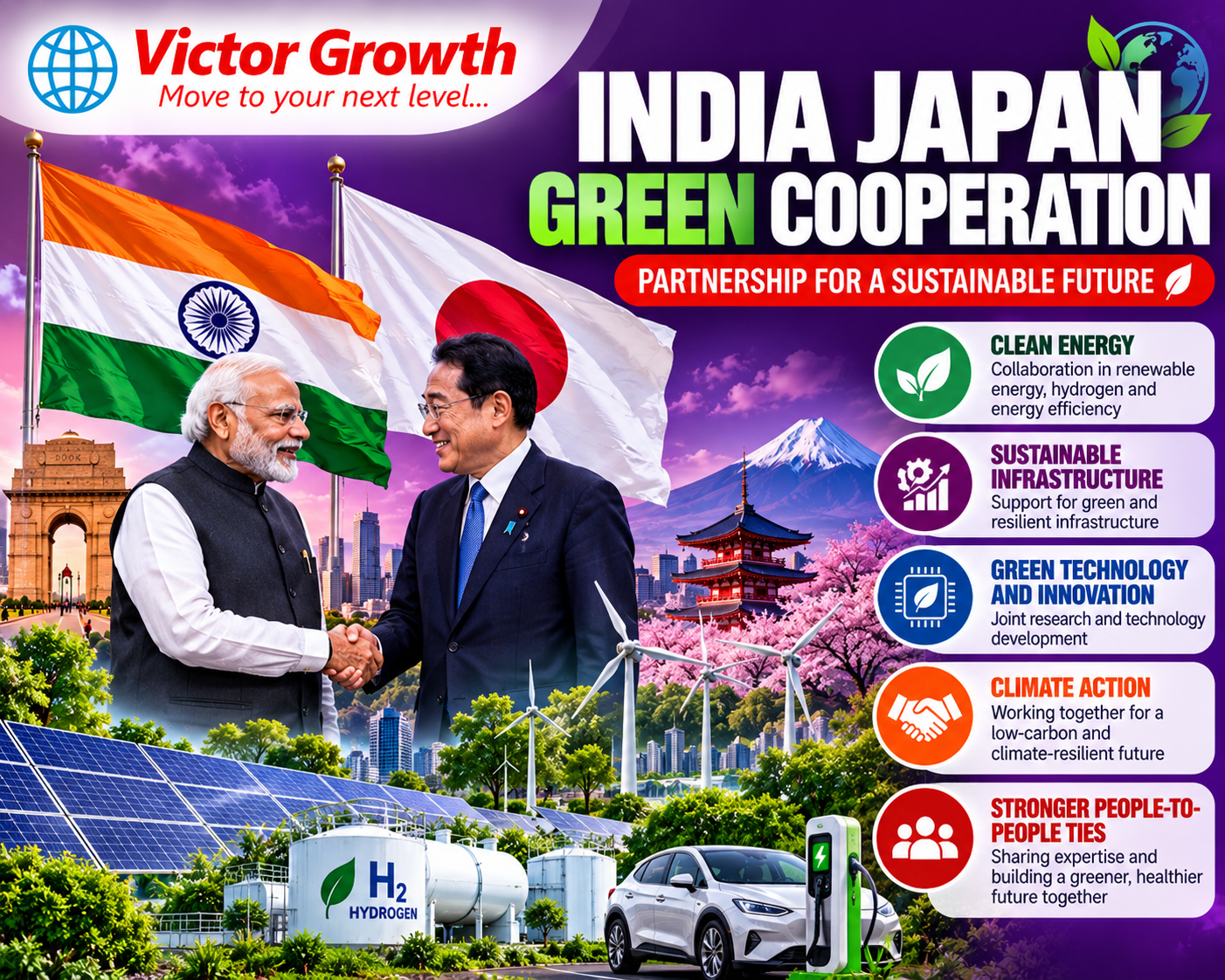
India and Japan are strengthening cooperation on clean energy, climate action and green technologies. A major recent development was the launch of the Operational Manual for the India–Japan Joint Crediting Mechanism (JCM) on 30 September 2026.
The manual provides the framework for implementing projects that use advanced low-carbon technologies, mobilise climate finance and generate high-integrity emission reductions. The cooperation operates under Article 6.2 of the Paris Agreement.
The development is part of the broader India-Japan Special Strategic and Global Partnership, which increasingly includes clean energy, energy security, critical minerals, batteries and green technologies.
What is the Joint Crediting Mechanism?
The Joint Crediting Mechanism (JCM) is a bilateral framework through which participating countries cooperate on projects that reduce or remove greenhouse-gas emissions.
Under the India-Japan JCM:
Japanese and Indian entities can collaborate on low-carbon projects.
Advanced Japanese technologies can be deployed in India.
Emission reductions can be quantified and verified.
Credits can be issued and transferred according to agreed rules.
Projects are expected to contribute to sustainable development.
India and Japan signed the JCM Memorandum of Cooperation in August 2025, followed by the Rules of Implementation in June 2026 and the Operational Manual in September 2026.
India-Japan Cooperation in Green Energy
The partnership covers several important areas.
1. Green Hydrogen and Green Ammonia
India aims to become a major producer and exporter of green hydrogen and its derivatives, while Japan is developing clean-hydrogen and ammonia supply chains.
India’s National Green Hydrogen Mission provides the domestic policy framework for this cooperation.
In 2026, an Indian company entered into long-term agreements with Japanese companies for the supply of green ammonia and green methanol, creating an emerging India-Japan clean-fuel supply chain.
2. Clean Energy Technologies
The two countries are exploring cooperation in:
Solar photovoltaic technology
Green hydrogen
Clean ammonia
Nuclear energy
Batteries
Energy-efficient technologies
At the 16th India-Japan Annual Summit in July 2026, both countries reaffirmed their commitment to expanding cooperation in these areas.
3. Cooperative Biogas for Growth
India and Japan launched the India-Japan Cooperative Biogas for Growth Initiative.
The initiative aims to support India’s objective of establishing 1,000 biogas and organic-fertiliser plants, leveraging India’s dairy cooperative network.
It links waste management, renewable energy, agriculture and rural development.
4. Batteries and Energy Storage
India and Japan have also agreed to cooperate on battery-related projects, with the objective of developing trusted and sustainable battery supply chains.
This is particularly important for:
Electric vehicles
Renewable-energy storage
Grid stability
Clean mobility
Why is India-Japan Green Cooperation Important?
Energy Security
India and Japan are both major energy-consuming economies. Cooperation in hydrogen, ammonia, renewables and resilient supply chains can reduce dependence on vulnerable energy sources.
Technology Transfer
Japan possesses advanced technologies in areas such as energy efficiency, batteries, hydrogen and low-carbon industrial processes. Collaboration can accelerate India’s green transition.
Climate Finance
The JCM can help mobilise investment for low-carbon projects while creating a transparent framework for emission reductions.
Green Industrialisation
Clean-energy cooperation can support new industries, jobs, manufacturing capabilities and export opportunities.
Indo-Pacific Cooperation
The partnership also complements broader cooperation between India and Japan on economic security, resilient supply chains and a sustainable Indo-Pacific.
JCM and Article 6.2: UPSC Concept
Article 6 of the Paris Agreement provides mechanisms for international cooperation in achieving climate goals.
Article 6.2 deals with cooperative approaches involving Internationally Transferred Mitigation Outcomes (ITMOs).
The India-Japan JCM is therefore important as a practical example of how countries can cooperate through carbon markets and internationally transferred emission reductions.
Challenges
India-Japan green cooperation must address:
High cost of emerging green technologies
Technology and financing gaps
Ensuring genuine emission reductions
Avoiding double counting of carbon credits
Developing reliable hydrogen and ammonia infrastructure
Building domestic manufacturing capabilities
Strong monitoring, reporting and verification mechanisms are therefore essential.
UPSC Relevance
Prelims
Remember:
JCM: Joint Crediting Mechanism
India-Japan JCM MoC: 2025
Rules of Implementation: 2026
Operational Manual: September 2026
JCM operates under Article 6.2 of the Paris Agreement
Key areas: low-carbon technology, climate finance and emission reductions
Mains – GS Paper III
The topic can be linked with:
Climate change and carbon markets
Renewable energy
Green hydrogen
Energy security
Technology transfer
Sustainable development
International environmental cooperation
Possible UPSC Mains Question
“The India-Japan Joint Crediting Mechanism represents the growing importance of bilateral cooperation in achieving climate goals. Discuss its potential for India’s clean-energy transition.”
Conclusion
India-Japan green cooperation is evolving from traditional development assistance towards a broader partnership involving clean energy, green hydrogen, carbon markets, batteries, biogas and climate technology.
The Joint Crediting Mechanism provides an important institutional framework for translating climate cooperation into actual projects. For UPSC aspirants, the topic connects Paris Agreement mechanisms, carbon markets, energy security, technology transfer and India’s sustainable-development goals.