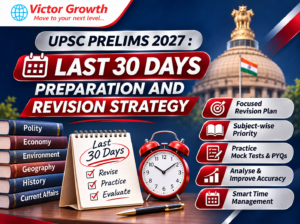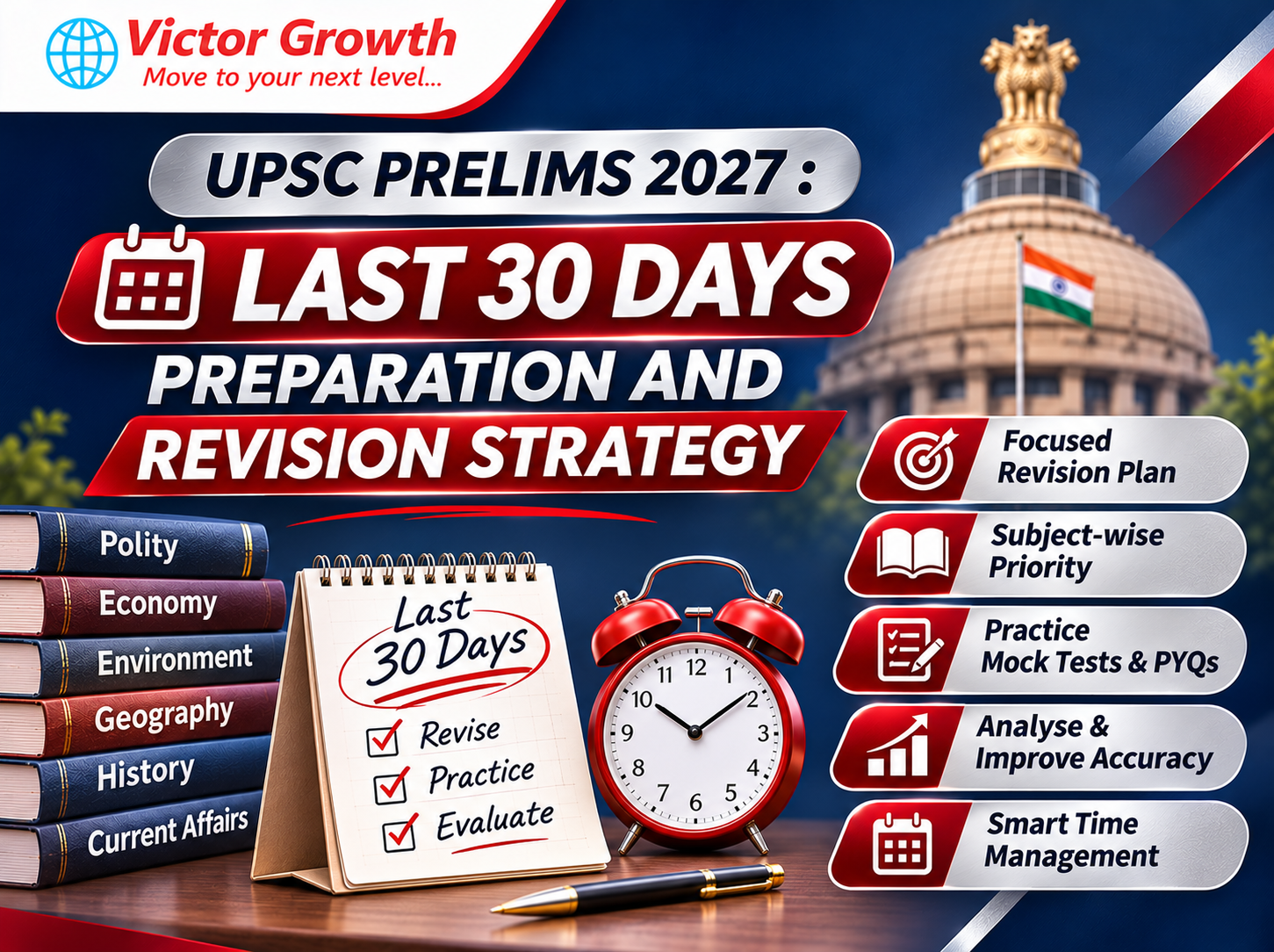
The final 30 days before the UPSC Civil Services Preliminary Examination are extremely important. This is the time to revise what you have already studied, improve accuracy, practise mock tests and strengthen your confidence. Instead of trying to cover the entire syllabus again, aspirants should focus on important topics, previous year questions and regular revision.
A well-planned last-month strategy can help you avoid unnecessary stress and perform better in the examination. Here are some practical tips to make the final 30 days of UPSC Prelims 2027 preparation more effective.
1. Prioritise Revision Over New Topics
During the last 30 days, avoid starting multiple new books or unfamiliar subjects. Focus on revising the topics you have already covered.
Give priority to:
Indian Polity and Constitution
History and Indian National Movement
Indian and World Geography
Indian Economy
Environment and Ecology
Science and Technology
Government schemes and important current affairs
Prepare a checklist of important topics and revise them systematically. Pay special attention to areas where you frequently make mistakes.
2. Follow a 30-Day Revision Plan
Divide the final month into three phases to manage your preparation effectively.
Period | Preparation Focus |
|---|---|
Days 1–10 | Revise core subjects such as Polity, History and Geography |
Days 11–20 | Revise Economy, Environment, Science and Technology, and Current Affairs |
Days 21–25 | Practise mock tests, solve PYQs and revise weak areas |
Days 26–30 | Final revision of short notes, important facts and frequently confused topics |
Adjust this schedule according to your preparation level. Consistency is more important than following a rigid timetable.
3. Practise Previous Year Question Papers
Previous Year Questions (PYQs) help you understand the UPSC examination pattern, question framing and important areas.
During the final month:
Solve previous year question papers under exam conditions.
Analyse why your answers were correct or incorrect.
Identify frequently repeated concepts.
Understand the logic behind statement-based questions.
Revise topics related to questions you answered incorrectly.
Practising PYQs helps you develop better question-solving skills and avoid repeated mistakes.
4. Take Mock Tests and Analyse Your Performance
Mock tests are essential for improving accuracy, speed and time management. However, simply attempting tests is not enough. Analysing your performance is equally important.
Follow these tips:
Attempt full-length mock tests regularly.
Practise within the actual examination time limit.
Identify weak subjects and topics.
Avoid random guessing.
Maintain a record of mistakes and revise them.
Do not become discouraged by low mock-test scores. Use them to identify areas that require improvement.
5. Revise Current Affairs Smartly
Current affairs play an important role in UPSC Prelims. Instead of reading daily news from the beginning, revise your existing current affairs notes and monthly compilations.
Focus on:
Government schemes and policies
Important Supreme Court judgments
International organisations and agreements
Environment-related developments
Science and technology developments
Important reports and indices
National and international events
Connect current affairs with static subjects to develop a better understanding of questions.
6. Give Special Attention to CSAT
Do not ignore CSAT (General Studies Paper II) during the final month. It is a qualifying paper, but clearing the minimum qualifying marks is compulsory.
Practise:
Reading comprehension
Basic mathematics
Logical reasoning
Data interpretation
Analytical ability
Solve at least a few CSAT practice sets every week and focus on improving accuracy.
7. Avoid Common Mistakes During the Last 30 Days
Many aspirants lose valuable preparation time by making avoidable mistakes. Try to avoid:
Starting completely new books or resources.
Ignoring revision in favour of collecting information.
Taking too many mock tests without analysing them.
Neglecting CSAT preparation.
Studying for long hours without proper breaks.
Comparing your preparation with other aspirants.
Losing confidence because of mock-test scores.
Maintain a healthy routine, get sufficient sleep and stay focused on your preparation.
8. Choose the Right Guidance for UPSC Preparation
Proper guidance, structured revision plans and regular practice can make the final stage of preparation more organised. Aspirants looking for the best NDA coaching in Kerala should also understand that NDA and UPSC Civil Services are different examinations with separate syllabi and preparation requirements.
At Victor Growth Coaching Centre, aspirants can explore guidance for competitive examinations and build disciplined preparation habits. Choose a coaching programme based on faculty guidance, study materials, test practice and individual learning requirements.
Frequently Asked Questions (FAQs)
1. Is 30 days enough to prepare for UPSC Prelims 2027?
Thirty days can be useful for intensive revision and practice, particularly for aspirants who have already completed most of the syllabus.
2. How many mock tests should I attempt in the last month?
Attempt mock tests regularly based on your preparation level. Focus more on analysing mistakes than increasing the number of tests.
3. Should I study new topics during the last 30 days?
Avoid starting large new topics. Prioritise revision and cover only essential gaps that can realistically be addressed.
4. Is CSAT important for UPSC Prelims?
Yes. CSAT is a qualifying paper, and candidates must secure the required minimum qualifying marks.
5. How should I revise current affairs before UPSC Prelims?
Revise monthly compilations, short notes and important government-related developments. Connect current affairs with static subjects wherever possible.
6. Should I revise NCERT books during the final month?
Revise important concepts and highlighted portions from NCERT books if they are part of your preparation. Avoid reading every book from the beginning.
Conclusion
The last 30 days before UPSC Prelims 2027 should be dedicated to smart revision, PYQ practice, mock-test analysis and improving accuracy. Avoid unnecessary distractions and focus on strengthening the concepts you have already studied. A realistic timetable, consistent practice and a positive mindset can help you approach the examination with confidence.