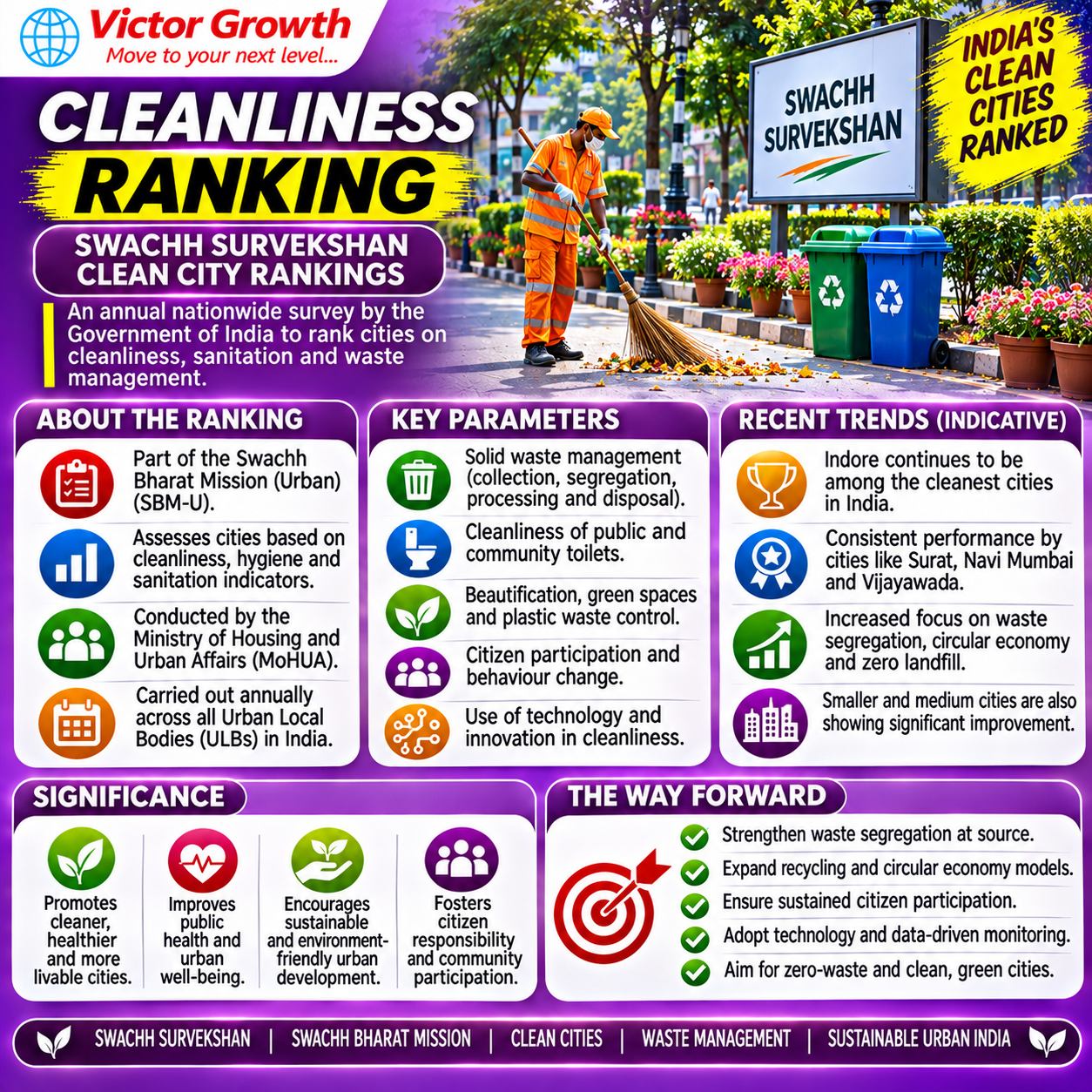
The Swachh Survekshan Awards 2025–26, India’s annual urban cleanliness survey, were announced on 11 November 2026. President Droupadi Murmu presented the awards at Vigyan Bhawan, New Delhi.
In a significant development, Navi Mumbai, Surat and Vijayawada emerged as the top three cities in the Super Swachh League category. The results also recognised cities for cleanliness in riverfront, coastal and Himalayan regions.
The 10th edition of the survey highlights India’s efforts to improve urban sanitation, scientific waste management and citizen participation under the Swachh Bharat Mission–Urban. <Cite refs={[“turn837780search0″,”turn837780search7”]}/>
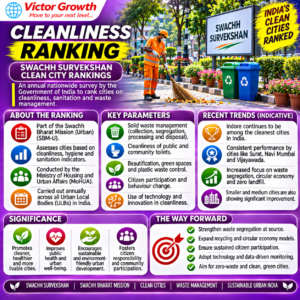
What Is Swachh Survekshan?
Swachh Survekshan is an annual cleanliness assessment conducted by the Ministry of Housing and Urban Affairs (MoHUA) under the Swachh Bharat Mission–Urban.
Launched in 2016, it aims to:
Encourage healthy competition among Urban Local Bodies (ULBs).
Improve solid waste management and sanitation.
Promote citizen participation in cleanliness activities.
Assess the performance of cities using measurable indicators.
Encourage behavioural change towards a cleaner urban environment.
The survey has expanded significantly from 73 Urban Local Bodies in 2016 to more than 4,700 cities in the 2025–26 edition. <Cite refs={[“turn837780search1″,”turn837780search8”]}/>
Major Findings of Swachh Survekshan 2025–26
The 10th edition was conducted under the theme ‘Swachhata Ki Nayi Pehel – Badhayein Haath, Karein Safai Saath’.
Important results include:
| Category | Top-ranked city |
|---|---|
| Super Swachh League | Navi Mumbai |
| Million-plus population category | Greater Visakhapatnam |
| 3–10 lakh population category | Ujjain |
| 50,000–3 lakh population category | Dewas |
| 20,000–50,000 population category | Vita |
| Swachh River Front Town | Rewa |
| Swachh Coastal Town | Puri |
| Clean Himalayan City | Rudrapur |
Other important rankings:
Surat and Vijayawada secured second and third positions in the Super Swachh League.
Jabalpur and Lucknow followed Greater Visakhapatnam in the million-plus category.
Bilaspur and Varanasi followed Rewa among riverfront towns.
Kerala’s Alappuzha secured second place among coastal towns, after Puri.
Jammu and Shopian secured second and third positions among Himalayan cities.
Indore, which had topped the national cleanliness rankings for eight consecutive years, featured in the new Swachh Shehar Jodi mentor category with Depalpur. <Cite refs={[“turn837780search0″,”turn837780search2″,”turn837780search3”]}/>
New Features of the 2025–26 Survey
This edition introduced several important changes:
1. Super Swachh League
A separate category recognises consistently high-performing cities, encouraging them to maintain standards while allowing other cities to compete in population-based categories.
2. Swachh Shehar Jodi
This initiative pairs high-performing mentor cities with mentee cities to promote peer learning and improve urban waste management.
Ahmedabad–Sanand, Indore–Depalpur and Tirupati–Kuppam were among the top three city pairs recognised.
3. New Geographic Categories
For the first time, awards specifically recognised:
Swachh River Front Towns
Swachh Coastal Towns
Clean Himalayan Cities
This broadens the assessment beyond conventional urban sanitation to include the cleanliness of ecologically sensitive and culturally important locations.
4. Digital Monitoring
More than 3,000 trained assessors conducted field evaluations supported by GPS-enabled monitoring and digital evidence verification.
The survey assessed Urban Local Bodies across 43 indicators covering 10 key assessment areas, including waste segregation, collection, transportation, sanitation access, sanitation-worker welfare and citizen feedback. <Cite refs={[“turn837780search0″,”turn837780search1″,”turn837780search8”]}/>
Significance of Swachh Survekshan
1. Competitive Federalism: Rankings encourage cities and states to improve sanitation services through healthy competition.
2. Better Public Health: Improved waste management and sanitation reduce exposure to disease-causing pathogens.
3. Environmental Protection: Scientific disposal and treatment of waste help prevent soil, air and water pollution.
4. Citizen Participation: Public feedback and community involvement encourage cleanliness as a shared responsibility.
5. Administrative Accountability: Performance-based assessment helps identify gaps in municipal service delivery.
6. Sustainable Urbanisation: Cleanliness initiatives contribute to healthier, more liveable and resilient cities.
Major Challenges in Urban Cleanliness
Despite progress, several challenges remain:
Waste segregation: Many households and commercial establishments do not consistently segregate waste at source.
Processing capacity: Municipalities often lack adequate composting, recycling and waste-treatment facilities.
Legacy dumpsites: Old landfills continue to create environmental and public-health risks.
Plastic pollution: Single-use plastics and improper disposal contribute to urban pollution.
Sanitation workers’ welfare: Workers require safer working conditions, protective equipment and social security.
Financial constraints: Smaller Urban Local Bodies face limitations in funding, technology and trained personnel.
Way Forward
India must move beyond ranking-based competition towards sustainable urban sanitation.
Strengthen Urban Local Bodies through adequate funding and technical capacity.
Promote the principles of the 3Rs – Reduce, Reuse and Recycle.
Ensure segregation of waste at source and scientific processing.
Improve wastewater treatment and sanitation infrastructure.
Protect the health, safety and dignity of sanitation workers.
Use digital monitoring and citizen feedback to improve accountability.
Encourage community participation through awareness campaigns and behavioural change.
UPSC Examination Relevance
Prelims
Swachh Survekshan and its implementing ministry.
Swachh Bharat Mission–Urban.
Super Swachh League and Swachh Shehar Jodi.
Urban Local Bodies.
Solid Waste Management Rules and waste segregation.
Mains – GS Paper II
Urban local governance and municipal administration.
Government schemes and service delivery.
Citizen participation and accountability.
Mains – GS Paper III
Solid waste management.
Environmental pollution and urban sustainability.
Sustainable development and public health.
Possible UPSC Mains Question:
“Swachh Survekshan has emerged as an important instrument for improving urban sanitation through competitive federalism and citizen participation. Examine its achievements and limitations.”
Conclusion
Swachh Survekshan 2025–26 demonstrates the growing importance of measurable performance, citizen participation and innovation in urban sanitation. However, a city’s cleanliness cannot be judged by rankings alone. Long-term success requires scientific waste management, strong municipal institutions, environmental protection and dignity for sanitation workers. The vision of a clean India must become a continuous civic responsibility rather than an annual competition.