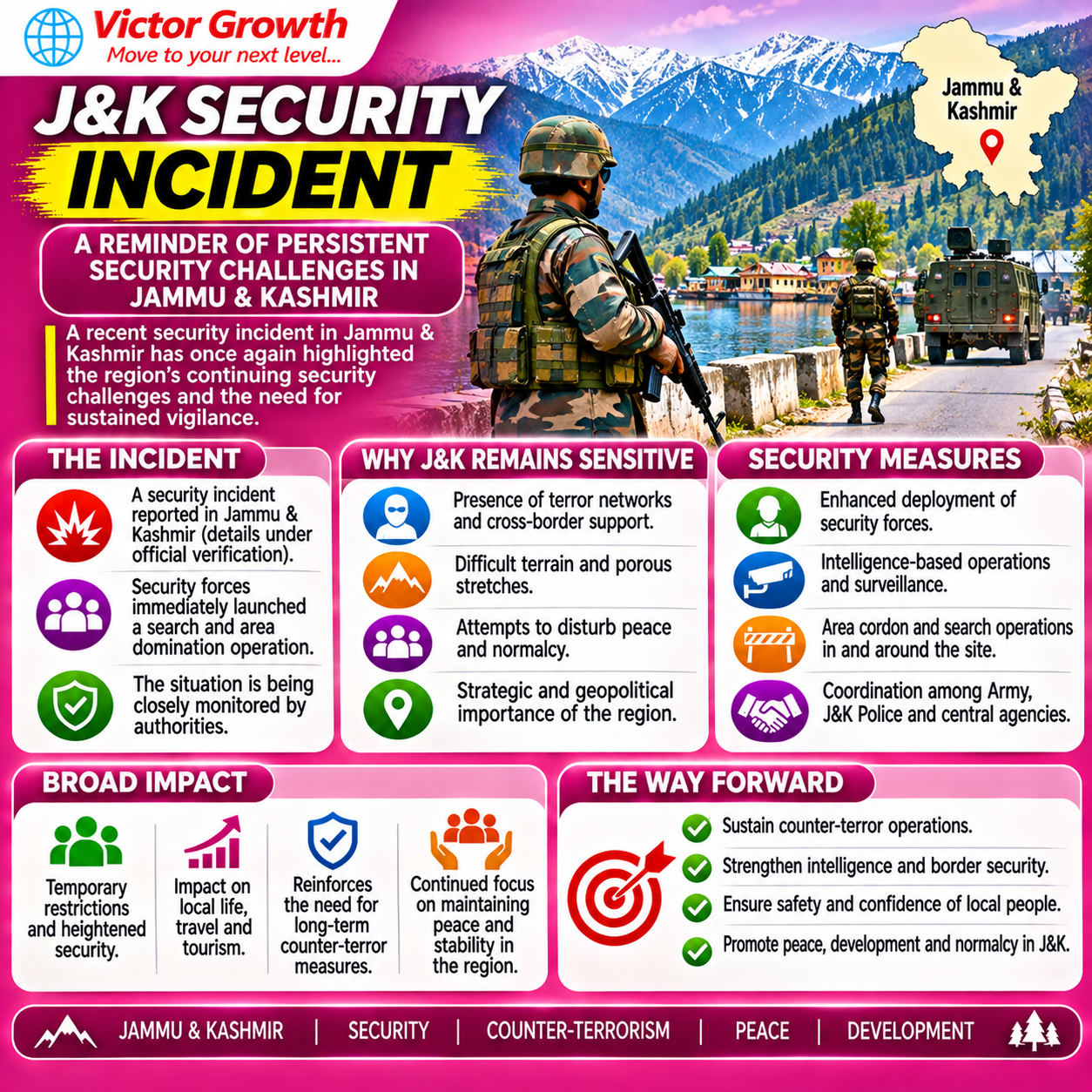
On 11 November 2026, motorcycle-borne attackers opened fire at a Central Reserve Police Force (CRPF) checkpoint in Akhran, near Mir Bazar in Kulgam district of Jammu and Kashmir, injuring three CRPF personnel.
The attackers fled the spot following retaliatory action by security personnel. A cordon-and-search operation was launched by the Jammu and Kashmir Police and other security agencies to identify and apprehend those responsible.
The attack comes amid increased security vigilance in the Kashmir Valley and highlights the continuing threat of terrorism despite improvements in the security situation. <Cite refs={[“turn218667search0″,”turn218667search3″,”turn218667search5”]}/>
What Happened in Kulgam?
The key developments include:
Motorcycle-borne assailants opened fire at a CRPF checkpoint around 2:15 PM.
Three CRPF personnel sustained bullet injuries and were shifted to hospitals for treatment.
Security personnel retaliated, preventing further casualties.
Police and security forces launched search operations to track the attackers.
Security checks and surveillance were strengthened across sensitive areas, including parts of National Highway 44.
The incident demonstrates the importance of intelligence-led security deployment, rapid response and coordination among security agencies.
Understanding the Security Situation in Jammu and Kashmir
Jammu and Kashmir occupies a strategically important position because of its geographical location, international borders and proximity to Pakistan.
The region faces multiple security challenges:
1. Cross-Border Terrorism
Terrorist organisations operating from across the border have attempted to infiltrate into Jammu and Kashmir and carry out attacks against security forces and civilians.
2. Terrorist Recruitment and Radicalisation
Online propaganda, misinformation and extremist networks can influence vulnerable individuals and facilitate recruitment.
3. Hybrid Terrorism
Hybrid terrorism involves individuals who may not be formally identified as members of terrorist organisations but participate in attacks, logistics, reconnaissance or other activities.
4. Over-Ground Workers (OGWs)
Over-Ground Workers provide logistical support, information, shelter and other assistance to terrorist networks. Identifying these support systems is an important part of counter-terrorism operations.
5. Drone-Based Threats
Drones can be misused for transporting weapons, ammunition and narcotics across borders, creating new challenges for border security agencies.
6. Narco-Terrorism
The illegal drug trade can generate funds for terrorist activities. Security agencies have highlighted the links between narcotics networks and terrorism in Jammu and Kashmir. <Cite refs={[“turn218667search6″,”turn218667search7”]}/>
Role of Security Forces in Jammu and Kashmir
India follows a multi-agency approach to counter-terrorism and maintain internal security.
| Organisation | Major Responsibility |
|---|---|
| Indian Army | Border security, counter-infiltration and counter-terrorism operations |
| CRPF | Internal security, law and order support and counter-insurgency |
| Jammu and Kashmir Police | Intelligence gathering, investigation and local policing |
| BSF | Security along designated international border areas |
| NIA | Investigation of terrorism-related offences under relevant laws |
Effective coordination among these agencies is essential for preventing attacks and maintaining public confidence.
Major Challenges for India’s Internal Security
Infiltration: Attempts by terrorist groups to cross international borders and the Line of Control.
Intelligence gaps: Identifying small, decentralised terrorist networks before they carry out attacks.
Technology-driven threats: Misuse of encrypted communication, drones and digital platforms.
Terror financing: Financial networks linked to illegal trade and other criminal activities.
Civilian security: Protecting local residents, tourists, migrant workers and public infrastructure.
Regional stability: Managing security challenges while maintaining peace and normal economic activity.
Way Forward
India requires a comprehensive approach that combines security measures with development and public participation.
Strengthen intelligence coordination: Improve information sharing between the Army, CRPF, police and intelligence agencies.
Modernise surveillance: Use drones, artificial intelligence, satellite imagery and advanced monitoring systems responsibly.
Counter terror financing: Strengthen action against illegal financial networks, narcotics trafficking and money laundering.
Community participation: Build trust between local communities and security agencies to improve intelligence gathering.
Cybersecurity: Counter online radicalisation, extremist propaganda and digital recruitment.
Promote development: Expand education, employment opportunities and economic activities to address vulnerabilities that extremist organisations may exploit.
Protect human rights: Ensure that counter-terrorism operations follow the rule of law and maintain public trust.
UPSC Examination Relevance
Prelims
Role and functions of CRPF, BSF and Indian Army.
National Investigation Agency (NIA).
Line of Control and international border.
Over-Ground Workers and hybrid terrorism.
Narco-terrorism and drone threats.
Mains – GS Paper III
Linkages between organised crime and terrorism.
Challenges to internal security through communication networks.
Role of external state and non-state actors in creating security threats.
Border management and counter-terrorism strategies.
Mains – GS Paper II
Centre–State coordination in internal security.
Governance and public trust in conflict-affected regions.
Possible UPSC Mains Question:
“Despite improvements in the security situation, Jammu and Kashmir continues to face challenges from cross-border terrorism and emerging forms of hybrid threats. Examine the challenges and suggest a comprehensive strategy to strengthen internal security.”
Conclusion
The Kulgam attack is a reminder that improvements in the overall security environment do not eliminate the threat of terrorism. India must strengthen intelligence networks, modernise security infrastructure and disrupt terrorist financing while promoting public trust and inclusive development. A balanced strategy combining security, governance and socio-economic progress is essential for lasting peace in Jammu and Kashmir.