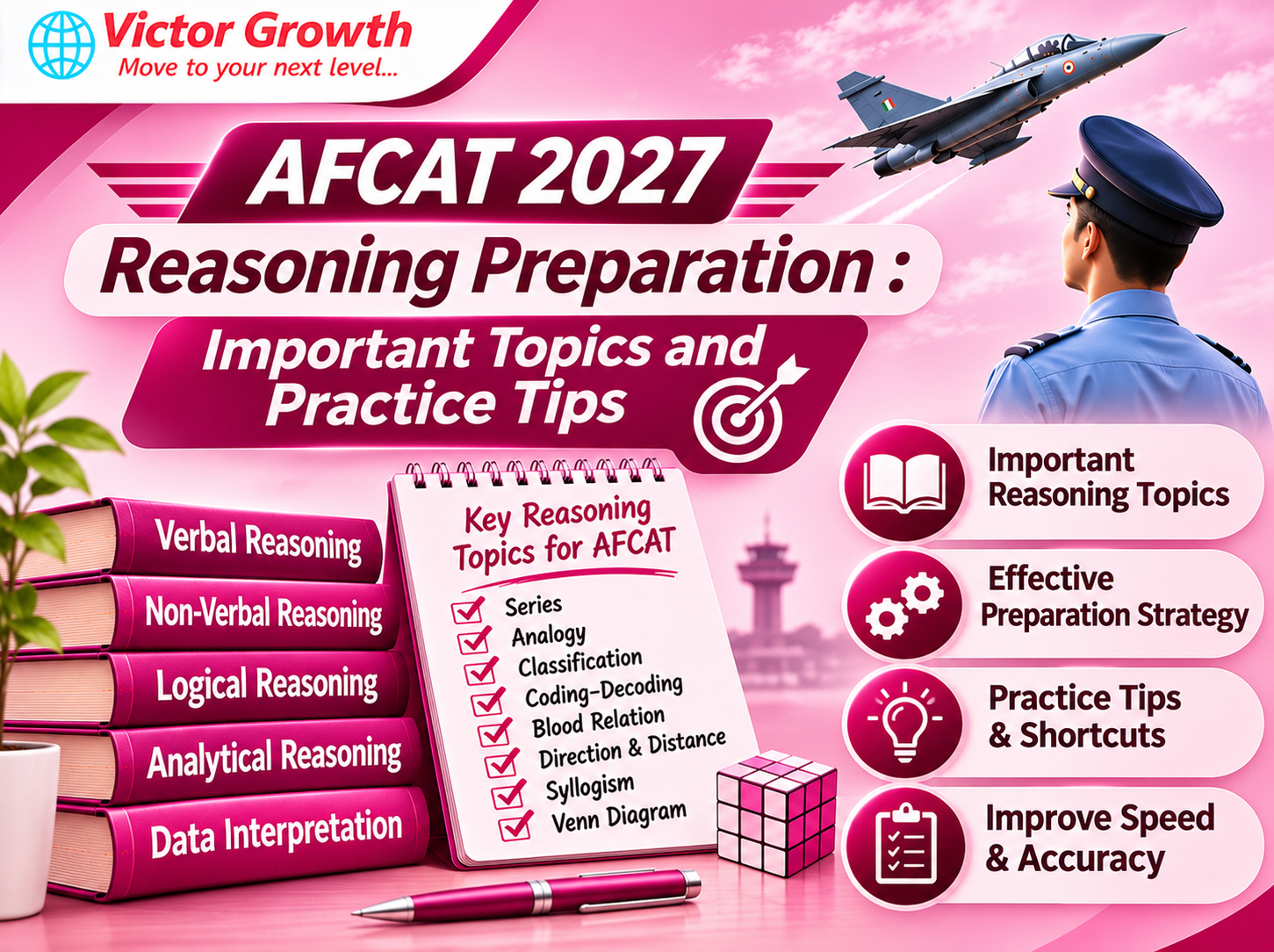
Reasoning and Military Aptitude is an important section of the Air Force Common Admission Test (AFCAT). It evaluates a candidate’s logical thinking, analytical ability, observation skills and problem-solving capacity.
Many aspirants find reasoning challenging because questions may involve different patterns, figures, sequences and logical relationships. However, with regular practice and a clear preparation strategy, candidates can improve their speed and accuracy.
For beginners preparing for AFCAT 2027, understanding the important reasoning topics and practising different question types are essential. This guide explains the syllabus, recommended books and effective preparation tips.
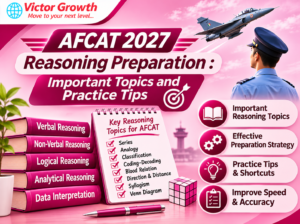
1. Understand the AFCAT 2027 Reasoning Syllabus
The Reasoning and Military Aptitude section includes verbal and non-verbal reasoning questions.
Topic | Important Areas |
|---|---|
Analogy | Identifying relationships between words, numbers and figures |
Classification | Finding the odd one out |
Coding and Decoding | Identifying patterns in letters and numbers |
Number Series | Finding missing numbers and patterns |
Alphabet Series | Identifying letter sequences |
Blood Relations | Understanding family relationships |
Direction Sense | Solving direction and distance problems |
Venn Diagrams | Understanding relationships between groups |
Figure Completion | Identifying missing parts of figures |
Pattern Recognition | Finding similarities and differences |
Embedded Figures | Identifying hidden shapes |
Spatial Ability | Understanding the position and movement of objects |
Candidates should practise both verbal and non-verbal reasoning to develop a balanced preparation strategy.
2. Focus on Important Reasoning Topics
Some topics require regular practice because they test logical thinking and pattern recognition.
A. Analogy
Analogy questions test your ability to identify relationships between two or more items.
For example, you may be asked to identify the relationship between two words, numbers or figures and find a similar relationship in another pair.
Preparation tip: Practise different types of word, number and figure analogies.
B. Coding and Decoding
These questions involve identifying a pattern used to represent letters, numbers or words.
Preparation tip: Learn alphabet positions, practise letter-based codes and identify common patterns.
C. Number and Alphabet Series
Candidates need to identify the relationship between numbers or letters to find the next or missing element.
Preparation tip: Practise addition, subtraction, multiplication, division and alternate patterns.
D. Blood Relations
These questions test your ability to understand family relationships.
Preparation tip: Draw simple family trees to understand relationships clearly instead of solving everything mentally.
E. Direction Sense
Direction-based questions involve movement, distance and identifying the final position of a person or object.
Preparation tip: Remember the four main directions and practise drawing simple diagrams to avoid confusion.
F. Non-Verbal Reasoning
Non-verbal reasoning focuses on figures, shapes, patterns and visual relationships.
Important areas include:
Figure series
Figure classification
Mirror images
Water images
Paper folding
Embedded figures
Figure completion
Pattern recognition
Preparation tip: Practise visual reasoning questions regularly to improve observation skills and speed.
3. Improve Your Logical Thinking and Problem-Solving Skills
Reasoning is not a subject that can be mastered through memorisation alone. You need to understand the logic behind each question.
Follow these suggestions:
Solve at least 20–30 reasoning questions daily.
Start with basic questions before attempting difficult ones.
Understand the pattern behind every question.
Practise both verbal and non-verbal reasoning.
Avoid using lengthy methods when simpler approaches are available.
Review incorrect answers and understand your mistakes.
Regular practice helps you recognise familiar patterns and solve questions more efficiently.
4. Best Books for AFCAT 2027 Reasoning Preparation
Choosing reliable study materials can make preparation easier.
Recommended books include:
A Modern Approach to Verbal and Non-Verbal Reasoning – R.S. Aggarwal: Covers important reasoning topics with practice exercises.
Analytical Reasoning – M.K. Pandey: Useful for developing logical and analytical thinking.
A New Approach to Reasoning – B.S. Sijwali and Indu Sijwali: Provides additional verbal and non-verbal reasoning practice.
AFCAT Previous Year Solved Papers: Helps candidates understand examination-level questions and patterns.
Avoid collecting too many books. Select one main reasoning book and practise previous year questions regularly.
5. Follow a Daily Reasoning Preparation Timetable
A consistent timetable helps candidates improve their reasoning skills gradually.
Time | Activity |
|---|---|
15 minutes | Revise previously studied topics |
20 minutes | Learn a new reasoning concept |
30 minutes | Solve topic-wise questions |
15 minutes | Practise non-verbal reasoning |
20 minutes | Attempt timed MCQs |
10 minutes | Analyse mistakes |
Beginners can adjust the schedule according to their preparation level and available time.
6. Practise Previous Year Questions and Mock Tests
Previous Year Questions (PYQs) help you understand the types of reasoning questions asked in AFCAT.
Follow these steps:
Complete the basic concepts of each topic.
Solve topic-wise previous year questions.
Practise questions within a time limit.
Attempt full-length mock tests regularly.
Analyse incorrect answers.
Revise difficult question patterns.
Do not focus only on solving more questions. Understanding why an answer is correct is equally important.
7. Common Mistakes to Avoid in Reasoning Preparation
Many aspirants make avoidable mistakes while preparing for reasoning.
Memorising answers instead of understanding patterns.
Ignoring non-verbal reasoning.
Spending too much time on one difficult question.
Avoiding timed practice.
Not revising completed topics.
Skipping previous year questions.
Losing confidence after making mistakes.
Remember that reasoning improves through regular problem-solving practice. Focus on accuracy first and gradually increase your speed.
8. Choose the Right Defence Coaching in Kerala
Proper guidance can help aspirants understand difficult reasoning concepts, improve problem-solving techniques and prepare through regular assessments.
When searching for the best NDA coaching in Kerala, remember that NDA and AFCAT are different examinations with separate eligibility requirements and preparation strategies. NDA is an entry route after Class 12, whereas AFCAT is designed for eligible graduates and other candidates who meet the prescribed qualifications.
Victor Growth Coaching Centre in Kochi provides coaching support for defence examination aspirants. Before selecting a programme, evaluate faculty experience, subject coverage, practice materials, mock tests and individual doubt-clearing support.
Frequently Asked Questions (FAQs)
1. Is reasoning important for AFCAT 2027?
Yes. Reasoning and Military Aptitude is one of the four major subject areas in the AFCAT written examination.
2. Which topics should I prepare first for AFCAT reasoning?
Start with analogy, classification, coding and decoding, number series, alphabet series, blood relations and direction sense. Then practise non-verbal reasoning.
3. Which book is best for AFCAT reasoning preparation?
A Modern Approach to Verbal and Non-Verbal Reasoning by R.S. Aggarwal is a useful resource for practising important reasoning topics.
4. How many reasoning questions should I practise daily?
Beginners can start with 20–30 questions daily and gradually increase the number as their speed and accuracy improve.
5. Is non-verbal reasoning important for AFCAT?
Yes. Candidates should practise figure series, pattern recognition, embedded figures and other visual reasoning topics.
6. Can beginners prepare for AFCAT reasoning without coaching?
Yes. With reliable books, regular practice, previous year questions and mock tests, beginners can prepare through self-study.
7. How can I improve my reasoning speed?
Practise regularly, understand common patterns, use simple solving methods and attempt timed practice tests.
Conclusion
Preparing Reasoning and Military Aptitude for AFCAT 2027 requires logical thinking, consistent practice and proper time management. Focus on important verbal and non-verbal reasoning topics, solve previous year questions and attempt regular mock tests.
Do not depend on memorising answers. Develop the ability to identify patterns and understand the logic behind every question. With disciplined preparation and regular practice, you can improve your reasoning skills and strengthen your overall AFCAT performance.