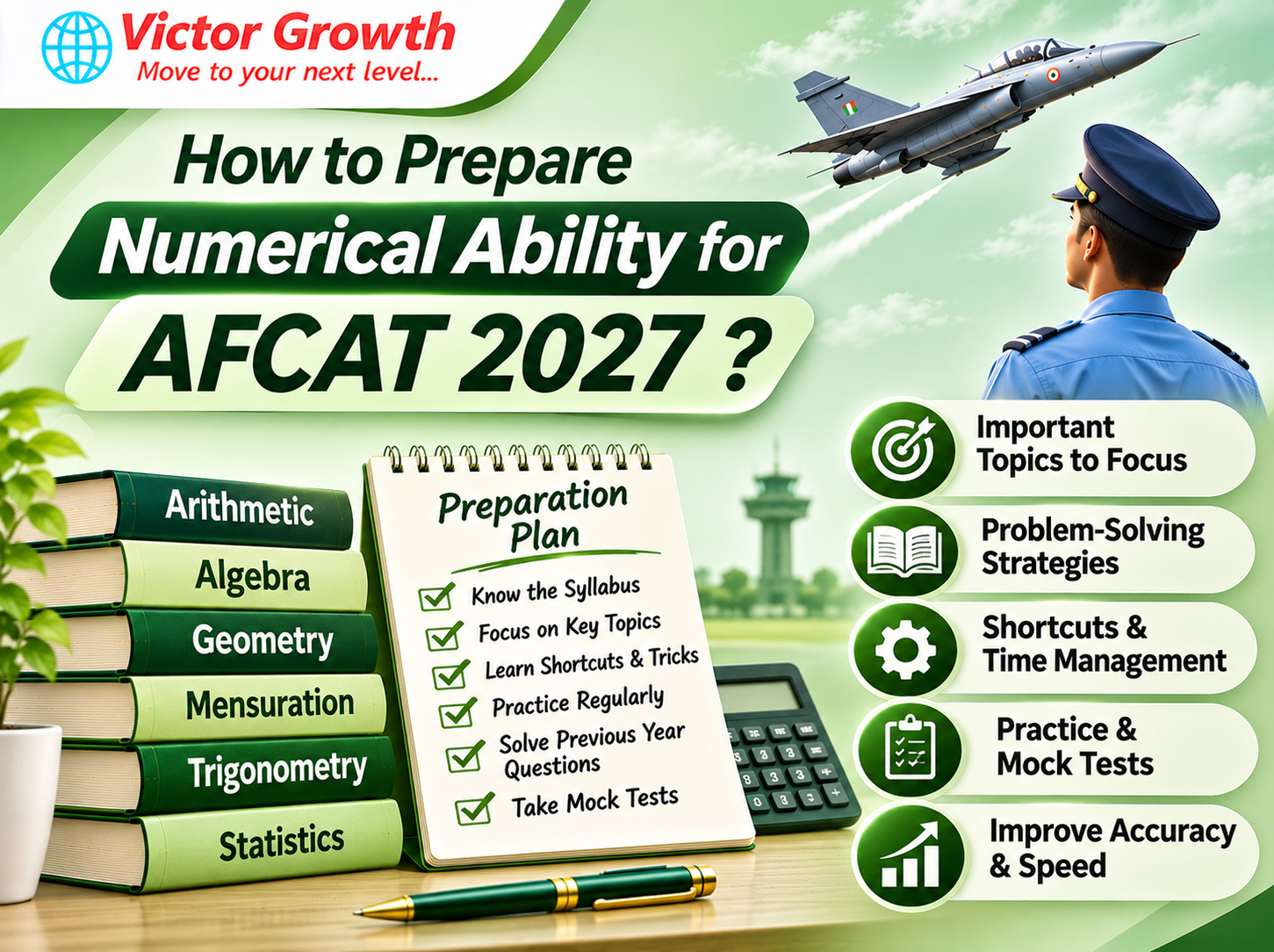
Numerical Ability is an important section of the Air Force Common Admission Test (AFCAT). It tests candidates’ mathematical knowledge, calculation speed and problem-solving skills. Many aspirants find this section challenging, especially if they have not practised mathematics regularly.
However, AFCAT Numerical Ability is generally based on matriculation-level mathematics. With a clear understanding of basic concepts, regular practice and proper time management, beginners can improve their performance.
This guide explains the important topics, recommended books and preparation strategies to help you prepare Numerical Ability for AFCAT 2027.
1. Understand the AFCAT Numerical Ability Syllabus
Before starting preparation, understand the topics included in the examination.
Topic | Important Areas |
|---|---|
Number System | Natural numbers, integers, fractions and decimals |
Percentage | Percentage calculations and applications |
Average | Simple and weighted averages |
Ratio and Proportion | Comparison of quantities |
Profit and Loss | Cost price, selling price and discount |
Simple Interest | Principal, rate and time |
Compound Interest | Interest calculations over multiple periods |
Time and Work | Work efficiency and completion time |
Time, Speed and Distance | Speed, distance and travel time |
Mixture and Alligation | Mixing quantities in different proportions |
Mensuration | Area, perimeter and volume |
Probability | Basic probability calculations |
Start with basic topics and gradually move towards more challenging questions.
2. Strengthen Your Mathematical Fundamentals
Beginners should focus on understanding concepts before attempting difficult questions.
Start by revising:
Addition, subtraction, multiplication and division.
Fractions and decimal numbers.
Squares and square roots.
Cubes and cube roots.
Basic algebra.
BODMAS rules.
Divisibility rules.
Important mathematical formulas.
If your fundamentals are strong, solving competitive examination questions becomes easier.
Preparation tip: Do not memorise formulas without understanding their applications. Solve simple examples first and then practise different question types.
3. Focus on Important Numerical Ability Topics
Some topics require regular practice because they involve calculations and multiple problem-solving steps.
A. Percentage
Percentage is one of the basic topics used in many other mathematical chapters.
Practise percentage increase, percentage decrease, conversions and percentage-based word problems.
B. Profit and Loss
Understand cost price, selling price, profit percentage, loss percentage and discount calculations.
C. Time and Work
Learn how to calculate individual and combined work efficiency. Practise questions involving multiple people completing a task together.
D. Time, Speed and Distance
Understand the relationship between speed, distance and time. Practise questions involving trains, average speed and relative speed.
E. Ratio and Proportion
Learn how to compare quantities, simplify ratios and solve direct and inverse proportion problems.
Preparation tip: Complete one topic at a time. Practise at least 20–30 questions after learning each topic.
4. Learn Important Formulas and Calculation Shortcuts
Remembering formulas can help you solve questions faster during the examination.
Some important formulas include:
Topic | Formula |
|---|---|
Percentage | (Value / Total Value) × 100 |
Average | Sum of observations / Number of observations |
Speed | Distance / Time |
Distance | Speed × Time |
Time | Distance / Speed |
Profit | Selling Price − Cost Price |
Loss | Cost Price − Selling Price |
Simple Interest | (Principal × Rate × Time) / 100 |
Area of Rectangle | Length × Breadth |
Area of Circle | πr² |
Prepare a separate formula notebook and revise it regularly.
5. Practise Mental Mathematics to Improve Speed
AFCAT has a limited examination duration. Therefore, calculation speed is important.
Follow these simple techniques:
Memorise multiplication tables up to 20.
Learn squares up to 30.
Learn cubes up to 15.
Practise percentage-to-fraction conversions.
Improve basic multiplication and division speed.
Solve simple calculations mentally.
Use shortcuts only when you understand the method.
Spend 10–15 minutes daily on calculation practice.
6. Best Books for AFCAT 2027 Numerical Ability
Choosing the right study materials helps you prepare systematically.
Recommended books include:
Quantitative Aptitude for Competitive Examinations – R.S. Aggarwal: Useful for understanding basic concepts and practising arithmetic questions.
Fast Track Objective Arithmetic – Rajesh Verma: Helpful for learning calculation techniques and shortcuts.
Objective Arithmetic – S. Chand: Provides practice questions on important mathematical topics.
AFCAT Previous Year Solved Papers: Helps candidates understand the examination pattern and question difficulty.
You do not need to complete every book. Choose one main resource and practise previous year questions regularly.
7. Follow a Daily Numerical Ability Study Timetable
A consistent timetable helps you improve mathematical skills gradually.
Time | Activity |
|---|---|
15 minutes | Revise formulas |
20 minutes | Learn a new concept |
30 minutes | Solve practice questions |
15 minutes | Mental mathematics |
20 minutes | Previous year questions |
10 minutes | Analyse mistakes |
Beginners can start with one hour of focused practice and gradually increase their study time.
8. Practise Previous Year Questions and Mock Tests
Previous Year Questions (PYQs) are useful for understanding the types of mathematical problems asked in AFCAT.
Follow these steps:
Complete the basic concepts of each topic.
Solve topic-wise previous year questions.
Attempt timed practice sets.
Take regular full-length mock tests.
Analyse incorrect answers.
Revise formulas and weak topics.
Avoid spending too much time on a single difficult question. Practise managing your time effectively.
9. Common Mistakes to Avoid
Many candidates struggle with Numerical Ability because of avoidable preparation mistakes.
Ignoring basic mathematical concepts.
Memorising formulas without understanding them.
Avoiding regular calculation practice.
Depending entirely on shortcuts.
Not revising completed topics.
Practising without a time limit.
Ignoring previous year questions.
Losing confidence after getting incorrect answers.
Remember that mathematical ability improves through consistent practice. Start with simple problems and gradually increase the difficulty level.
10. Choose the Right Defence Coaching in Kerala
Candidates who struggle with mathematics may benefit from structured classes, regular assessments and individual doubt-clearing sessions.
When searching for the best NDA coaching in Kerala, remember that NDA and AFCAT are different examinations with separate eligibility criteria and preparation requirements. NDA is an entry route after Class 12, whereas AFCAT is designed for eligible graduates and other candidates who meet the prescribed qualifications.
Victor Growth Coaching Centre in Kochi provides coaching support for defence examination aspirants. Before choosing a programme, evaluate faculty experience, subject coverage, practice materials, mock tests and academic support.
Frequently Asked Questions (FAQs)
1. Is Numerical Ability difficult in AFCAT 2027?
The difficulty level depends on your mathematical foundation. The questions are generally based on matriculation-level mathematics, and regular practice can improve performance.
2. Which topics are important in AFCAT Numerical Ability?
Percentage, Average, Profit and Loss, Ratio and Proportion, Time and Work, Time, Speed and Distance, Simple and Compound Interest and Number System are important preparation areas.
3. Which book is best for AFCAT Numerical Ability?
Quantitative Aptitude for Competitive Examinations by R.S. Aggarwal is a useful resource for learning concepts and practising questions.
4. How many hours should I study mathematics daily for AFCAT?
Around one to two hours of focused daily practice is a useful starting point. Candidates who are weak in mathematics may need additional practice.
5. Can beginners prepare for AFCAT mathematics?
Yes. Beginners should start with basic concepts, learn important formulas and gradually practise examination-level questions.
6. Are shortcuts important for AFCAT Numerical Ability?
Shortcuts can save time, but candidates should first understand the basic mathematical methods. Use shortcuts only when you are confident about their application.
7. Are mock tests necessary for Numerical Ability?
Yes. Mock tests help improve calculation speed, accuracy and time management under examination conditions.
Conclusion
Preparing Numerical Ability for AFCAT 2027 requires a strong foundation, regular calculation practice and a clear understanding of mathematical concepts. Focus on important topics, revise formulas, solve previous year questions and attempt mock tests regularly.
Do not be afraid of mathematics if you are a beginner. Start with simple problems, practise consistently and gradually improve your speed and accuracy. With the right preparation strategy and determination, you can strengthen your Numerical Ability and move closer to your dream of joining the Indian Air Force.