
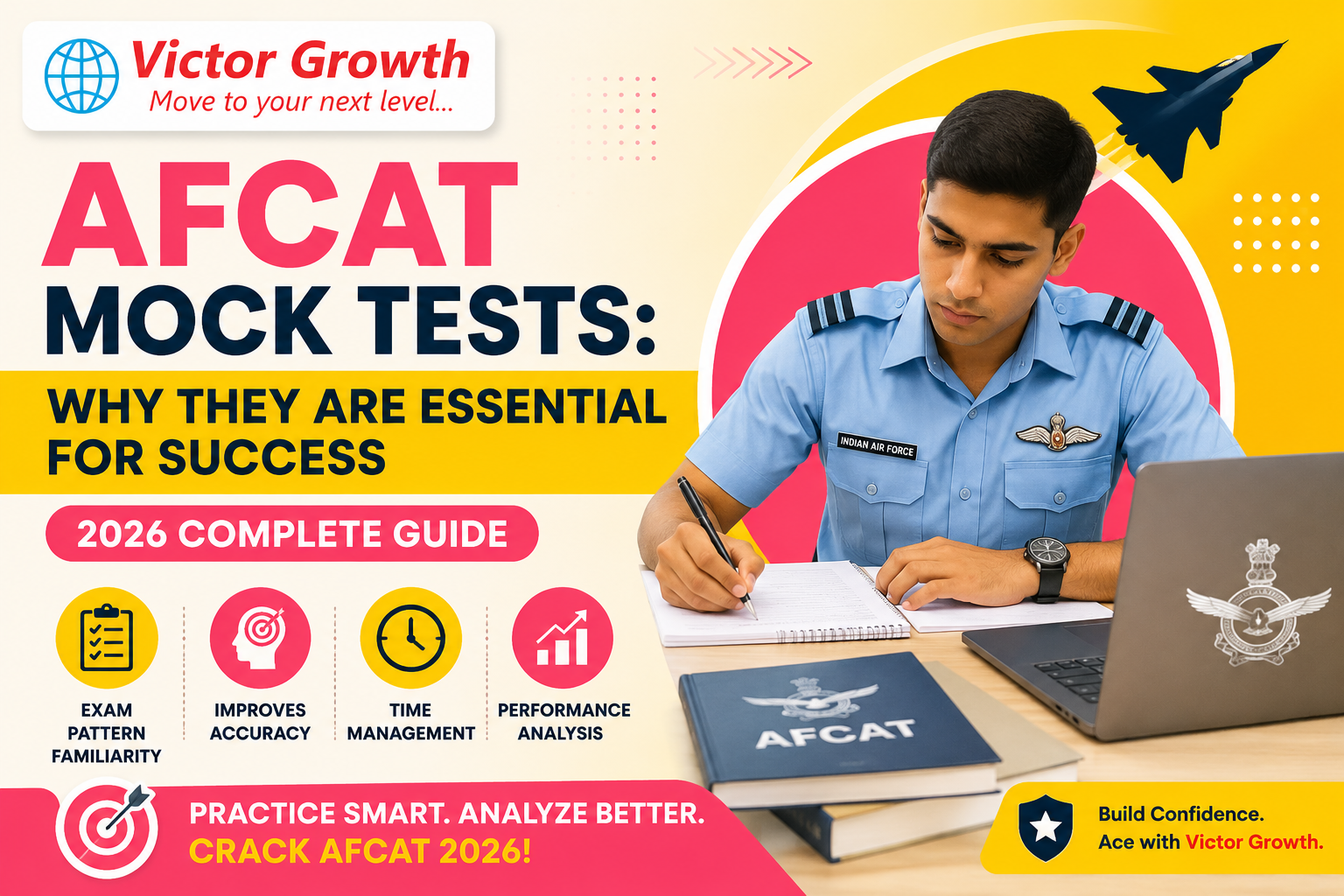
The Ultimate Strategy to Crack AFCAT with Regular Mock Tests | Best AFCAT Coaching in Kerala
Preparing for the Air Force Common Admission Test (AFCAT) requires more than just studying the syllabus. Success in AFCAT depends on a candidate’s ability to apply knowledge under pressure, manage time effectively, and maintain accuracy. This is where AFCAT mock tests become one of the most important components of preparation.
For aspirants aiming to join the Indian Air Force through the Flying Branch or Ground Duty branches, regular mock tests can significantly improve performance and boost confidence. Students enrolled in the best AFCAT coaching in Kerala often find that a structured mock test programme helps identify strengths, eliminate weaknesses, and enhance overall exam readiness.
In this comprehensive guide, we will discuss the importance of AFCAT mock tests, their benefits, effective strategies for attempting them, common mistakes to avoid, and how they contribute to achieving a high AFCAT score.
What is an AFCAT Mock Test?
An AFCAT mock test is a simulated examination designed to replicate the actual AFCAT pattern, syllabus, difficulty level, and time constraints.
A quality mock test includes questions from:
- General Awareness
- Verbal Ability in English
- Numerical Ability
- Reasoning and Military Aptitude
Candidates experience the actual examination environment before the real test.
AFCAT Exam Pattern
Understanding the pattern is essential before attempting mock tests.
| Section | Questions |
|---|---|
| General Awareness | 25 |
| Verbal Ability in English | 30 |
| Numerical Ability | 18 |
| Reasoning and Military Aptitude | 27 |
| Total | 100 |
Total Marks:
300
Time:
2 Hours
Marking Scheme:
- Correct Answer: +3
- Incorrect Answer: -1
Negative marking makes accuracy just as important as speed.
Why AFCAT Mock Tests Are Essential for Success
1. Familiarity with the Exam Pattern
Many candidates know the syllabus but struggle with the exam format.
Mock tests help candidates understand:
- Number of questions
- Distribution of topics
- Difficulty level
- Section transitions
- Time pressure
Regular exposure reduces surprises on exam day.
2. Improves Time Management
Time management is one of the biggest challenges in AFCAT.
Candidates have:
120 minutes for 100 questions.
Average time per question:
Approximately 72 seconds.
Mock tests teach students:
- Which questions to attempt first.
- When to skip difficult questions.
- How much time to spend on each section.
- How to revise remaining questions.
3. Builds Examination Confidence
Confidence comes from preparation.
Students who attempt 20–30 mock tests before AFCAT often:
- Feel less nervous.
- Handle pressure better.
- Stay calm during difficult questions.
- Maintain concentration.
Confidence directly impacts performance.
4. Identifies Strengths and Weaknesses
Mock tests provide detailed analysis.
Example:
Candidate A:
English:
24/30
Reasoning:
20/27
Math:
9/18
General Awareness:
12/25
The analysis clearly shows mathematics requires additional attention.
Without mock tests, such weaknesses often remain unnoticed.
5. Improves Accuracy
Because AFCAT has negative marking, random guessing can reduce scores.
Mock tests help candidates learn:
- Intelligent guessing.
- Option elimination.
- Risk management.
- Accuracy improvement.
A candidate with 85% accuracy generally scores much higher than someone with 60% accuracy.
6. Enhances Speed
Speed develops through repeated practice.
Initially:
100 questions:
150 minutes.
After practice:
100 questions:
105–110 minutes.
Remaining time can be used for revision.
7. Reduces Exam Anxiety
Many candidates know the answers but panic during exams.
Mock tests simulate:
- Time pressure.
- Difficult questions.
- Mental fatigue.
- Unexpected situations.
Repeated exposure reduces anxiety.
8. Helps Develop a Personal Exam Strategy
Every candidate is different.
Some perform better by attempting:
English → Reasoning → GK → Math.
Others prefer:
GK → English → Reasoning → Math.
Mock tests help identify the best strategy.
Benefits of Sectional Mock Tests
Apart from full-length tests, sectional tests are equally important.
English
Practice:
- Reading comprehension
- Error detection
- Vocabulary
Numerical Ability
Practice:
- Percentage
- Profit and Loss
- Average
- Ratio
- Time and Work
Reasoning
Practice:
- Analogy
- Coding-Decoding
- Series
- Venn Diagrams
General Awareness
Practice:
- Current Affairs
- Defence Exercises
- Science
- Geography
- History
- Polity
How Many AFCAT Mock Tests Should You Attempt?
Beginner
5 sectional tests.
5 full tests.
Intermediate
10 sectional tests.
10 full tests.
Advanced
20+ sectional tests.
20–30 full-length mocks.
Best Time to Start Mock Tests
Phase 1
Complete syllabus.
Phase 2
Topic-wise tests.
Phase 3
Sectional tests.
Phase 4
Full-length mocks.
Phase 5
Previous year papers.
How to Analyse an AFCAT Mock Test
Many students take tests but never analyse them.
Analysis is more important than the test itself.
Check:
Accuracy
Correct answers percentage.
Speed
Time spent per question.
Weak topics
Which chapters need improvement?
Silly mistakes
Calculation errors.
Reading mistakes.
Question misunderstanding.
Time allocation
Did one section consume too much time?
Common Mistakes Students Make
1. Taking Mock Tests Without Preparation
Basic concepts should be clear.
2. Ignoring Analysis
Learning happens after the test.
3. Attempting Every Question
Negative marking can reduce scores.
4. Panicking After Low Scores
Low scores indicate areas for improvement.
5. Comparing Scores with Others
Focus on personal improvement.
AFCAT Mock Test Strategy
First 15 Minutes
Attempt easiest questions.
Next 45 Minutes
Reasoning and English.
Next 30 Minutes
General Awareness.
Last 30 Minutes
Mathematics and revision.
AFCAT Mock Test Preparation Tips
Maintain an Error Notebook
Write:
- Wrong answers.
- Correct concepts.
- Revision notes.
Practice Daily
Even one sectional test improves consistency.
Attempt Full-Length Tests Weekly
Increase frequency near the examination.
Revise Frequently
Mock tests reveal weak areas for revision.
Simulate Real Conditions
Sit for 2 hours without interruption.
Avoid mobile phones.
Use a timer.
Role of Mock Tests in AFCAT Success
Candidates who perform well in AFCAT usually:
✔ Complete syllabus.
✔ Solve previous year papers.
✔ Attempt 20–30 full-length mock tests.
✔ Analyse every test.
✔ Improve weak sections.
✔ Build confidence through repeated practice.
Mock tests convert theoretical knowledge into practical exam performance.
Why Choose the Best AFCAT Coaching in Kerala for Mock Test Preparation?
A structured AFCAT coaching programme offers much more than classroom teaching.
The best AFCAT coaching in Kerala provides:
Comprehensive Mock Test Series
- Topic-wise tests
- Sectional tests
- Full-length tests
Detailed Performance Analysis
Students receive:
- Score reports
- Accuracy reports
- Time management analysis
- Rank comparison
Expert Guidance
Faculty members explain:
- Difficult questions
- Shortcuts
- Exam strategies
Regular Revision Sessions
Weak topics are reinforced through practice.
Updated Question Bank
Questions follow the latest AFCAT pattern and trends.
Personalized Mentoring
Individual guidance helps students improve consistently.
30-Day AFCAT Mock Test Plan
| Week | Plan |
|---|---|
| Week 1 | 3 sectional tests |
| Week 2 | 3 sectional + 1 full test |
| Week 3 | 2 sectional + 2 full tests |
| Week 4 | 4 full-length tests + revision |
Analyse every test thoroughly.
Final Tips for AFCAT Aspirants
✅ Do not fear mock tests.
✅ Start early.
✅ Analyse every mistake.
✅ Focus on accuracy.
✅ Improve time management.
✅ Revise weak areas.
✅ Stay consistent.
✅ Practice under actual exam conditions.
Remember, mock tests are not merely assessment tools—they are training sessions for the actual AFCAT examination.
Conclusion
AFCAT mock tests are one of the most effective ways to improve speed, accuracy, confidence, and exam temperament. They help candidates understand the exam pattern, identify weaknesses, and refine strategies for maximum performance. Regular practice through sectional and full-length mock tests, combined with systematic analysis, can significantly improve AFCAT scores.
For serious defence aspirants, enrolling in the best AFCAT coaching in Kerala with a structured mock test programme, expert mentoring, and performance tracking can provide a competitive advantage and increase the chances of success in the AFCAT examination and the subsequent selection process.
Frequently Asked Questions (FAQs)
Q1. Why are AFCAT mock tests important?
They improve time management, accuracy, confidence, and familiarity with the exam pattern while helping identify weak areas.
Q2. How many AFCAT mock tests should I attempt before the exam?
Aspirants should aim for 15–30 full-length mock tests along with sectional practice tests.
Q3. When should I start taking AFCAT mock tests?
Begin sectional tests after completing basic concepts and full-length mocks after covering most of the syllabus.
Q4. Are AFCAT mock tests harder than the actual exam?
Good-quality mock tests are designed to match or slightly exceed the actual difficulty level to prepare candidates effectively.
Q5. How should I analyse an AFCAT mock test?
Review accuracy, speed, weak topics, silly mistakes, and time allocation for each section.
Q6. Can mock tests improve my AFCAT score?
Yes. Consistent mock test practice combined with detailed analysis can significantly increase scores.
Q7. How often should I take AFCAT mock tests?
Initially, one full-length test per week is sufficient. Increase to 2–3 tests per week in the final month before the exam.
Q8. Should I attempt all questions in AFCAT?
No. Due to negative marking, candidates should avoid blind guessing and focus on accuracy.
Q9. What is the ideal score in AFCAT mock tests?
Consistently scoring 200+ marks with good accuracy is generally a positive indicator of readiness, though actual cut-offs vary by exam cycle.
Q10. Where can I get quality AFCAT mock tests in Kerala?
The best AFCAT coaching in Kerala typically offers updated mock test series, sectional and full-length exams, detailed performance analytics, expert feedback, and personalised mentoring to help aspirants maximise their AFCAT performance and prepare confidently for a career in the Indian Air Force.